Agas Map of London
Agas Map of London Detail from Agas map Agas Map of London, Civitas Londinum, London Bridge detail Detail from Civitas Londinum Agas Map on Office Wall

Agas Map of London 16th Century

Price range: £39.95 through £89.95

The Agas Map of London — Tudor London Before the Great Fire

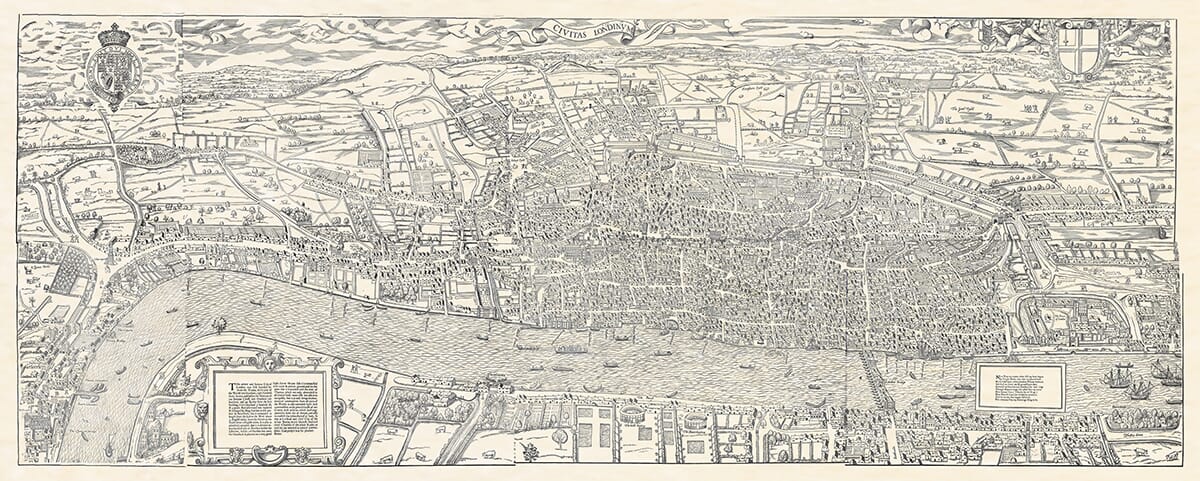
The Agas Map of London, often known as Civitas Londinum, is one of those old maps that rewards a slow look. At first it seems simply decorative — a handsome view of London spread out along the Thames — but the longer you study it, the more it begins to feel like a window into another city altogether.

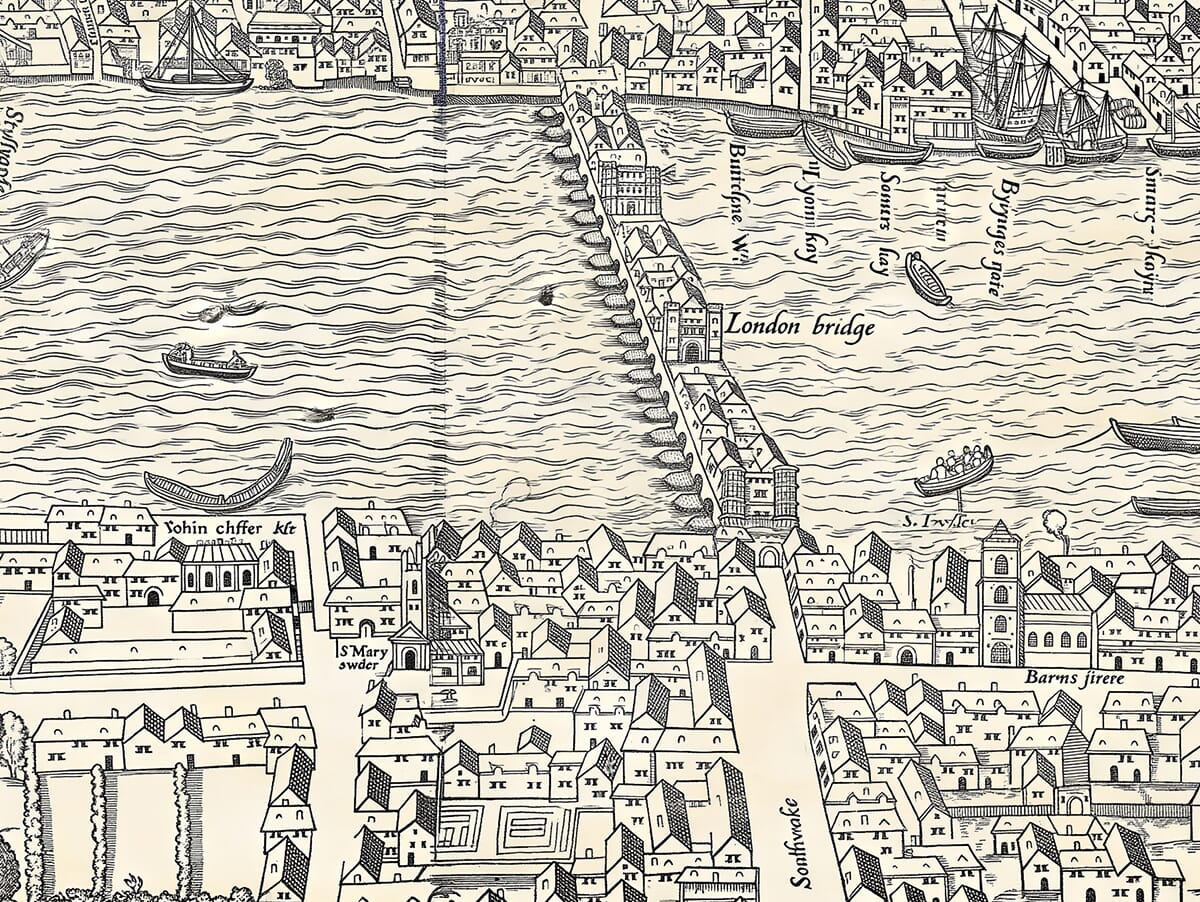
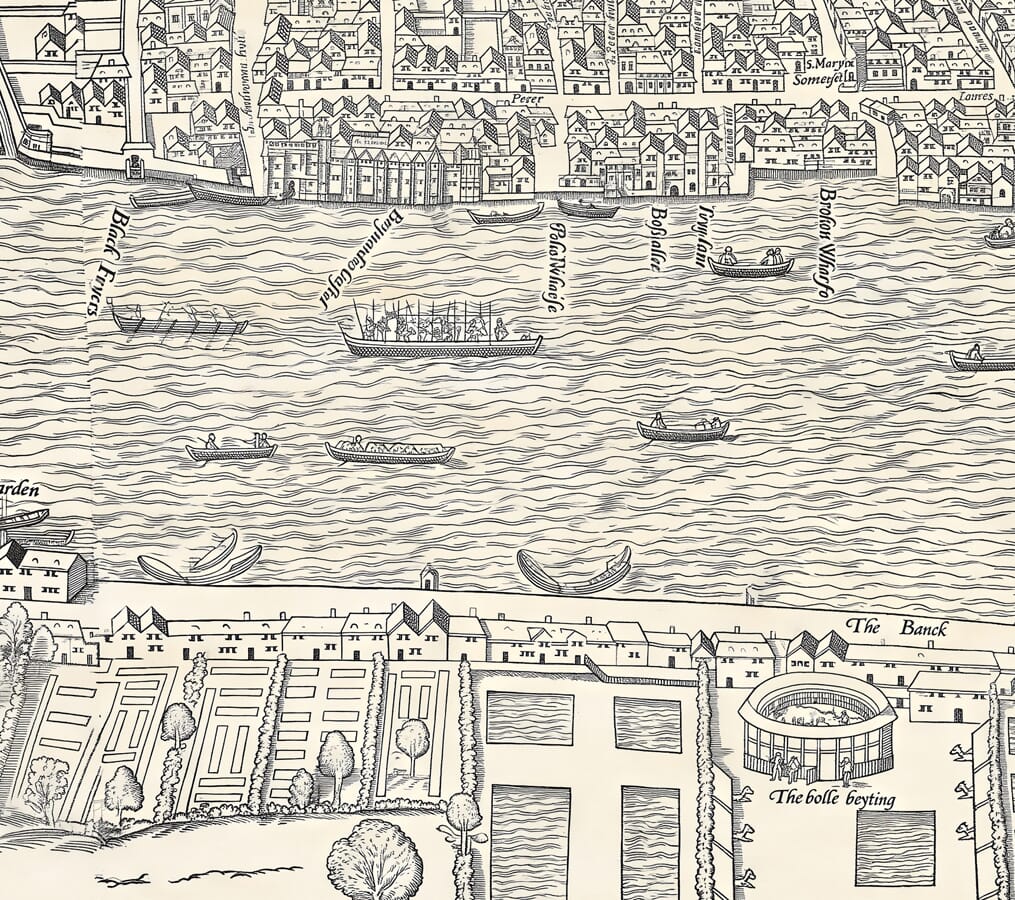
This is London before the Great Fire of 1666. Before the familiar modern street plan. Old St Paul’s Cathedral still dominates the rooftops, London Bridge is packed with buildings, and the Thames is alive with boats. Around the edges of the city there are fields, gardens, lanes and open ground — reminders that Tudor London was still a much smaller place than the capital we know today.

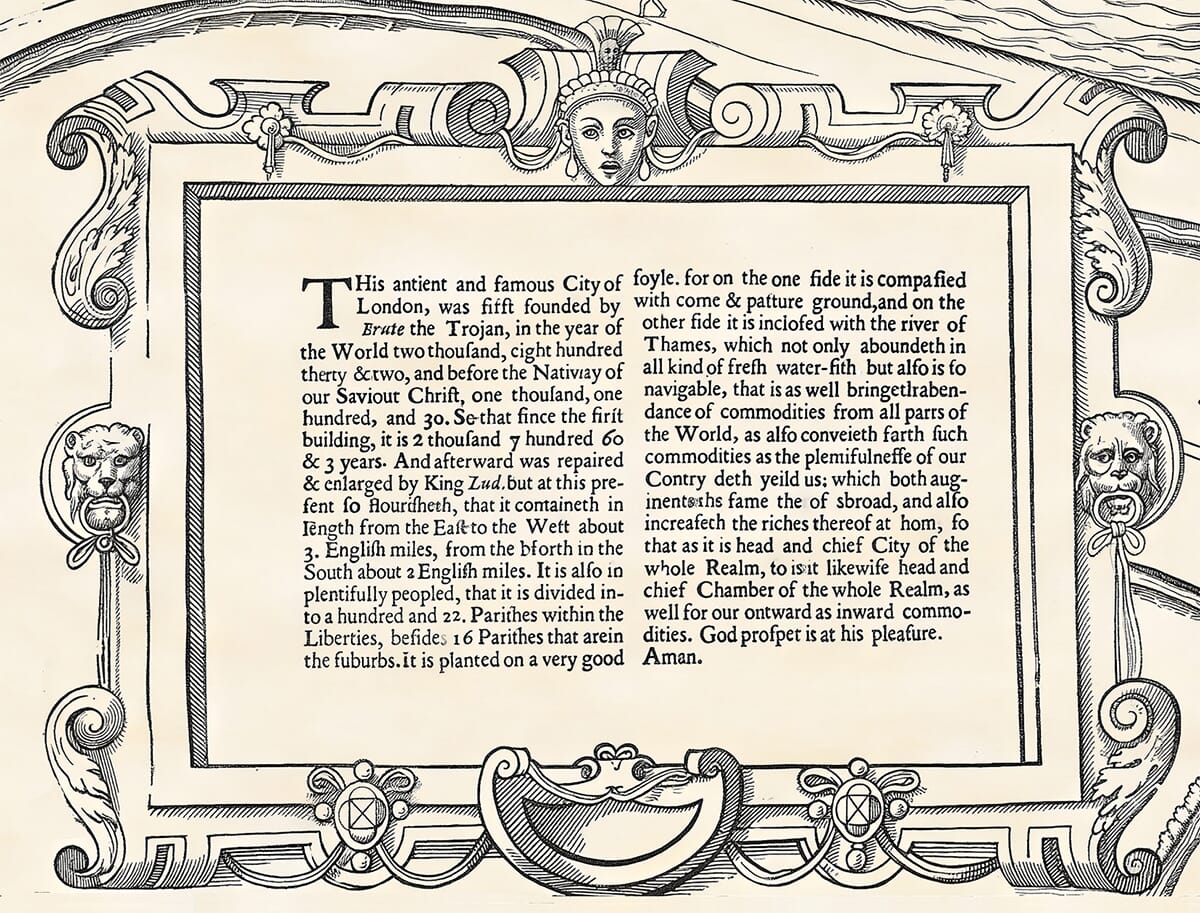
Although the map has long been called the Agas Map, after the surveyor Ralph Agas, that attribution is now generally treated with caution. The name has stuck, though, and for many people the “Agas Map of London” remains the familiar way to describe this remarkable sixteenth-century view. It is also known as the Woodcut Map of London, a reference to the way the original image was produced.

What makes the map so appealing is its mixture of detail and character. It is not just a street map, and not quite a bird’s-eye view either. It sits somewhere between the two: part record, part panorama, part portrait of the city. The Tower of London, Westminster, Southwark, the city walls and the busy river all have their place, but so do smaller details that give the whole thing life.

As a piece of wall art, the Agas Map has a particular strength. Its long, panoramic shape gives it real presence without feeling loud or modern. It suits a city home or apartment beautifully, especially where the aim is to add history, texture and quiet interest rather than just decoration. It has been a popular choice with London-based interior designers, and has also been bought by London tour guides and others with a close working knowledge of the city.

The Old Map Company has digitally edited a scan from the original to create a fine art print with renewed clarity and balance. The intention is not to over-restore it or make it look newly made, but to bring back the strength of the image so that it can be enjoyed as both a historic map and a striking decorative piece — comparable in spirit to the day it was drawn.

For anyone interested in old maps of London, Tudor history, architecture or the story of the capital, the Agas Map remains one of the great images of the city. It is beautiful, informative and full of atmosphere — a statement piece, certainly, but also a map that keeps inviting you back for another look.
+ read more

A stunning certified FINE ART PRINT on heavy textured art paper — not a poster

Available in two sizes:  Medium  16″ x 41″ and Large at a stunning  60″ x 24″

  • Direct from the publisher — no middlemen
  • Printed in-house in Cornwall
  • Free UK delivery — international shipping available
  • Produced to meet — and often exceed — museum-quality standards

SELECT SIZE

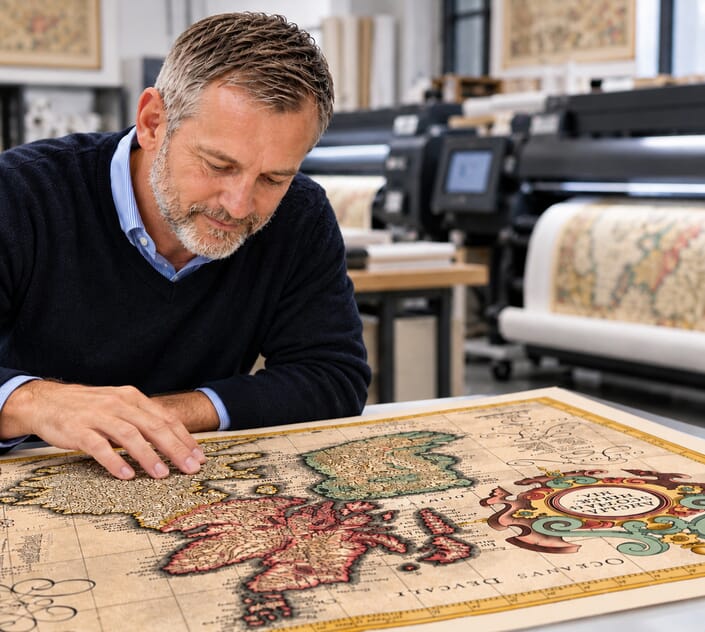
Inspecting Vintage Map Reproduction

Fine Art Map Reproductions – Museum-Quality Printing

Unlike most online offerings, our maps are produced entirely in-house, not outsourced to print-on-demand or drop-shipping services. This allows complete control over quality while offering better value. Each map begins with a high-resolution original, carefully enhanced and printed to order using archival papers and pigment inks for exceptional clarity, depth, and longevity. Every piece is personally overseen — no map leaves our workshop unless it is of a quality we would be proud to display ourselves.

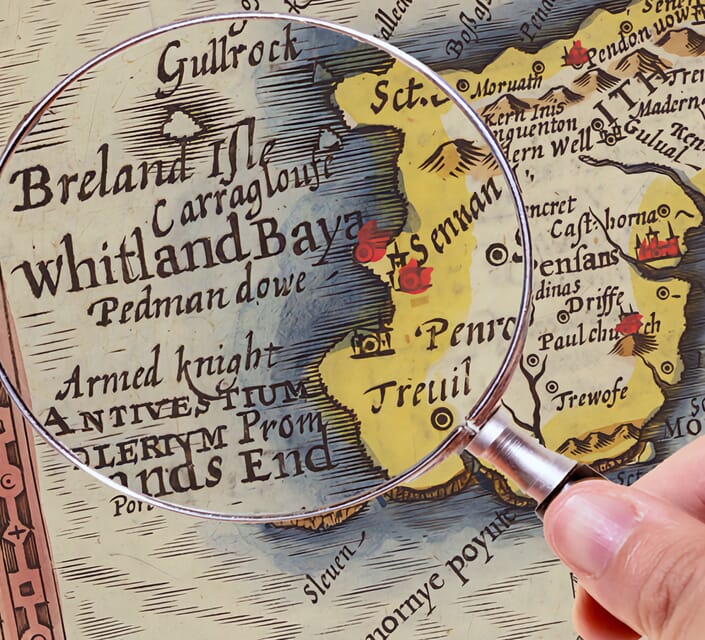
Hand hold a magnifying glass over West Cornwall Map

Authentic Old Map Paper & Accurate Colour Reproduction

Paper choice is essential to the authenticity of our maps. We use specially sourced 190gsm paper made in the UK from pure materials and traditionally pressed with natural woollen felts. This process creates a subtle, randomly textured surface that closely resembles an original antique document. Likewise the use of premium quality ink fully saturates the paper, producing remarkable clarity, depth, and historical character. Colour fastness and sharpness will remain good for in excess of 100 years!

Map in Postal Tube
Buy Old Maps Online in the UK Today Trading online since 1999

The Old Map Company of Great Britain offers a vast and carefully curated collection of the very finest expertly reproduced vintage maps. Our range includes works by renowned cartographers such as John Speed and Willem Blaeu, covering Scotland, England, and beyond. Free UK courier delivery is included, with EU, USA, and worldwide shipping available at cost and calculated at checkout. If you need assistance, our team is always happy to help you choose the perfect map.

RECENT REVIEWS

Daz
DazGB
Verified ownerVerified owner
5/5

Speedy delivery A beautiful representation

4 weeks ago
David H
David H
Verified ownerVerified owner
5/5

Got there in time and loves it! Cheers David [Gift from US to UK]

3 months ago
Ellan C-S
Ellan C-S
Verified ownerVerified owner
5/5

Thanks Lauren. We received it today - it's gorgeous! Thank you, Ellan

3 months ago
Ivano Di Battista
Ivano Di Battista
Verified ownerVerified owner
5/5

Thank you for your prompt service. I have a gallery and framing business in South Wales. I'm so pleased it is printed in the UK

3 months ago
Robert B
Robert B
Verified ownerVerified owner
5/5

My Isles of Scilly map arrived safely and I'm delighted with it!

4 months ago
Andrew T
Andrew T
Reviewer
5/5

The print arrived safely and we're delighted with it - a lovely reminder of our honeymoon 15 years ago.

4 months ago
Hannah J
Hannah J
Verified ownerVerified owner
5/5

I have just received them! I'm sure our clients will be pleased with them and there could be more projects off the back of this one where we can use more. [Interior Designers]

4 months ago
Sean MacManus
Sean MacManus
Verified ownerVerified owner
5/5

I just received my map of Ireland by Ewart today and, as usual, I am delighted by its quality. The crispness and fineness of detail is excellent and the colour reproduction surpasses my expectations. Please relay my thanks to Steve for another fine effort!

5 months ago
John G
John G
Verified ownerVerified owner
5/5

Many thanks, Lauren. Very pleased with the map and the service: would recommend The Old Map Company to anyone interested in Old Maps.

6 months ago
Lois K
Lois K
Verified ownerVerified owner
5/5

Thrilled , Lauren! Thank You

6 months ago
Ed Simpson
Ed Simpson
Verified ownerVerified owner
5/5

Many thanks, the map arrived safely this morning, and I’m really pleased with it. A stunning reproduction, just as I had hoped. I will keep browsing your website, and may yet be tempted by more of your items! Have a great weekend.

6 months ago
Daniel McCade
Daniel McCade
Verified ownerVerified owner
5/5

Just arrived, wonderful map! Thanks very much!

8 months ago
Jonathon R
Jonathon R
Verified ownerVerified owner
5/5

The map – beautiful – arrived safely, very many thanks.

1 year ago
Rasa Terbetiene
Rasa Terbetiene
Verified ownerVerified owner
5/5

Thank you, I have already found the map. It’s wonderfull! Good luck! Rasa

3 years ago
Mina M.
Mina M.
Verified ownerVerified owner
5/5

My apologies for the very late reply. I wanted to reach out to thank you so much for rushing my order. My partner absolutely loved it. I am amazed with the service so that is a five-star from me. I wish you all the best.

4 years ago

The Agas Map as a Record of Working Tudor London

The Agas Map is often admired for its great landmarks, but some of its most revealing evidence lies between them. Look beyond the Tower, Westminster and the principal churches, and the map begins to show London as a working city: a place organised around trade, neighbourhood, authority and the constant movement of goods and people.

In the sixteenth century, the City of London was not simply a collection of streets. It was divided into wards, each with its own civic identity and local responsibilities. Within those wards were numerous parishes, while certain districts, known as liberties, possessed legal privileges or remained partly outside ordinary City control. These overlapping boundaries mattered. They influenced policing, taxation, trade, poor relief and the everyday loyalties of Londoners. Although the Agas Map does not set out every boundary in the manner of a modern administrative plan, it gives physical form to the compact neighbourhoods in which this system operated.

The street pattern also preserves the close relationship between place and occupation. London’s trades were regulated through guilds and livery companies, and people working in the same craft often gathered in particular streets or districts. Names associated with bread, milk, poultry, fish, metalwork and textiles were practical descriptions before they became historical curiosities. Cheapside was one of the great commercial streets, while markets and specialised trading areas served both local households and merchants arriving from farther afield. The map allows us to see how closely these activities were packed together within the City walls.

Commercial life was also inseparable from civic government. The livery companies regulated standards, training and entry into many trades, while the mayor, aldermen and Common Council governed the City through institutions whose authority had developed over centuries. Company halls, parish churches and Guildhall were therefore not merely prominent buildings; they were places where business was supervised, disputes were settled, charity was organised and public decisions were made. The map’s concentration of such institutions helps explain why the old City exercised an influence far beyond its small physical size.

This was a city in which home and workplace were rarely separate in the modern sense. A merchant might conduct business from the same premises in which his family lived. Workshops, storerooms and yards stood behind street-facing houses, while apprentices and servants formed part of the household. The repeated roofs and narrow frontages shown on the map should not be read as an exact architectural survey, yet they convey the density of a city where living, making, buying and selling took place within a remarkably confined area.

The map also reveals the importance of routes. Streets such as Cheapside, Cornhill, Fleet Street and the Strand were more than lines of communication. They were commercial spaces, ceremonial approaches and places where news, goods and public life circulated. The road westward linked the mercantile City with the royal and governmental centre at Westminster, while roads leading from the gates connected London with surrounding villages and the wider country. Goods entering by road joined those arriving at riverside wharves, making London the meeting point of regional and overseas trade.

Open spaces on the map are equally instructive. Gardens, yards, church precincts and undeveloped land appear beside intensely built-up streets. Some large enclosures were the remains of religious houses and institutional estates whose use had changed following the Reformation. Elsewhere, green plots behind buildings suggest food production, recreation or private gardens. Their presence reminds us that Tudor London had not yet become a continuous mass of development. Cultivated and semi-rural ground remained close to busy commercial districts.

The image also hints at the practical difficulties of urban life. London depended upon a complicated network of wells, conduits, lanes, yards and river access. Streets had to accommodate pedestrians, horses, carts, livestock and traders, while waste and drainage presented persistent problems. The Agas Map cannot show the sound, smell or congestion of such a place, but its packed buildings and crowded routes help us imagine the pressures created by rapid growth.

Perhaps the map’s greatest historical value is that it preserves relationships rather than isolated monuments. It shows commerce beside worship, government beside domestic life, and dense streets beside fields. The Londoner who knew one parish, one market and one trade would nevertheless have belonged to a city tied together by civic ceremony, river traffic, commercial regulation and shared dependence upon the surrounding countryside.

For a closer tour of the map’s principal landmarks, including London Bridge, Old St Paul’s, the city walls and Southwark, read our illustrated article, The Agas Map of London: Exploring Tudor London.

You may also like…

×
Product added to cart
No products in the cart.