
 Verified owner
Got there in time and loves it! Cheers David [Gift from US to UK]
 Verified owner
Thanks Lauren. We received it today - it's gorgeous! Thank you, Ellan
 Verified owner
Thank you for your prompt service. I have a gallery and framing business in South Wales. I'm so pleased it is printed in the UK
 Verified owner
My Isles of Scilly map arrived safely and I'm delighted with it!

The print arrived safely and we're delighted with it - a lovely reminder of our honeymoon 15 years ago.
 Verified owner
I have just received them! I'm sure our clients will be pleased with them and there could be more projects off the back of this one where we can use more. [Interior Designers]
 Verified owner
I just received my map of Ireland by Ewart today and, as usual, I am delighted by its quality. The crispness and fineness of detail is excellent and the colour reproduction surpasses my expectations. Please relay my thanks to Steve for another fine effort!
 Verified owner
Many thanks, Lauren. Very pleased with the map and the service: would recommend The Old Map Company to anyone interested in Old Maps.
 Verified owner
Many thanks, the map arrived safely this morning, and I’m really pleased with it. A stunning reproduction, just as I had hoped. I will keep browsing your website, and may yet be tempted by more of your items! Have a great weekend.
 Verified owner
Just arrived, wonderful map! Thanks very much!
 Verified owner
The map – beautiful – arrived safely, very many thanks.
 Verified owner
Thank you, I have already found the map. It’s wonderfull! Good luck! Rasa
 Verified owner
My apologies for the very late reply. I wanted to reach out to thank you so much for rushing my order. My partner absolutely loved it. I am amazed with the service so that is a five-star from me. I wish you all the best.
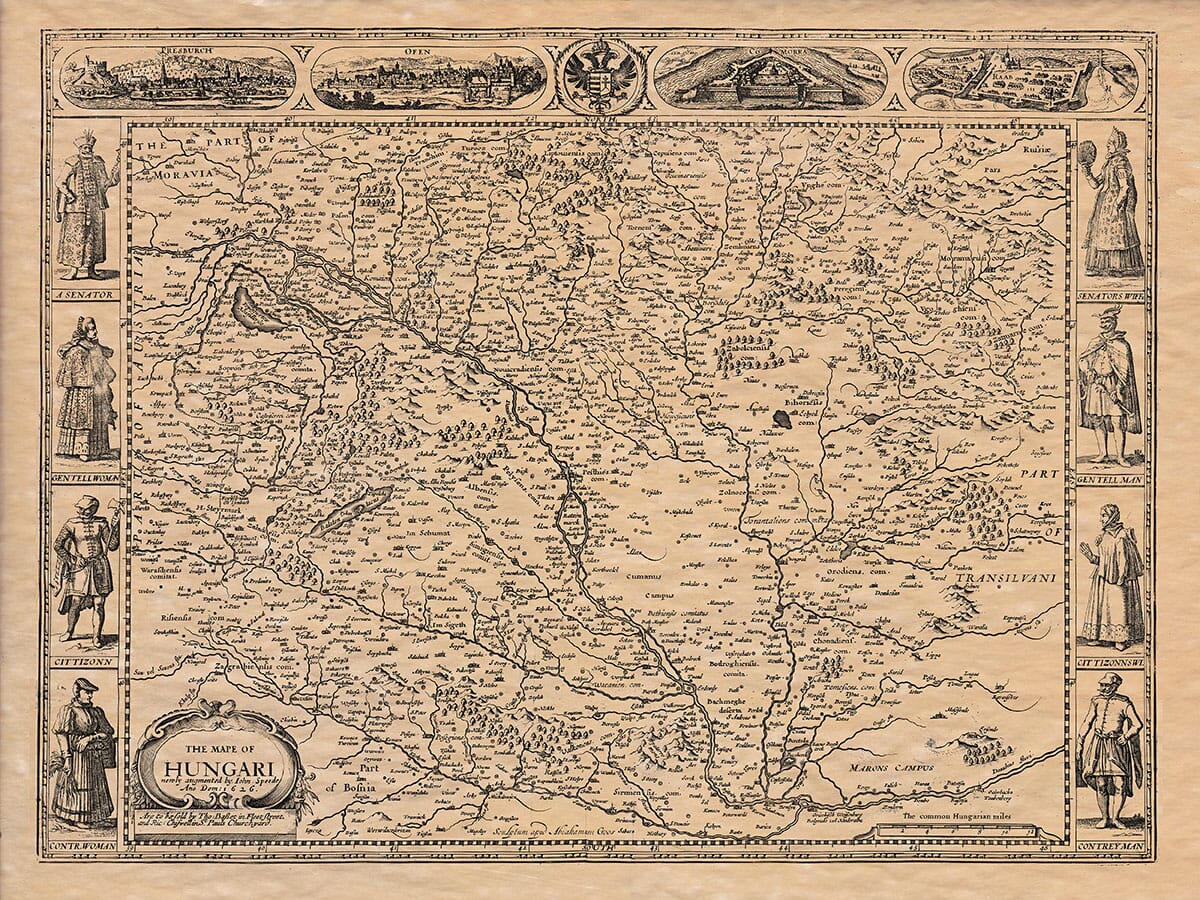
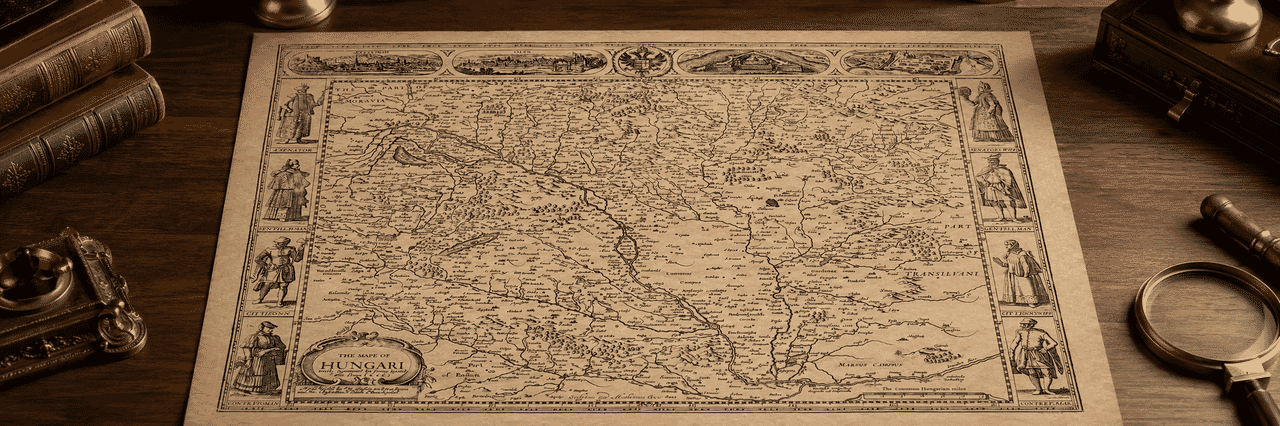
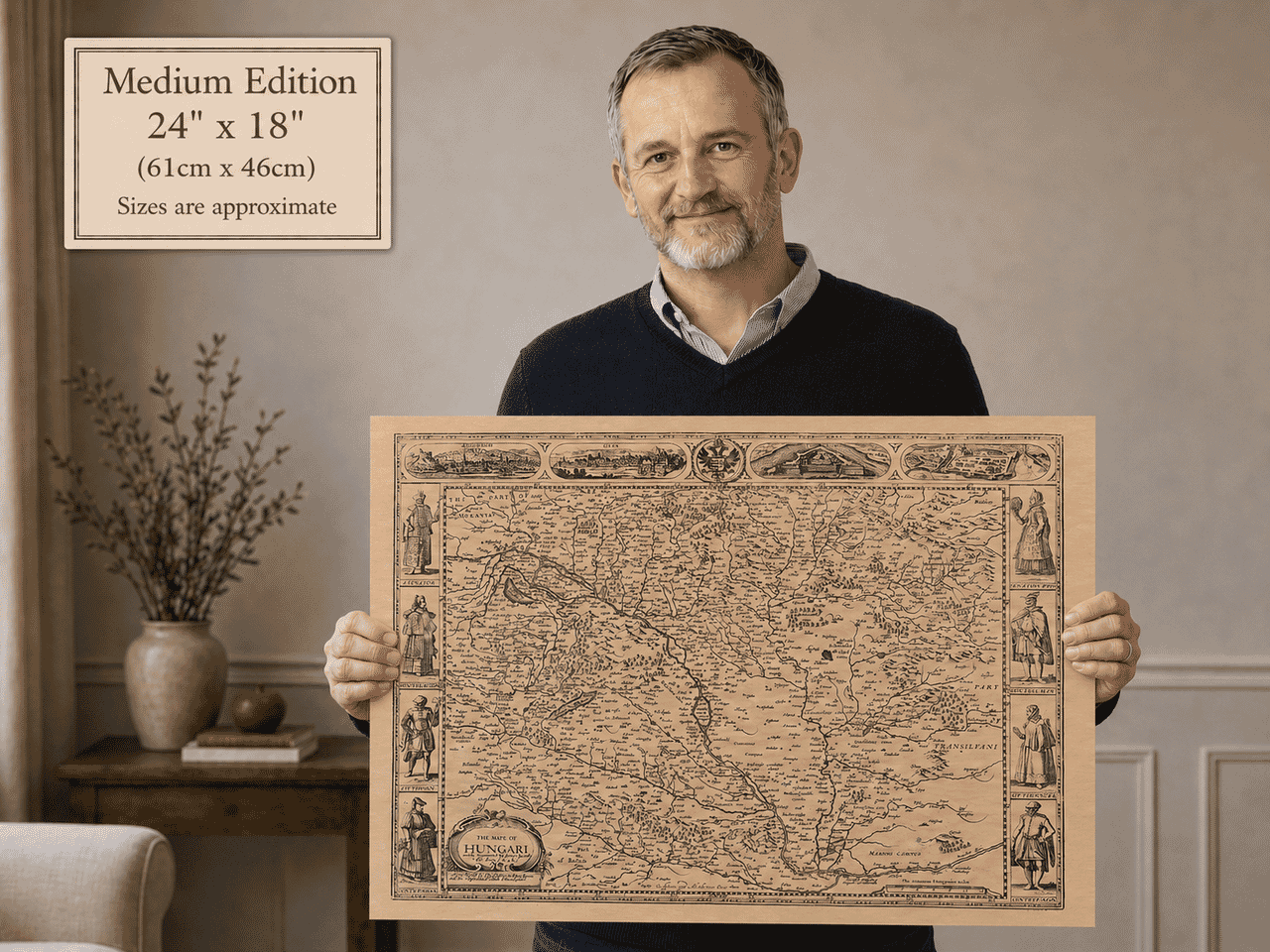
John Speed’s The Mape of Hungari is dated 1626 and first appeared in London in 1627 in A Prospect of the Most Famous Parts of the World. It depicts the historic Kingdom of Hungary at a time when the region was divided between competing Habsburg and Ottoman interests and when the kingdom extended far beyond the boundaries of modern Hungary. The map is one of Speed’s characteristic carte-à-figures designs, combining geography with city views and figures in contemporary dress.
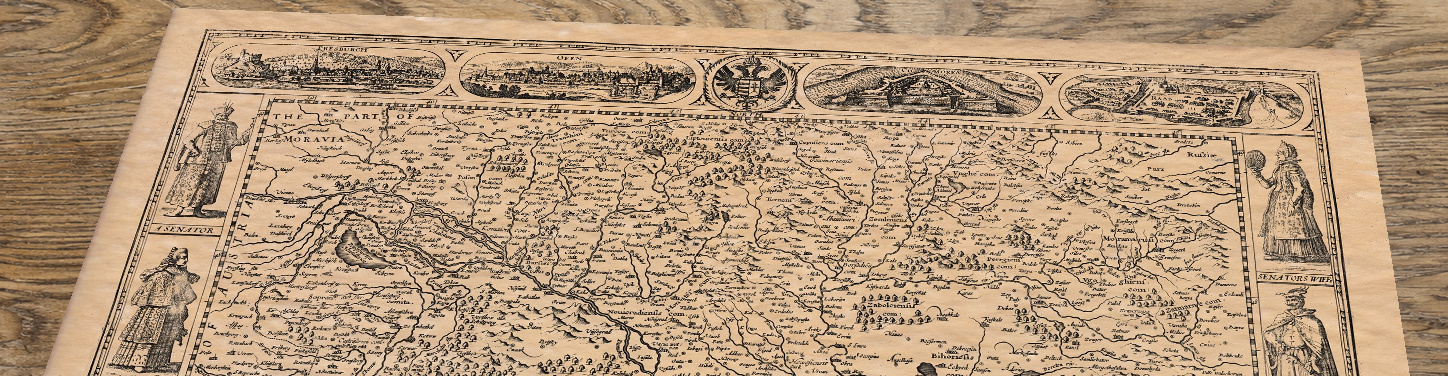
Original title: The Mape of Hungari newly augmented by Iohn Speed Anno Dom. 1626
Cartographer: John Speed
Engraving: Produced in the workshop of Abraham Goos
Date on the plate: 1626
First published: London, 1627
Atlas: A Prospect of the Most Famous Parts of the World
Geographical source: Speed drew substantially upon the earlier mapping of Gerard Mercator
Area shown: The historic Kingdom of Hungary and adjoining parts of Central Europe
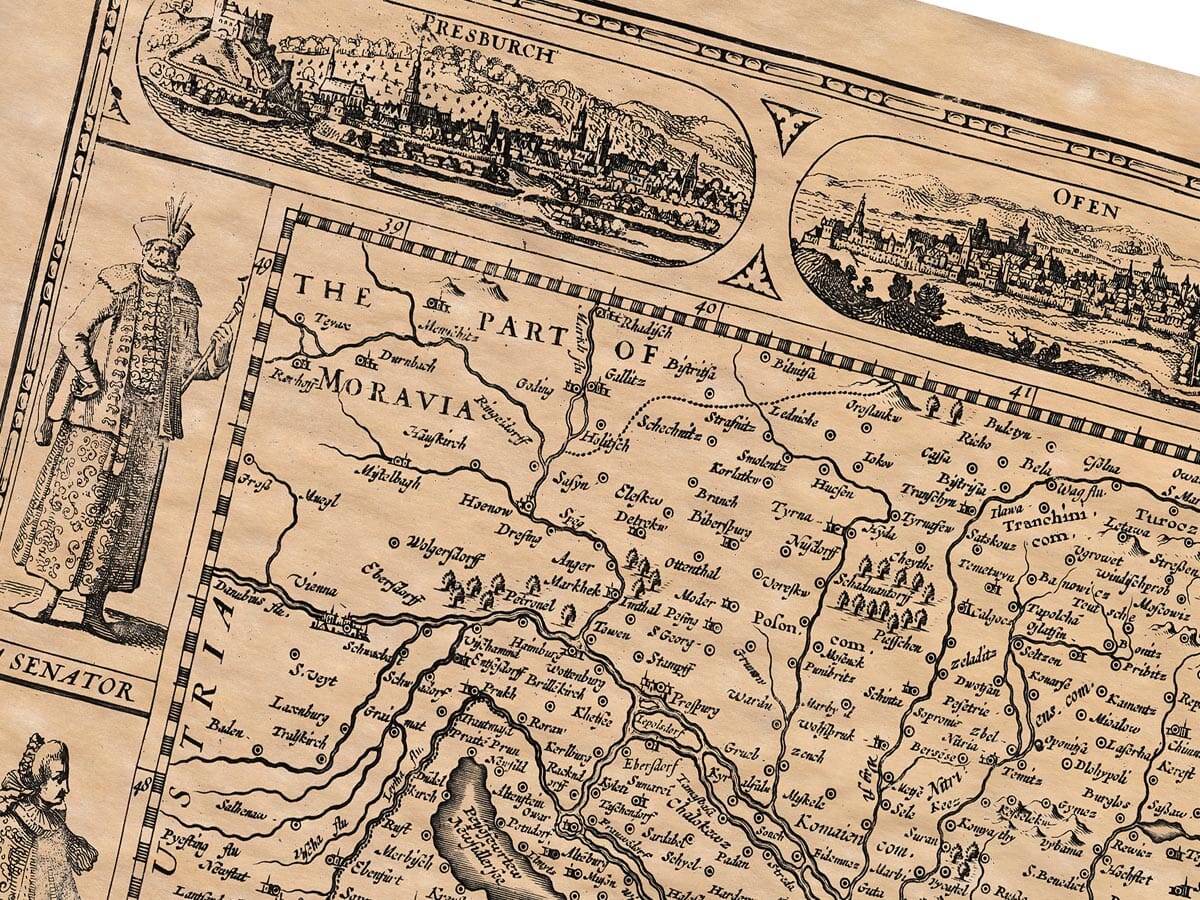
City views: Presburg (Bratislava), Ofen (Buda), Comorra (Komárno) and Raab (Győr)
Decorative features: Eight figures in contemporary regional dress arranged along the side borders
Technique: Copperplate engraving
The country shown by Speed should not be confused with the boundaries of Hungary today. His map covers a much wider Central European landscape, including places now lying within Slovakia, Croatia, Serbia, Romania and neighbouring countries.
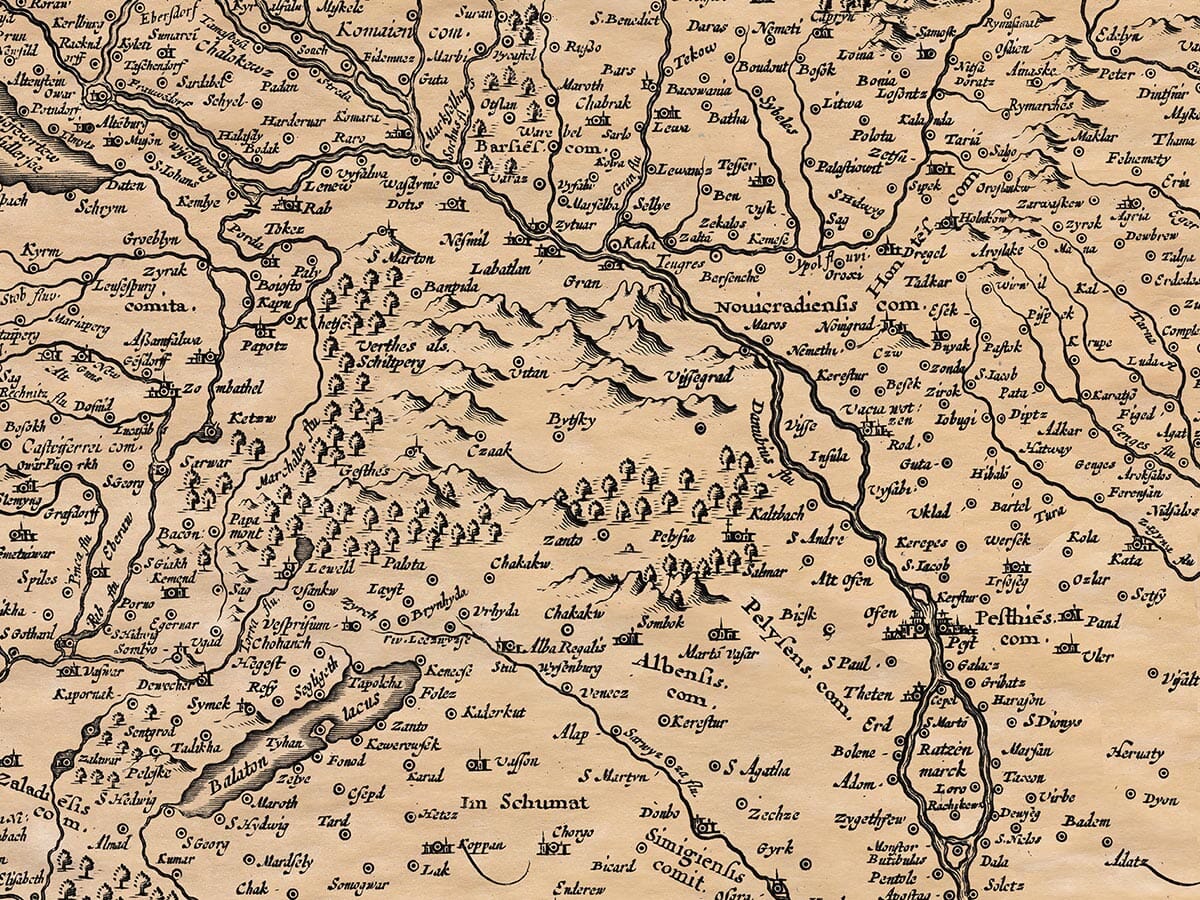
The Danube forms the great geographical axis of the sheet, with its tributaries running through a densely engraved landscape of towns, mountains and settlements. Buda occupies a prominent position, while Vienna appears towards the western side of the territory shown.
This wider extent is especially important for anyone using the map for family or regional history. A place associated today with Slovakia or Croatia, for example, may quite properly appear within a seventeenth-century map entitled Hungary.
Across the top are four engraved city prospects: Presburg, Ofen, Comorra and Raab — known today as Bratislava, Buda, Komárno and Győr.
These are not randomly chosen ornaments. They were important fortified, administrative or commercial centres in a region repeatedly affected by warfare between the Habsburg monarchy and the Ottoman Empire.
The city views also help distinguish Speed’s map from the geographical sources on which he relied. Rather than merely copying an earlier map, the Speed publication turns the geography into a much more elaborate visual object intended for the international atlas market.
The side borders contain male and female figures representing different ranks of Hungarian society. They include a senator and his wife, a gentleman and gentlewoman, citizens and country people.
These should be understood as seventeenth-century representations of regional costume rather than portraits of named individuals. Their purpose was to give atlas readers an impression of the people and dress of a distant country as well as its geography.
This is an especially useful piece of provenance missing from the present page.
Research into Speed’s Hungary map identifies Gerard Mercator’s mapping as an important geographical source. The map itself also carries the inscription Sculptum apud Abrahamum Goos, indicating that the engraving was produced in the workshop of the Amsterdam engraver Abraham Goos.
That makes the sheet a good example of how Speed’s world atlas was created. Although issued in London under his name, it drew upon established European geographical sources and the highly skilled Dutch engraving trade.
Speed then transformed that inherited geography by adding the city prospects, costume figures and English descriptive material that gave his atlas its distinctive character.
The substantial text retained below was originally associated with Speed’s map and records how Hungary was described to an English readership in the early seventeenth century.
It mixes geography and political history with stories, assumptions and opinions characteristic of its period. Some passages would not be written in the same way today, but retaining them provides valuable evidence of how Speed and his contemporaries understood Hungary and Central Europe.
John Speed included an extensive description of Hungary on the reverse of the original map. The following modern translation preserves his account of the kingdom as it was understood by an English writer in the early seventeenth century. Some descriptions reflect the opinions, legends and prejudices of that period rather than modern historical understanding.

Verso of John Speed’s Old Map of Hungary translated into modern English
Speed’s map depicts the historic Kingdom of Hungary rather than the present-day country alone. Its geographical coverage includes places now situated in Hungary, Slovakia, Croatia, Serbia, Romania and neighbouring parts of Central Europe.
It isn’t unusual for historians to describe not only modern Hungary but also the larger region once called Dacia, since time and history have split them apart. Today, they have their own rulers, laws, languages, and religions. I’ll describe Hungary in full to avoid the trouble of dividing it into separate sections.
Location & History:
Hungary lies southeast of Germany and borders Austria. In the past, both shared the land called Pannonia—Austria having the more prosperous half. Now, they are separate territories. Austria has become more powerful, producing many German princes and influencing the election of the Holy Roman Emperor.
Hungary’s Sovereignty:
Hungary remains an independent kingdom. Though not as wealthy or populous as before, this decline came not from weakness, but from constantly defending Europe from Turkish invasions. Because of this, it’s sometimes called “the Cockpit of the World”—a place where rulers frequently fight, win, or lose territory.
Early Inhabitants:
The earliest people were the Pannonians, who were driven out by the Getae (a Gothic tribe). When the Goths moved to Italy, the Huns settled here. The Huns originally lived near the Palus Maeotis (Sea of Azov), but around 373 A.D. they moved west and overran parts of Europe. Later, they were displaced by the Lombards, who had lived in Scandinavia but migrated south due to lack of resources. The Lombards ruled this region until they invaded Italy under Alboin, after which Charlemagne ended their rule.
Rise of the Huns:
After Charlemagne, the Huns returned and grew strong enough to fight the Roman Empire. Around 432 A.D., they chose Attila as king. He styled himself with titles like “Attila, son of Mundzich, fifth from Nimrod, scourge of God.” He was extremely powerful and conquered many lands. However, he died unexpectedly—reportedly choking in his sleep on his own blood after a night of drinking.
Struggles for Control:
Afterward, the Huns were displaced again by the Lombards, and later by Charlemagne. They didn’t firmly control Hungary until the reign of Emperor Arnulf, around 900 A.D. Even today, Hungary struggles to hold the land due to brutal raids by the Tatars. The name “Hungary” comes from the current people and their ancestors, who have lived here for over 1,200 years.
Geography:
Proper Hungary is bordered by Austria to the west, the River Tibiscus to the east, Poland and Russia to the north, and the River Save to the south.
Natural Riches:
The land is incredibly fertile—some say it can grow crops three times a year with little effort. It produces plenty of fruits, grapes (for excellent wine), and livestock. There’s so much meat that Hungary supplies other countries as well. Wild animals like deer, boars, and hares are common food, and birds like pheasants, partridges, and pigeons are plentiful.
Minerals & Rivers:
Hungary has mines full of iron, steel, copper, silver, and gold. Its rivers are useful for trade and even contain gold. The Tibiscus (Tisza) is the main river and stays entirely within the country. Another saying goes that it’s made of two parts water and one part fish due to its abundance. Other rivers include the Danube, Drava, and Sava, all rich in fish and gold.
Springs and Waters:
Some springs have healing powers, others are deadly. One is said to kill those who drink from it, except for birds who can survive its effects.
People & Culture:
The Hungarians are strong, proud, warlike, and not very friendly to outsiders. They don’t value arts or trades much and look down on those who don’t fight. Their greatest shame is to be called a coward, and a man accused of cowardice must prove himself by dueling a Turk. If he wins, he’s considered a true gentleman. Only sons inherit property—daughters get no share. Women bring no dowries except a wedding garment, and until marriage, they sleep separately. Their language is Slavic, and their religion is mixed—some are Catholic, most are Protestant. Christianity was introduced here more than 600 years ago.