
£49.95 – £69.95Price range: £49.95 through £69.95
Buda and Pest by László Vörös, 1833
This exceptionally detailed old map shows Buda, Pest and Óbuda as separate towns four decades before they were united as Budapest. The Danube forms the centre of the composition, dividing hilly Buda from the rapidly expanding streets of Pest.
Created by Hungarian surveyor and engineer László Vörös, the map combines an urban plan with detailed hydrographic information about the river, its channels, islands, banks and changing depths.A stunning certified FINE ART PRINT on heavy textured art paper — not a poster
Unlike most online offerings, our maps are produced entirely in-house, not outsourced to print-on-demand or drop-shipping services. This allows complete control over quality while offering better value. Each map begins with a high-resolution original, carefully enhanced and printed to order using archival papers and pigment inks for exceptional clarity, depth, and longevity. Every piece is personally overseen — no map leaves our workshop unless it is of a quality we would be proud to display ourselves.
Paper choice is essential to the authenticity of our maps. We use specially sourced 190gsm paper made in the UK from pure materials and traditionally pressed with natural woollen felts. This process creates a subtle, randomly textured surface that closely resembles an original antique document. Likewise the use of premium quality ink fully saturates the paper, producing remarkable clarity, depth, and historical character. Colour fastness and sharpness will remain good for in excess of 100 years!
The Old Map Company of Great Britain offers a vast and carefully curated collection of the very finest expertly reproduced vintage maps. Our range includes works by renowned cartographers such as John Speed and Willem Blaeu, covering Scotland, England, and beyond. Free UK courier delivery is included, with EU, USA, and worldwide shipping available at cost and calculated at checkout. If you need assistance, our team is always happy to help you choose the perfect map.
Speedy delivery A beautiful representation
Got there in time and loves it! Cheers David [Gift from US to UK]
Thanks Lauren. We received it today - it's gorgeous! Thank you, Ellan
Thank you for your prompt service. I have a gallery and framing business in South Wales. I'm so pleased it is printed in the UK
My Isles of Scilly map arrived safely and I'm delighted with it!
The print arrived safely and we're delighted with it - a lovely reminder of our honeymoon 15 years ago.
I have just received them! I'm sure our clients will be pleased with them and there could be more projects off the back of this one where we can use more. [Interior Designers]
I just received my map of Ireland by Ewart today and, as usual, I am delighted by its quality. The crispness and fineness of detail is excellent and the colour reproduction surpasses my expectations. Please relay my thanks to Steve for another fine effort!
Many thanks, Lauren. Very pleased with the map and the service: would recommend The Old Map Company to anyone interested in Old Maps.
Many thanks, the map arrived safely this morning, and I’m really pleased with it. A stunning reproduction, just as I had hoped. I will keep browsing your website, and may yet be tempted by more of your items! Have a great weekend.
Just arrived, wonderful map! Thanks very much!
The map – beautiful – arrived safely, very many thanks.
Thank you, I have already found the map. It’s wonderfull! Good luck! Rasa
My apologies for the very late reply. I wanted to reach out to thank you so much for rushing my order. My partner absolutely loved it. I am amazed with the service so that is a five-star from me. I wish you all the best.
Historical Background
Buda and Pest before Budapest
László Vörös published this map in 1833, when Buda, Pest and Óbuda were still separate towns. They were formally united as Budapest only in 1873. The map therefore records the settlements during an important period of urban growth, before the Chain Bridge provided the first permanent crossing between Buda and Pest.
Attribution
• Original title: Alap’s vizhelyezeti térképe Buda és Pest szabad királyi fő Városainak • Cartographer and publisher: László Vörös • Place of publication: Buda • Date: 1833 • Scale: Approximately 1:7,200 • Area shown: Buda, Pest, Óbuda and the adjoining course of the Danube • Map type: Combined city plan and hydrographic survey
A Map Centred upon the Danube
The broad course of the Danube dominates the map. Channels, islands, sandbanks, shorelines and river depths are recorded alongside lengthy notes explaining the behaviour and condition of the waterway.
Vörös was a qualified surveyor involved in measuring the Danube, and his map reflects that technical background. It is not simply a street plan: it examines the river as a physical system that affected navigation, construction and the future growth of both towns.
Buda, Pest and Óbuda
Buda occupies the hilly western bank, with the fortified Castle Hill and its closely built streets shown above the river. Óbuda appears farther north as a smaller and more loosely developed settlement.
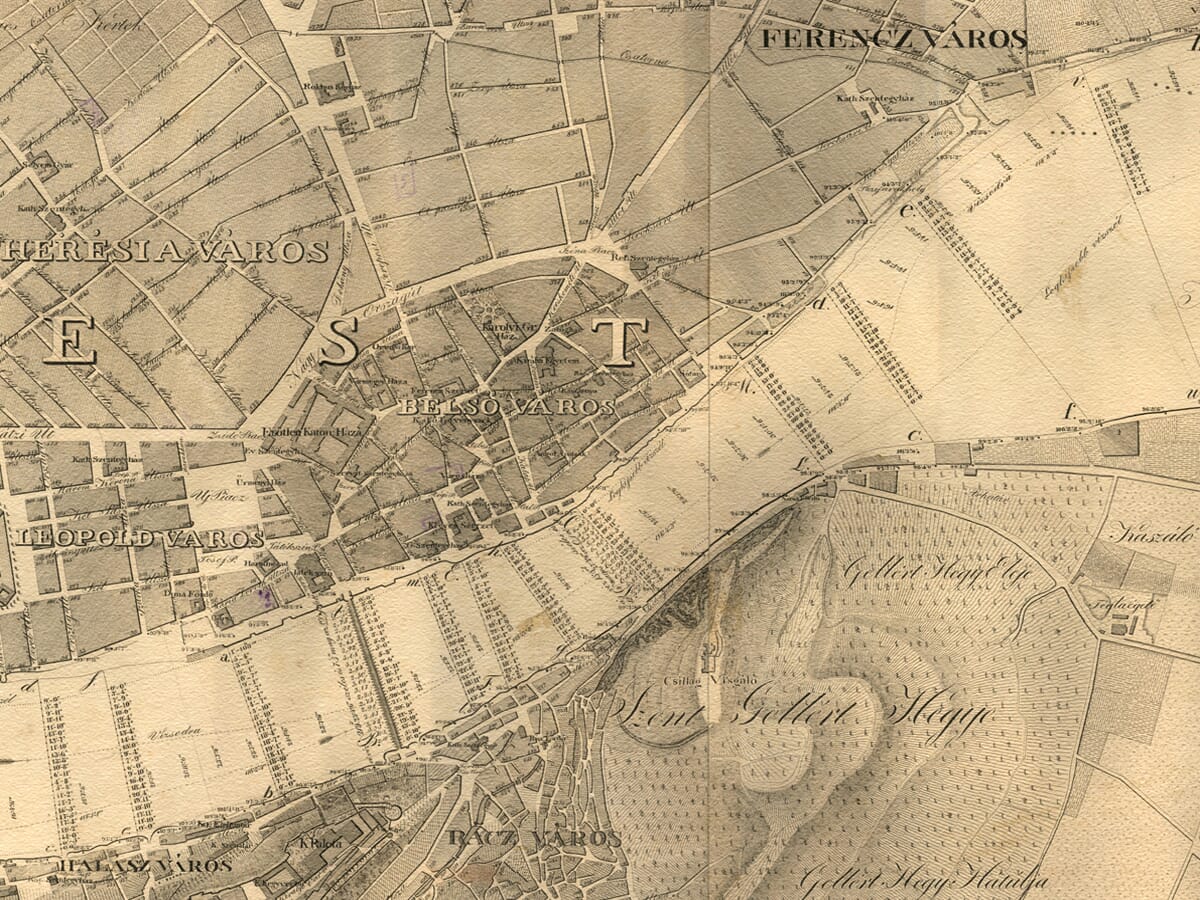
Across the Danube, Pest displays a denser and increasingly regular street pattern. Its built-up centre is surrounded by expanding suburbs, fields, gardens, roads and undeveloped plots, revealing the direction in which the growing commercial town was spreading.
Before the Chain Bridge
No permanent bridge crosses the Danube on this map. Movement between Buda and Pest still depended upon boats, ferries and a seasonal temporary crossing.
Construction of the Széchenyi Chain Bridge began in 1840 and the bridge opened in 1849. Vörös’s map therefore preserves the appearance of the two principal towns before the structure that would physically and symbolically bind them together.
A Record before the Great Flood
The map was published five years before the destructive Pest flood of 1838. Its careful recording of channels, banks, islands and low-lying ground gives the hydrographic information particular historical significance.
The flood devastated large parts of Pest and prompted changes in building practices and flood protection. Vörös’s survey records the riverside landscape that existed shortly before that disaster.
The First Hungarian “Térkép”
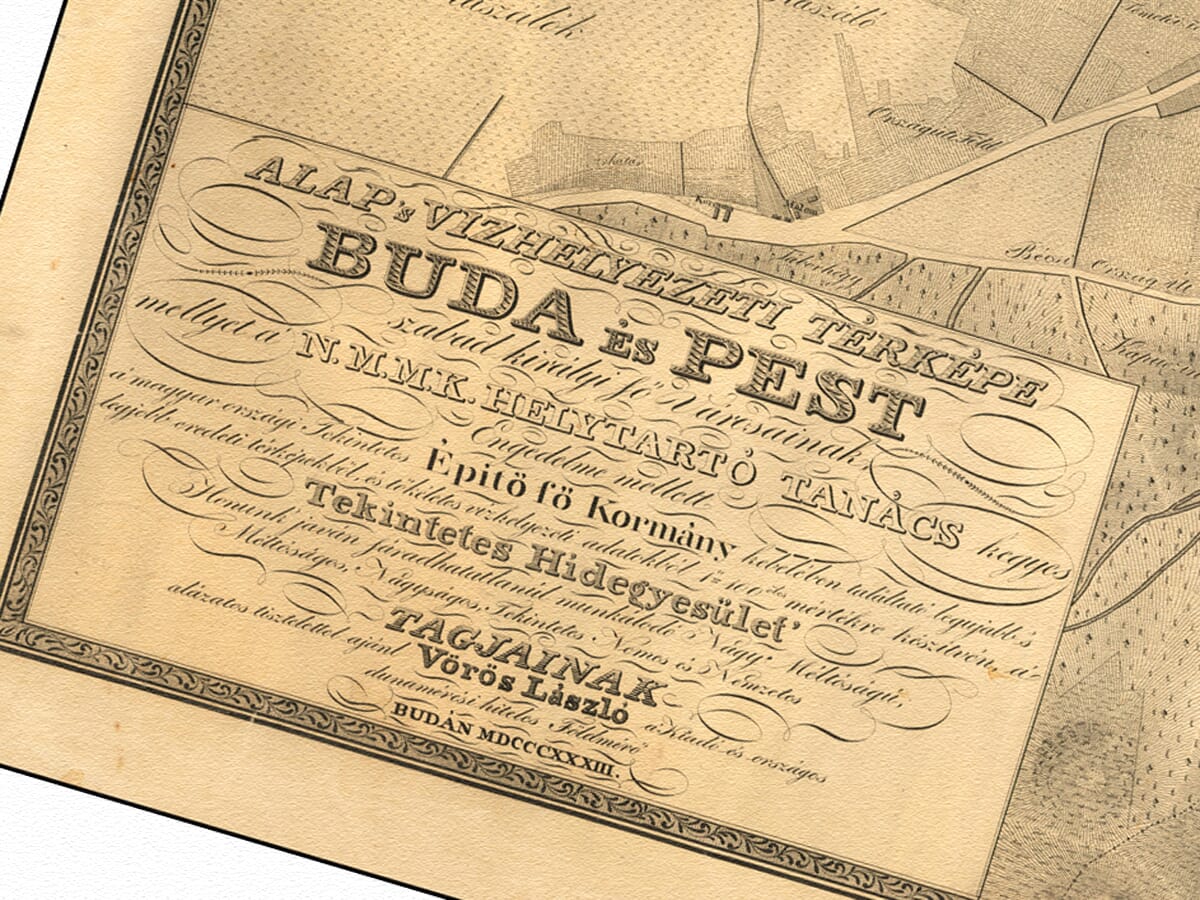
The long Hungarian title is historically important because it contains the earliest known use of the Hungarian word térkép in the title of a published map.
The work is effectively two maps in one: a detailed plan of Buda and Pest and a technical survey of the Danube. This combination explains its unusual elongated format and the large blocks of descriptive text printed along the lower-right edge.
Details across the Landscape
The map distinguishes built-up districts, individual plots, gardens, vineyards, woodland, roads and areas of open land. A key near the upper edge explains the symbols used for different types of terrain and development.
Margaret Island—then commonly associated with the older name Nyulak-szigete or Rabbits’ Island—appears in the Danube, while the expanding town of Pest, the slopes of Buda and the settlements along both banks are rendered with remarkable precision.