Historical Background
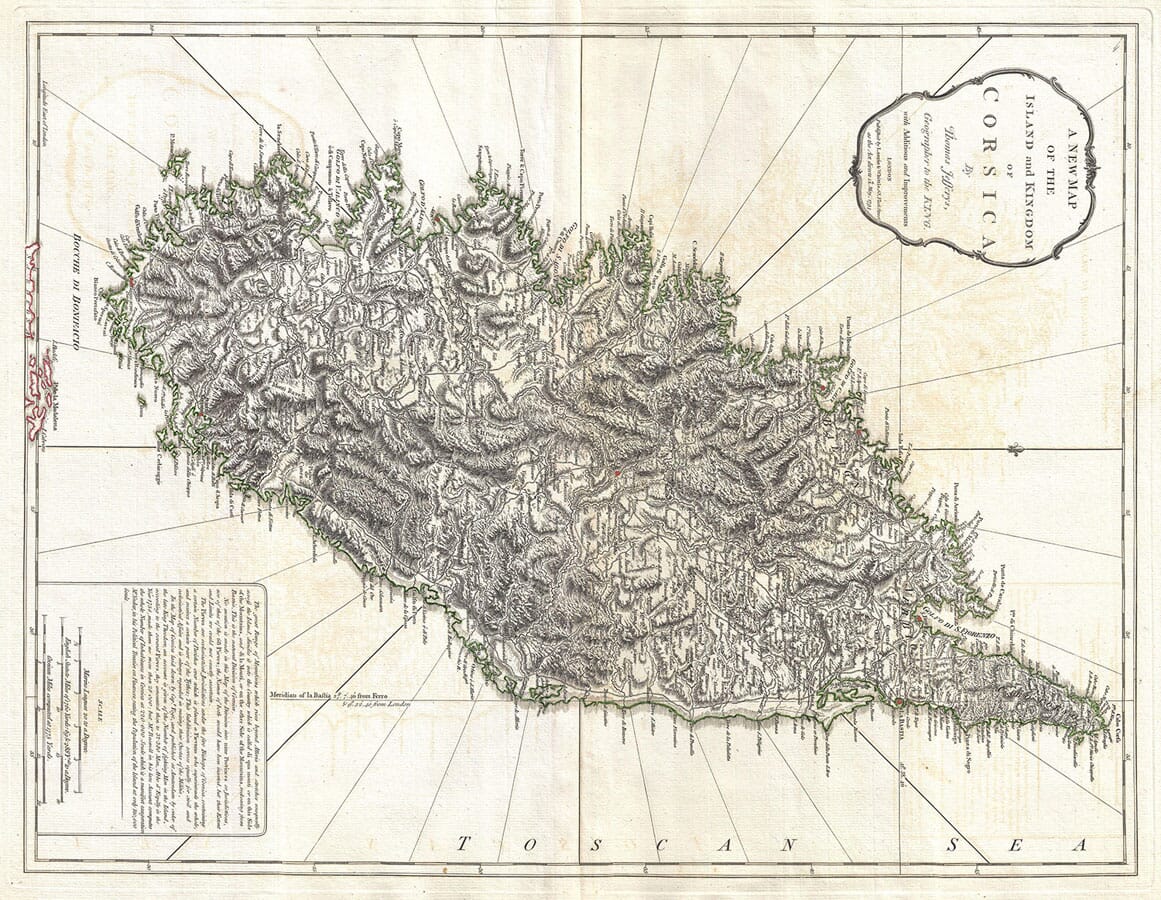
Thomas Jefferys’s map of Corsica presents the island as a closely worked landscape of mountains, rivers and coastal settlements. This version was published in London by Laurie and Whittle with an imprint dated 12 May 1794. The title, A New Map of the Island and Kingdom of Corsica, appears inside an ornamental cartouche, while a separate panel supplies geographical observations. Together, the engraved terrain and extensive lettering make the island itself the principal subject of the sheet.
Map Details
- Original title: A New Map of the Island and Kingdom of Corsica
- Cartographer credited: Thomas Jefferys, Geographer to the King
- Publishers: Robert Laurie and James Whittle
- Publication place: 53 Fleet Street, London
- Map imprint: 12 May 1794; the exact atlas issue of the reproduced sheet is unconfirmed
- Area shown: Corsica, adjoining waters and part of northern Sardinia
- Original scale: Approximately 1:310,000
- Format: Engraved map with mountain relief, coloured coastal outlines and descriptive notes
- Orientation: North towards the right in the landscape presentation shown here
The mountains at the centre of the map
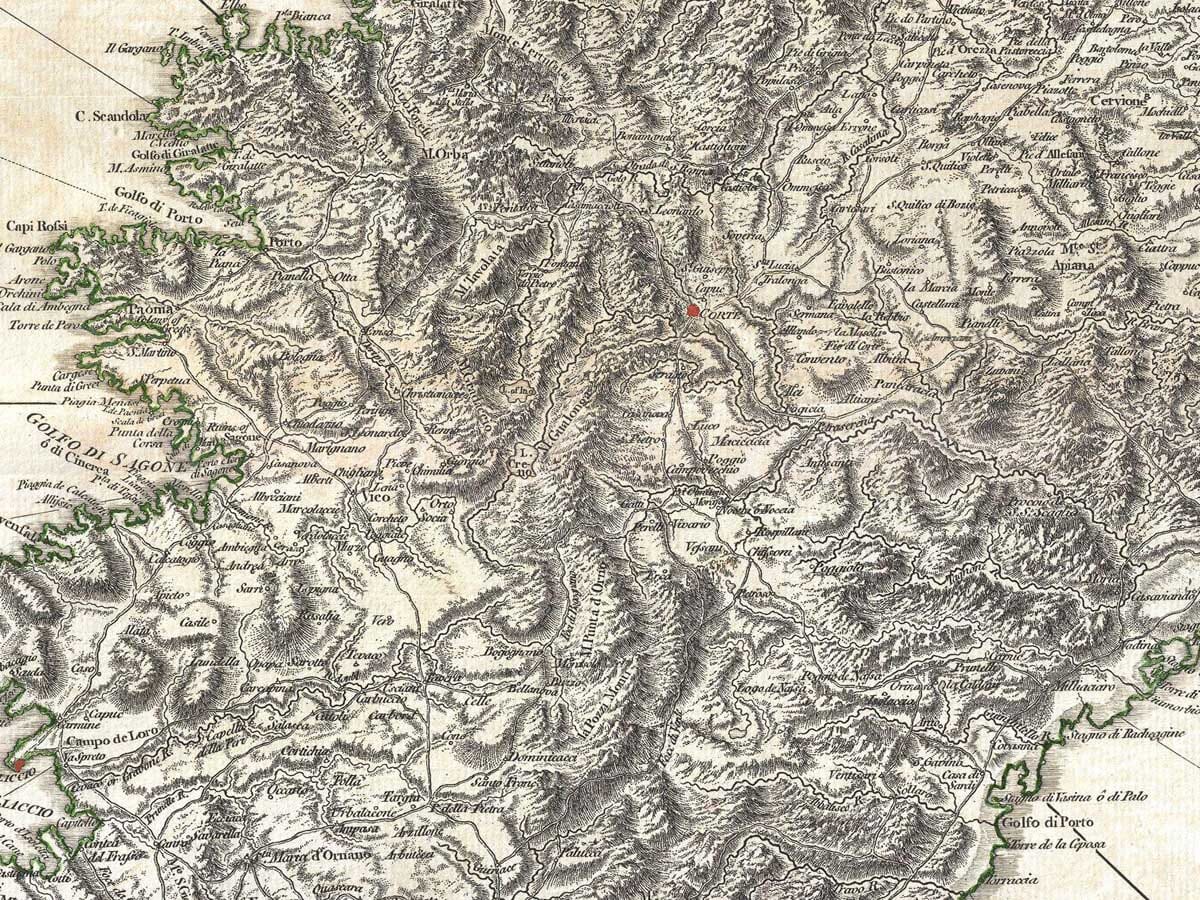
Corsica’s rugged interior occupies most of the engraving. Closely spaced strokes follow ridges and slopes, with individual peaks emerging from a dense network of valleys. This gives the island a strongly textured appearance. Rather than providing modern contour lines, the map uses pictorial relief and hachuring to communicate the character of the ground.
Rivers wind away from the central highlands towards both coasts, creating passages through the shaded terrain. Settlement names and small symbols sit between the hills and waterways. Seen from a distance, the mountains dominate; at closer range, the map resolves into a detailed inhabited landscape. This contrast is one of the particular pleasures of the print.
Cap Corse and the eastern coast
The long projection of Cap Corse gives the northern end a recognisable shape. Small coastal places and headlands are named along its narrow shores, while Bastia appears near its base on the eastern side. The map allows this distinctive peninsula to be read as part of the whole island without a separate inset.
The eastern coastline is generally straighter than the deeply indented western shore. Its thin green outline separates the land from the open water labelled Toscan Sea. Bays, river mouths and settlements supply points of reference along the coast. The engraved lettering retains historical forms, so names may differ from those found on a modern map or road sign.
Western bays and the Strait of Bonifacio
On the western side, successive gulfs and projecting headlands break up the coastline. Ajaccio and its surrounding gulf are among the features that can be followed through the dense detail. The contrast between sheltered coastal waters and the mountainous country behind them is especially clear in this part of the sheet.
At the southern end, Bonifacio faces the passage labelled Bouches de Bonifacio. A small portion of Sardinia enters the map beyond the strait, reminding the viewer that Corsica’s geography is connected with neighbouring islands and sea routes. Offshore islets and coastal names receive attention here, rather than the island being presented as an isolated outline.
Title, navigation and explanatory notes
The cartouche credits Thomas Jefferys and states that the map includes additions and improvements. Jefferys had died before this publication, so the 1794 date identifies the later Laurie and Whittle version rather than a new survey personally undertaken by him. The imprint records the London publishing business responsible for issuing this sheet.
Long directional lines cross the surrounding sea, with a small north indicator and a graticule around the border. A rectangular note panel and several scale bars occupy another corner. These devices give the sheet a practical geographical character alongside its ornamental title. The historical observations in the panel belong to the map’s period and should not be treated as current information about Corsica’s population or government.
A map published during wartime interest
The publication year coincided with British military operations on Corsica during the French Revolutionary Wars. Coastal places on the map, including Bastia and San Fiorenzo, were also subjects of contemporary British naval views. That setting helps explain the interest such a detailed island map could hold for a London readership, although this sheet is not a plan of an individual battle or siege.
The existing product image presents the portrait map sideways in a landscape format, with north towards the right. Its original lettering and arrangement are retained. As a fine art print, this old map of Corsica combines a remarkably detailed mountainous interior with the coastal geography and publishing conventions of the late eighteenth century.



 Verified owner