
Historic maps do not always fit neatly into geographical categories. Some were designed to explain winds, tides or the heavens; others preserved reports of sea monsters, speculative coastlines, imagined islands and places that had never been reliably surveyed.
This collection brings together maps, charts and diagrams in which observation sits beside inherited authority, folklore and artistic invention. Their unusual details show how cartographers and publishers organised uncertain knowledge—and how readers once pictured oceans, polar regions, distant lands and the wider cosmos.
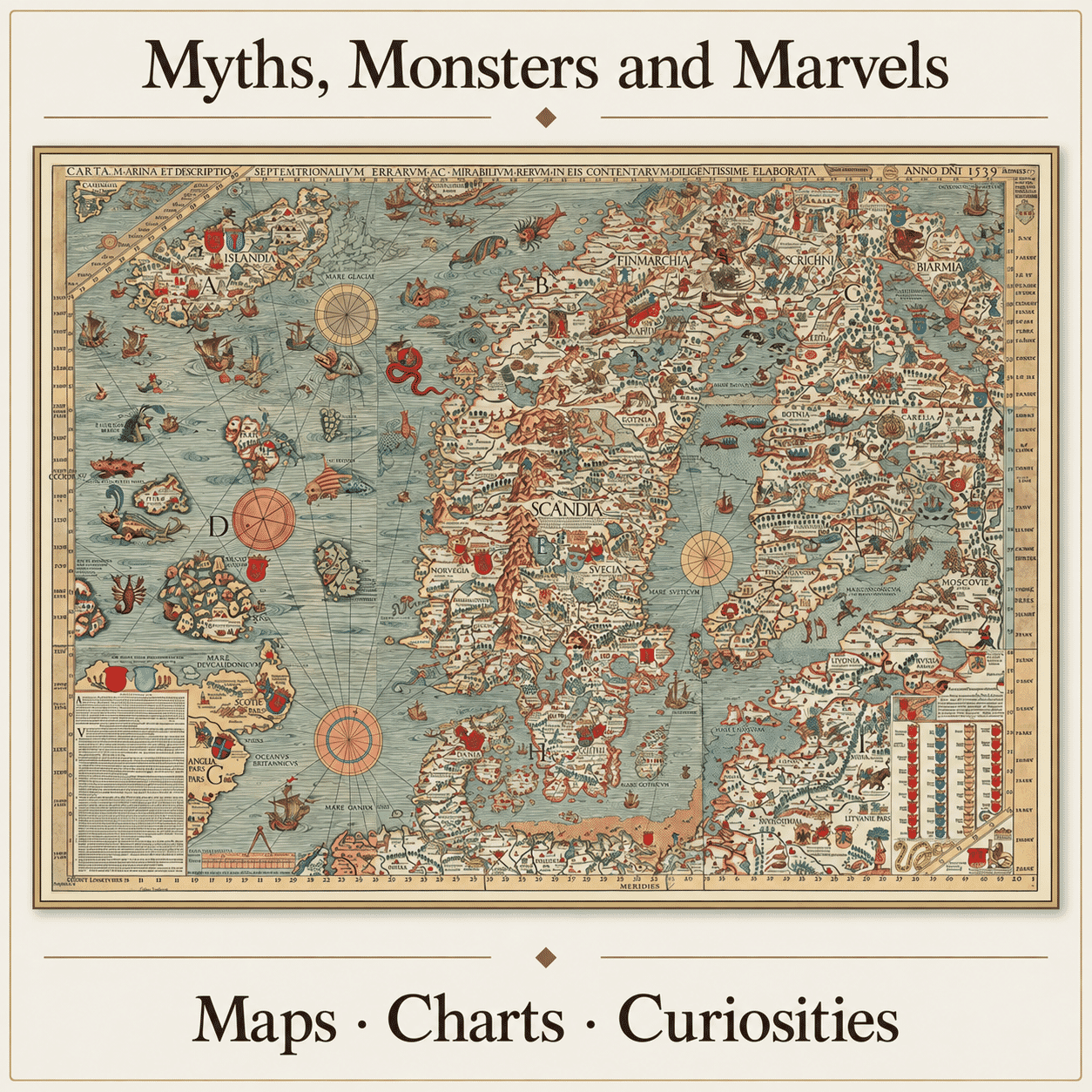
Curious Maps, Imagined Worlds and Unexpected Subjects
Beyond the Familiar Map
Not every map was intended simply to help a reader find a place. Some attempted to explain natural forces, organise the heavens or picture territories that had never been reliably surveyed. Others filled unknown seas with monsters and marvels. These works occupy the fascinating borderland between observation, inherited belief, artistic convention and imagination.
Why Old Maps Contain Curiosities
Early mapmakers worked with incomplete reports gathered from travellers, sailors, scholars and earlier publications. When evidence was scarce, an old authority or compelling story could be repeated from one map to the next. Decorative elements also had a purpose: they filled open space, displayed the engraver's skill and helped make an expensive publication desirable to its original audience.
Maps That Reward a Second Look
The pleasure of an unusual map often lies in its smaller details. A mythical creature may surface beside an otherwise careful coastline; personified winds may blow from the margins; an ingenious diagram may arrange the universe according to a theory no longer accepted. These features prompt questions about how people once understood the world rather than merely illustrating where they lived.
Distinctive Prints for Collectors
Historic curiosities make memorable display pieces because they resist being understood at a glance. They suit studies, libraries and rooms where an image can invite conversation. The reproductions retain the old typography, engraving and paper character of the sources, presenting their oddities as part of the history rather than correcting them for a modern audience.


