Historical background
Andreas Cellarius’s Scenographia Systematis Mundani Ptolemaici is one of the most memorable celestial images of the seventeenth century. It is often loosely described as a star map, but that does not quite capture what it is. This is really a map of an idea: the old Ptolemaic universe, with the Earth fixed at the centre and the heavens arranged around it in ordered circles.
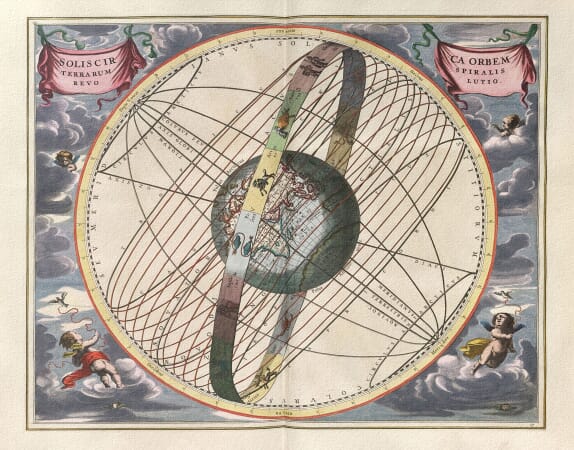
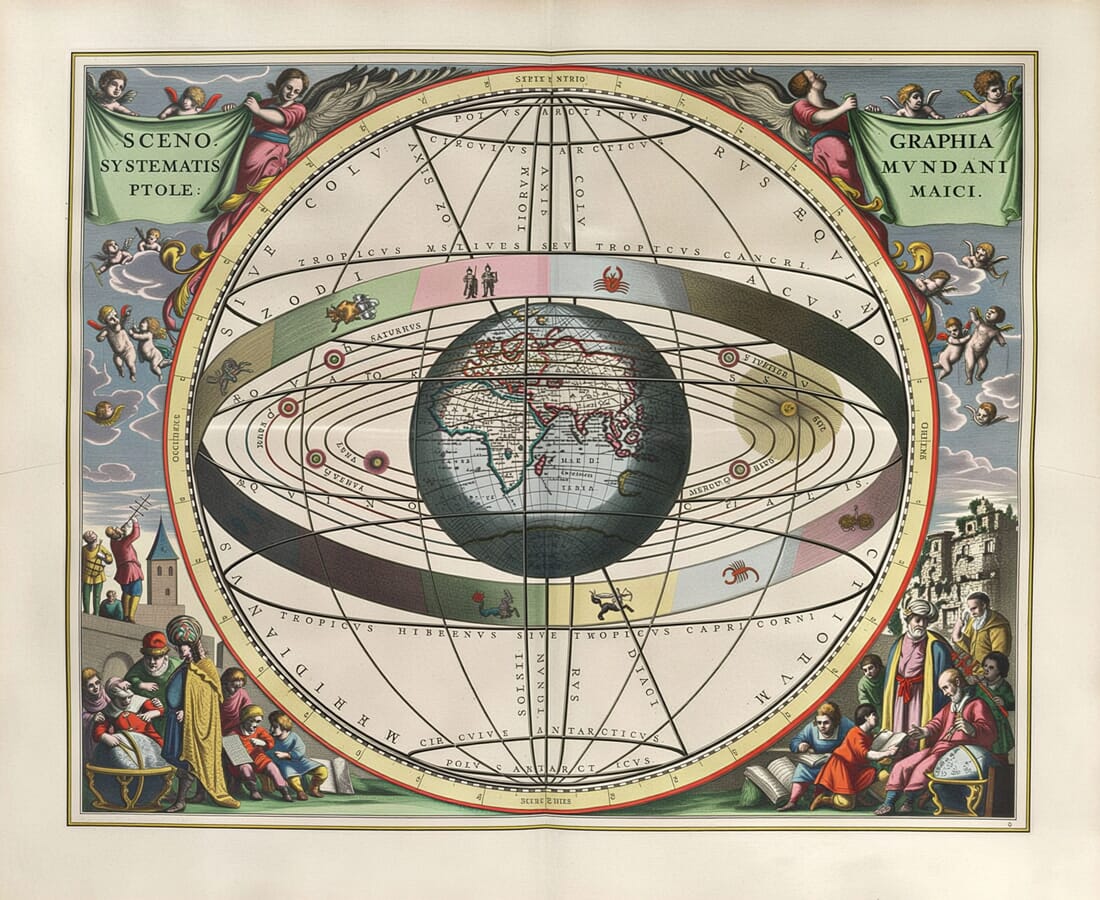
At the heart of the design is the globe of the Earth. Around it sweep the paths of the Moon, Mercury, Venus, the Sun, Mars, Jupiter and Saturn. Beyond them are larger celestial bands, the zodiac and the outer structure of the heavens. It is astronomy, but not astronomy as a modern textbook would show it. Cellarius turns the universe into theatre.
The plate was published in Harmonia Macrocosmica, the great celestial atlas issued in Amsterdam in 1660 by Johannes Janssonius. The atlas was one of the finest achievements of Dutch Golden Age mapmaking. It contained a series of large engraved plates showing different ways of understanding the heavens, including the Ptolemaic, Copernican and Tychonic systems.
That is part of what makes the work so interesting. Cellarius was not simply drawing constellations. He was presenting the competing world systems that had shaped astronomical thought. His atlas belonged to a moment when Europe was still digesting the enormous intellectual shift from an Earth-centred cosmos to a Sun-centred one.
Andreas Cellarius himself was a German-born scholar and schoolmaster who worked in the Dutch Republic. He was not an astronomer of the first rank in the way that Copernicus, Kepler or Galileo were, but he had a remarkable gift for bringing astronomical knowledge into visual form. In Harmonia Macrocosmica, he created a book that was scholarly, decorative and deeply ambitious.
The title of this particular plate is important. Scenographia Systematis Mundani Ptolemaici may be understood as a scenic representation of the Ptolemaic world system. The word “scenic” is useful. Cellarius is not merely setting out data. He is arranging a view. The heavens become a stage, and the viewer is invited to look into the architecture of the universe.
The Ptolemaic system takes its name from Claudius Ptolemy, the second-century astronomer and geographer working in Alexandria. His astronomical writings shaped European, Islamic and later Renaissance astronomy for well over a thousand years. To modern eyes, the idea of the Earth at the centre may seem obviously wrong. But that is too easy a judgement. The Ptolemaic model was a serious and highly developed attempt to explain what observers actually saw in the sky.
From Earth, the heavens do appear to revolve around us. The Sun rises and sets. The Moon changes position. The planets wander against the background of fixed stars. Ptolemy’s system gave a mathematical structure to those observations, using circles, spheres and refinements to explain planetary motion. It was not primitive guesswork. It was one of the most sophisticated intellectual systems of the ancient world.
For medieval and Renaissance Europe, the Ptolemaic cosmos also fitted a broader vision of order. The Earth occupied the centre. Around it were successive celestial spheres. The heavens were not empty space in the modern sense, but a structured, meaningful realm. Astronomy, philosophy, theology and astrology all overlapped.
By the time Cellarius’s atlas appeared, that older certainty had been shaken. Copernicus had placed the Sun at the centre of the planetary system. Tycho Brahe had proposed a compromise model. Kepler had introduced elliptical orbits. Galileo’s telescope had revealed things that did not fit comfortably into the old scheme: mountains on the Moon, moons around Jupiter, and the phases of Venus.
So this plate is not just an illustration of an ancient theory. It is a seventeenth-century image of an older universe at the very moment when the modern universe was coming into view.
That tension gives it much of its fascination. Cellarius’s Ptolemaic chart is beautiful, confident and grand, but historically it belongs to an age of argument. The old system had not vanished. The new one had not yet become common sense. In that gap, printers, scholars and readers needed images that could help them compare and understand different models of the heavens.
Cellarius supplied exactly that.
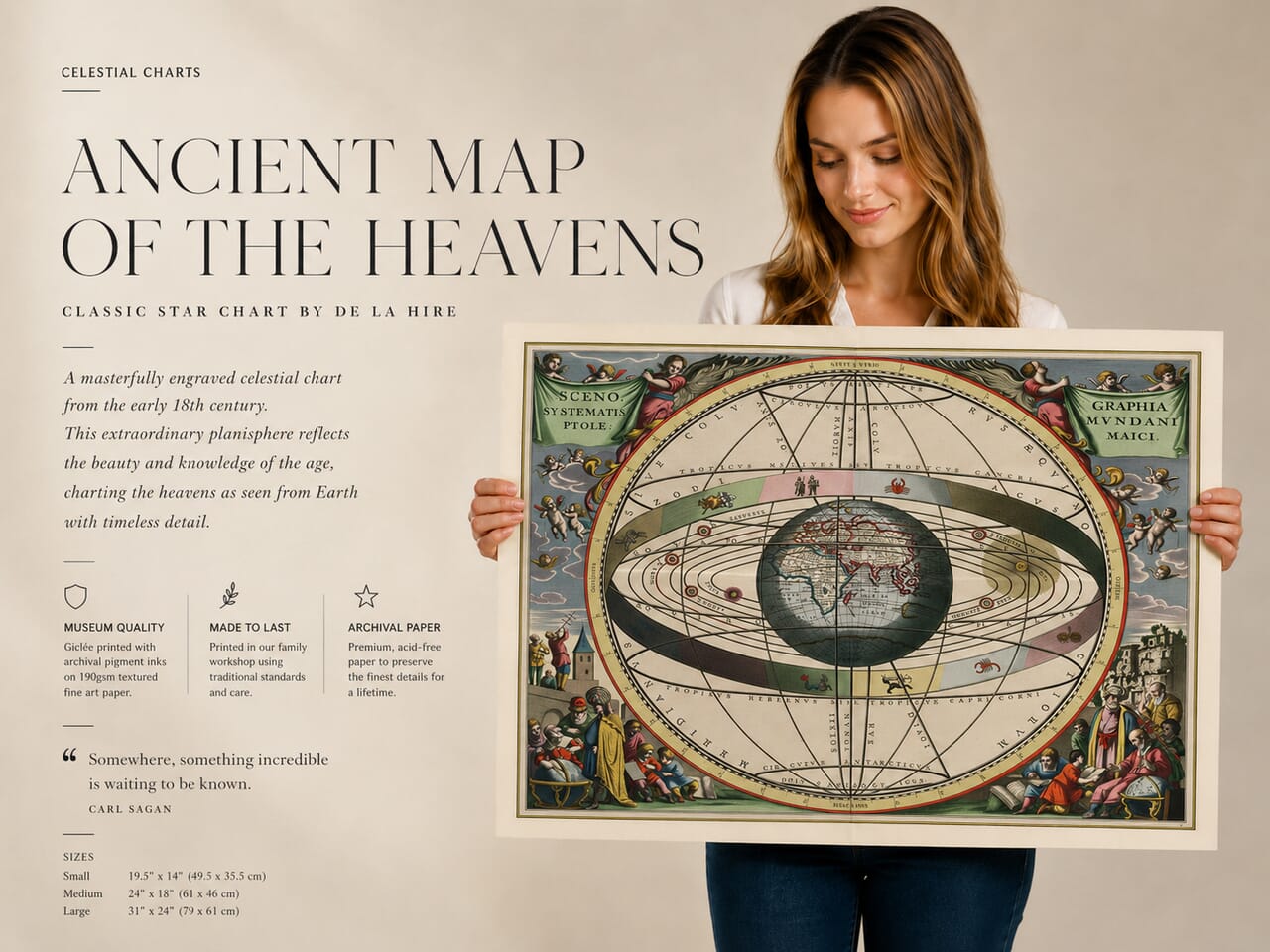
The composition is extraordinary. The central Earth is dark and solid, almost theatrical in its shading. Around it, the planetary paths sweep outward in elegant curves. The zodiac band cuts across the design, with signs and symbols set into the celestial structure. The whole thing has movement, but it is disciplined movement. Nothing feels accidental.
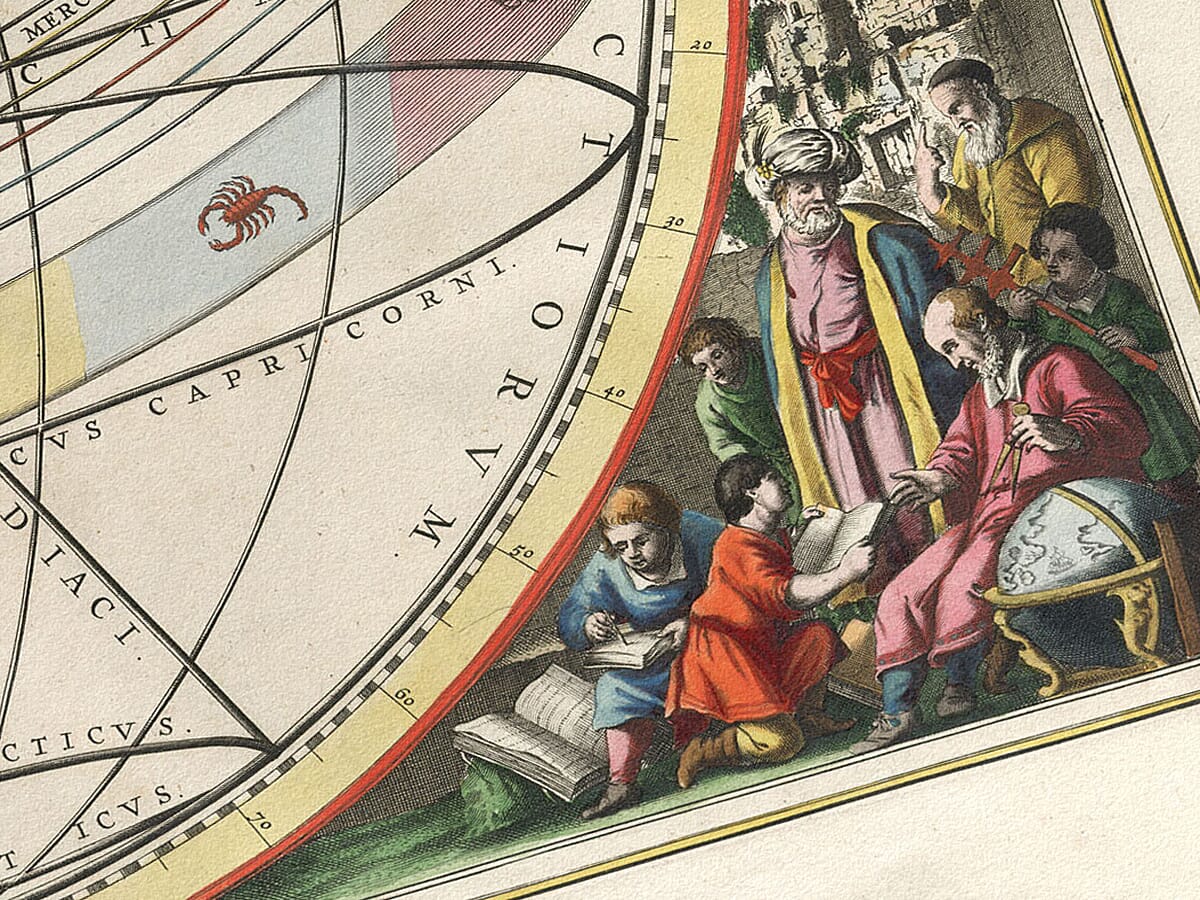
The surrounding figures add another layer. Cherubs hold banners. Scholars sit with books and instruments. Observers gesture towards the heavens. Architectural fragments, clouds and classical details frame the scene. The image is not only saying “this is how the universe works.” It is saying “this is a subject worthy of contemplation.”
That sense of theatre is very Baroque. Seventeenth-century scientific images were often expected to impress as well as instruct. A chart like this belonged in a learned folio atlas, but it also had the visual force of a work of art. It was designed for people who valued knowledge, but who also understood the power of display.
The Dutch context matters. Amsterdam in the seventeenth century was one of the great centres of printing, engraving and atlas production. Maps of countries, cities, sea routes and empires were being made with extraordinary skill. Cellarius extended that same mapmaking culture into the sky. In his hands, the heavens could be mapped with as much elegance as the Earth.
The zodiac is especially striking in this plate. Today we tend to separate astronomy and astrology sharply. In Cellarius’s world, the separation was not so neat. The zodiac belonged to astronomy, astrology, calendar-making, medicine, agriculture and religious time. It helped connect the observed heavens with the seasons and with human life on Earth.
That is one reason the chart still speaks to modern viewers. It is not only a scientific diagram. It is an image of connection. Earth, planets, zodiac, time, observation and belief are all held together in one grand design.
[We first became properly aware of the decorative power of the Cellarius celestial charts not through a library catalogue, but through interior design. Several examples from the collection were being used as wall décor in a Cypriot hotel, where their scale, colour and classical drama gave the rooms an immediate sense of scholarship and occasion. It was a useful reminder that these charts are not only historically important; they also work beautifully in real interiors. — Ed.]
That point is worth making because Cellarius prints do have a very particular presence on the wall. They are decorative, but not merely decorative. They carry a story. A viewer may first notice the colour and drama, then the central globe, then the planetary paths, then the figures, then the strange beauty of the old cosmological order.
The more one looks, the more there is to see.
There are also small human touches in the design. The scholars in the corners remind us that knowledge is made by people: reading, measuring, arguing, observing. The instruments and books are not incidental decoration. They place the image in the world of study. This is a chart for libraries, universities, observatories, collectors and anyone who enjoys the history of ideas.
It also has a strong philosophical quality. The chart asks, in visual form, where the Earth belongs. Is our world the centre? Is it one moving body among others? What is order? What can be known by observation, and what is inherited from tradition? Those questions were alive in Cellarius’s time, and they have not entirely lost their force.
As a historical object, the plate belongs to the period before modern astronomical photography. The sky could not yet be recorded by camera or satellite. It had to be observed, calculated, engraved and imagined. The printed line was the means by which the cosmos became visible on paper.
That gives these old celestial charts a special charm. They are not fantasy, but neither are they modern science illustrations. They sit somewhere between measurement and imagination. They show what people knew, what they believed, and how beautifully they could picture it.
The colouring adds greatly to the appeal. Soft greens, blues, reds and ochres give the design warmth without overwhelming the engraving. The central circular form gives the whole image authority and balance. It is a busy print, certainly, but not chaotic. Cellarius knew how to manage complexity.
This makes the chart particularly suited to interiors with a scholarly or reflective character: a study, library, office, hallway, reading room, university space, hotel reception or observatory-inspired room. It has enough detail to reward close looking, yet enough overall structure to work from a distance.
It is also an excellent subject for anyone interested in astronomy, astrology, classical learning, the history of science or unusual wall art. Unlike a conventional landscape or country map, it does not describe a single place. It describes a worldview.
That is why the wording matters. Calling it simply an “ancient star map” is understandable from a search point of view, but historically it is more precise to call it a celestial chart or cosmographical chart. Its subject is not just the stars. Its subject is the structure of the universe according to the Ptolemaic system.
Cellarius’s genius was to make that structure visible and memorable. He took a difficult intellectual model and turned it into a grand image. The viewer does not need to know the mathematics of planetary motion to feel the drama of the design. The Earth is held in the centre. The planets turn. The zodiac encircles. Scholars watch and wonder.
There is something moving about that. The chart belongs to a world whose astronomy has been superseded, yet it does not feel dead. It feels like a record of human curiosity. Every age looks upward and tries to make sense of the heavens. This is one of the most beautiful printed examples of that impulse.
For a modern fine art print, Scenographia Systematis Mundani Ptolemaici offers a rare combination: historical depth, decorative richness and intellectual atmosphere. It is not a casual image. It has weight. It brings with it the memory of old libraries, early science, classical learning and the long human effort to understand the sky.
That is its lasting appeal. Cellarius gives us more than a map of the heavens. He gives us a picture of thought itself: ordered, ambitious, imperfect and beautiful.






 Verified owner