
 Verified owner
Got there in time and loves it! Cheers David [Gift from US to UK]
 Verified owner
Thanks Lauren. We received it today - it's gorgeous! Thank you, Ellan
 Verified owner
Thank you for your prompt service. I have a gallery and framing business in South Wales. I'm so pleased it is printed in the UK
 Verified owner
My Isles of Scilly map arrived safely and I'm delighted with it!

The print arrived safely and we're delighted with it - a lovely reminder of our honeymoon 15 years ago.
 Verified owner
I have just received them! I'm sure our clients will be pleased with them and there could be more projects off the back of this one where we can use more. [Interior Designers]
 Verified owner
I just received my map of Ireland by Ewart today and, as usual, I am delighted by its quality. The crispness and fineness of detail is excellent and the colour reproduction surpasses my expectations. Please relay my thanks to Steve for another fine effort!
 Verified owner
Many thanks, Lauren. Very pleased with the map and the service: would recommend The Old Map Company to anyone interested in Old Maps.
 Verified owner
Many thanks, the map arrived safely this morning, and I’m really pleased with it. A stunning reproduction, just as I had hoped. I will keep browsing your website, and may yet be tempted by more of your items! Have a great weekend.
 Verified owner
Just arrived, wonderful map! Thanks very much!
 Verified owner
The map – beautiful – arrived safely, very many thanks.
 Verified owner
Thank you, I have already found the map. It’s wonderfull! Good luck! Rasa
 Verified owner
My apologies for the very late reply. I wanted to reach out to thank you so much for rushing my order. My partner absolutely loved it. I am amazed with the service so that is a five-star from me. I wish you all the best.
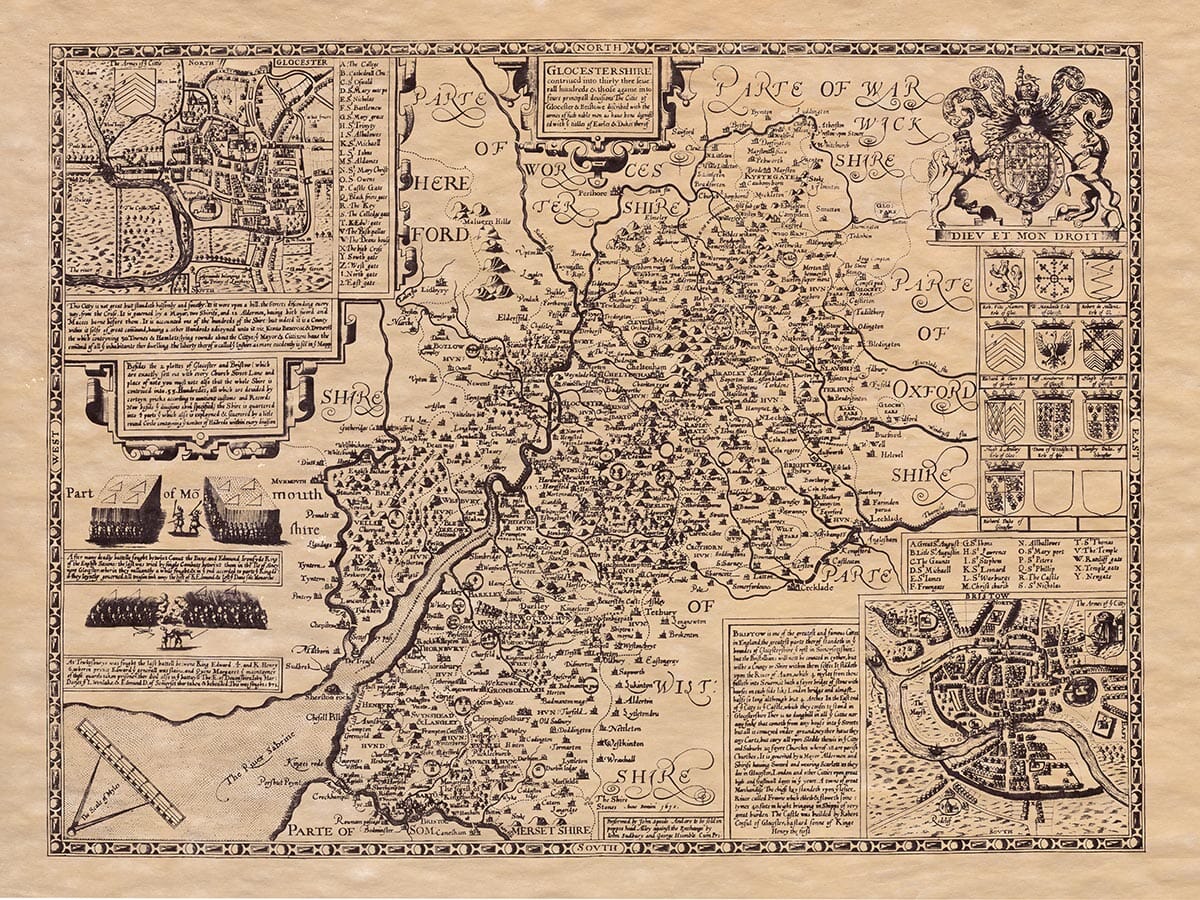
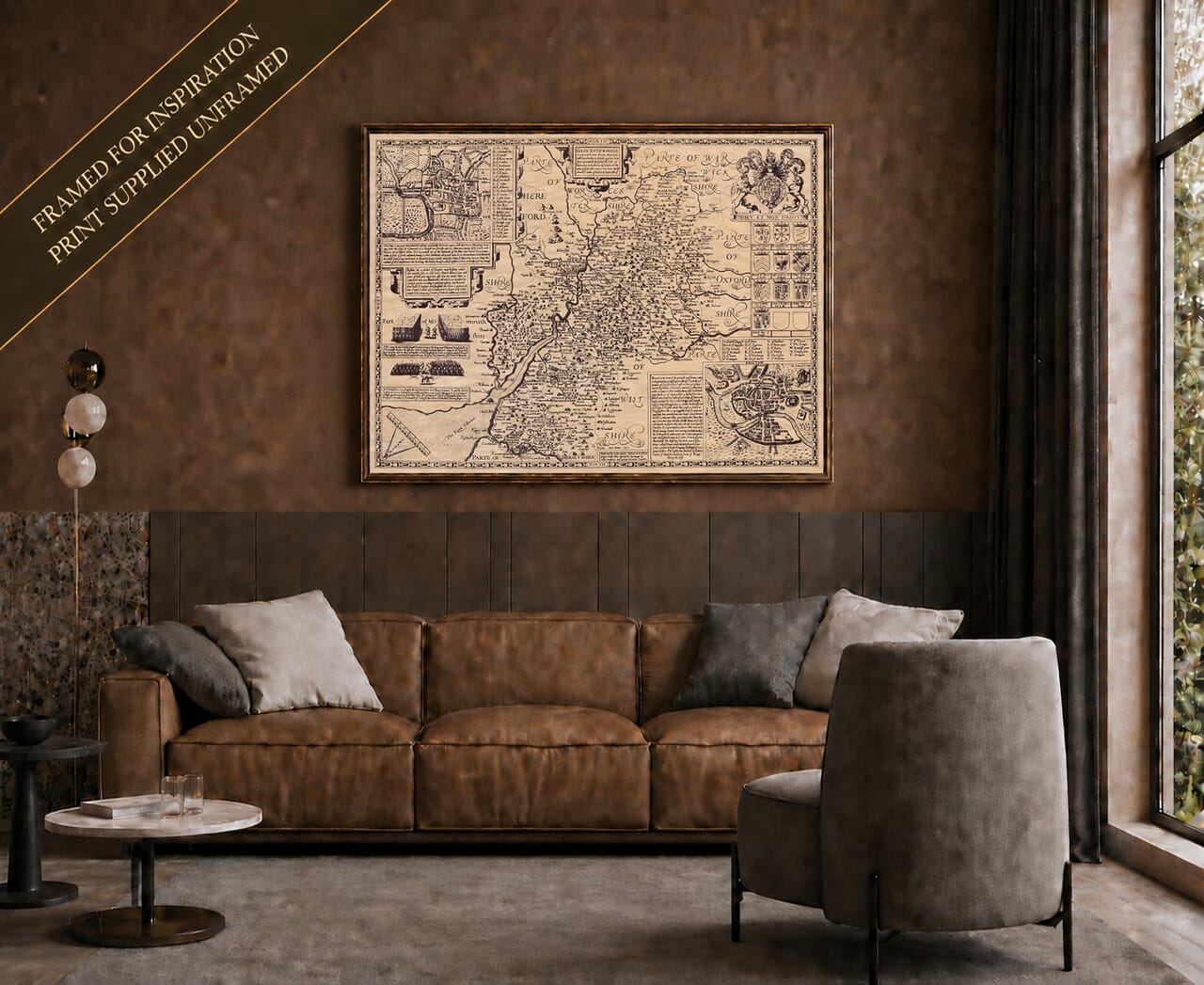
John Speed’s old map of Gloucestershire gives unusual prominence to both Gloucester and Bristol. Their town plans frame a county view shaped by the River Severn, the Forest of Dean and the Cotswolds. Battle illustrations and heraldic panels add another layer of detail, bringing the county’s remembered history into the same composition as its towns, rivers and hundreds.
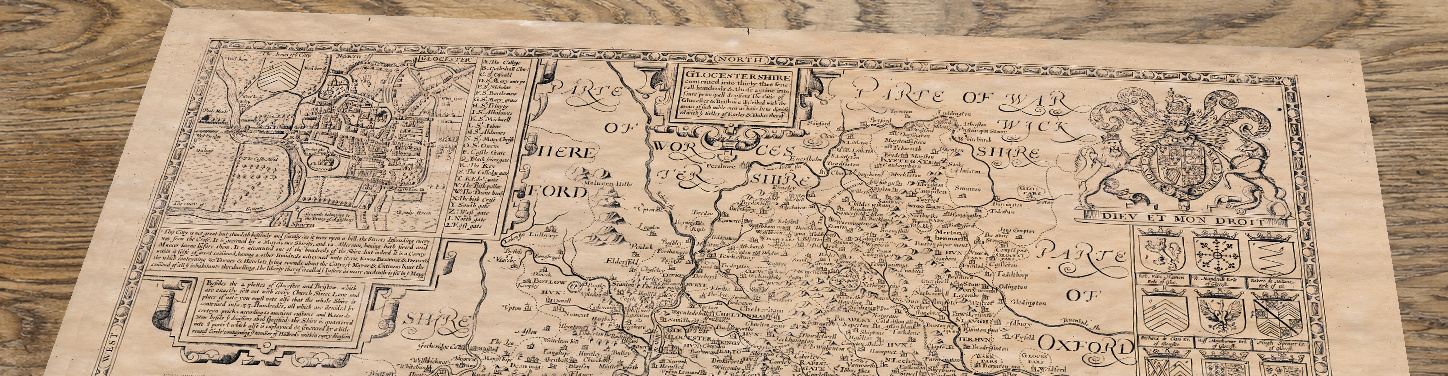
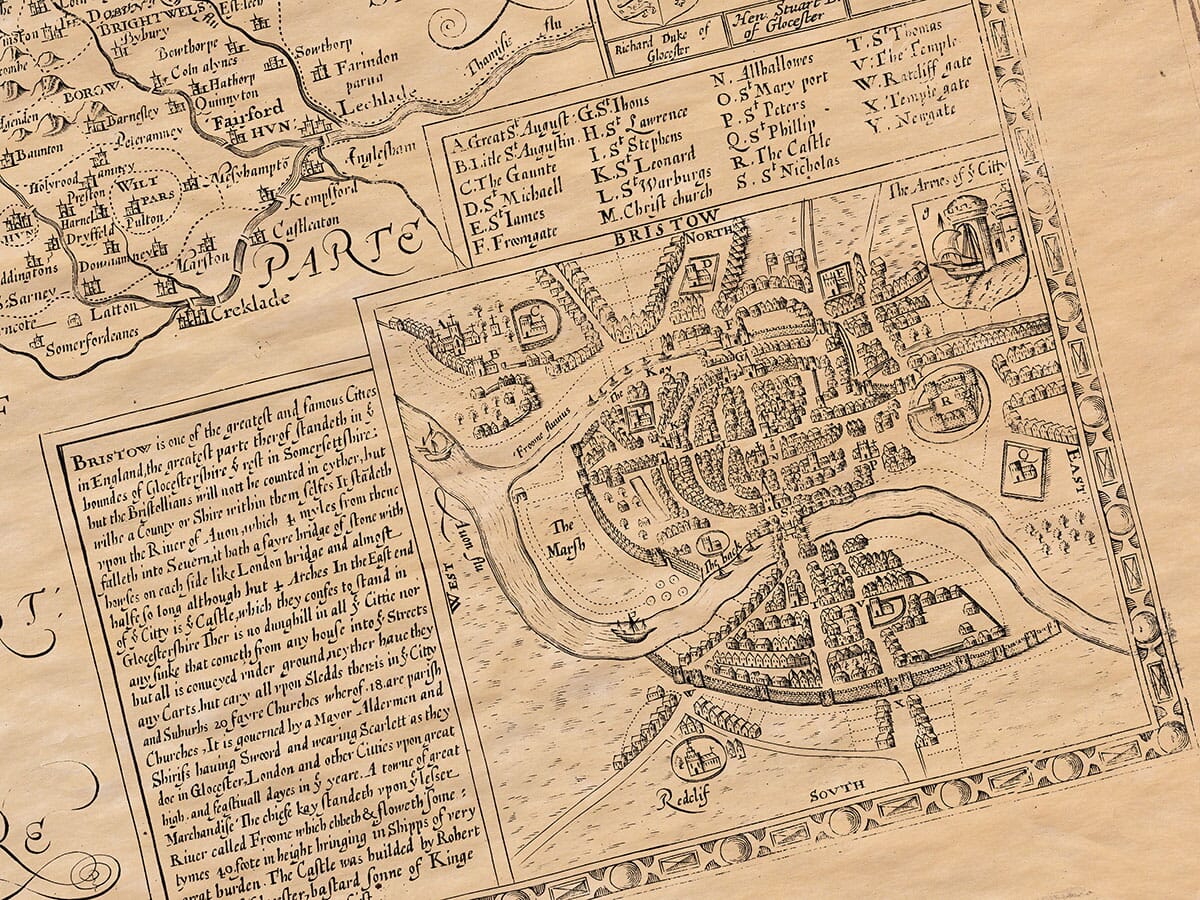
Gloucester’s plan is placed at the upper left, while Bristol’s much larger inset fills the lower right. Their streets, churches and fortified features are presented pictorially, with keys and written descriptions to assist the reader. Bristol is labelled ‘Bristow’, one of several spellings that make the map interesting to compare with modern usage. The Bristol view includes its riverside setting and shipping, reflecting the importance of waterborne trade to the city.
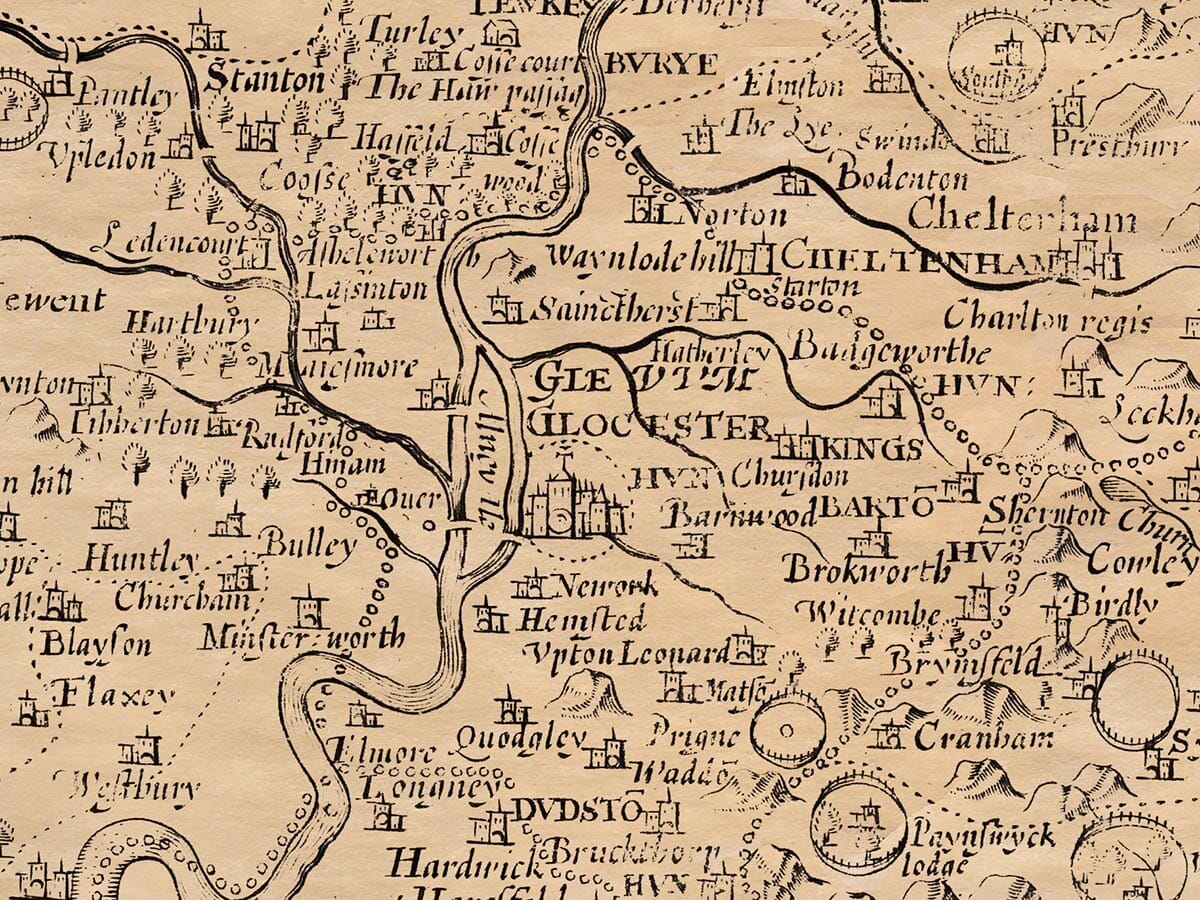
The Severn runs through the western part of the county, with the Forest of Dean beyond it and the Cotswold country to the east. Gloucester and Tewkesbury stand within this river landscape; Cirencester lies farther east. Trees, small hills and settlement symbols describe the terrain visually, while named hundreds organise the countryside. The map’s title refers to thirty-three hundreds, a useful detail when comparing it with other historical accounts that group the county differently.
The scenes on the left include the traditional encounter between Edmund Ironside and Canute at Alney Island and the Battle of Tewkesbury in 1471. The former belongs to the county’s legendary historical tradition and should not be treated as an independently verified eyewitness account. The coats of arms on the opposite side similarly connect the map with titles and lineage. Two empty shield spaces remain visible; they are part of the design, without requiring an unsupported explanation that the spaces were sold.
An engraved date of 1610 survives on the sheet. The design belongs to Speed’s county atlas, first published in London in 1611, but the reproduced imprint names Thomas Bassett and Richard Chiswell. Their names point to the later publisher state associated with the 1676 edition. The town plans and older geography continued through the map’s publication history rather than being newly surveyed for each printing. This fine art print is supplied unframed.
John Speed’s published county map was accompanied by a detailed historical description of Gloucestershire. The following modern-English adaptation brings that account to today’s reader. It reflects historical beliefs and place names, rather than present-day historical or scientific conclusions.
Boundaries:
Gloucestershire, formerly called Gleaucerbenrchyne in Old Saxon, is bordered by Worcestershire and Warwickshire to the north, Oxfordshire and Wiltshire to the east, Somerset to the south, and the River Wye and Herefordshire to the west.
Size and Shape:
The county stretches about 48 miles from Bristol on the River Avon in the south to Clifford on another River Avon in the north. Its widest point, from Lechlade in the east to Preston in the west, spans roughly 28 miles. The total length of its borders is about 138 miles. Gloucestershire is long and narrow, with a mild and pleasant climate and fertile soil. According to the medieval writer William of Malmesbury, the county produces plenty of grain and fruit, both wild and cultivated. Even the laziest person would be inspired to farm here. Wild apple and pear trees grow along roads and footpaths, bearing sweet, beautiful fruit that keeps well. The county has more vineyards than anywhere else in England, producing rich, sweet wine that nearly rivals French varieties. The countryside is dotted with homes, impressive churches, and bustling towns.
The River Severn is the county’s pride. It’s the widest, fastest, and most fish-rich river in England. Its waters can rise violently, stirring up sand and flooding like a tide — dangerous for inexperienced boaters, but locals who know the river well navigate it with ease.
Early Inhabitants and Customs:
The area was once inhabited by the Dobuni tribe, whose territory stretched into what is now Oxfordshire. Between the Severn and Wye rivers, part of the Silures tribe from South Wales lived. A unique local custom remains: when someone is convicted of a crime, their property goes to the Crown for just one year and one day. After that, it is returned to their heirs, unlike in other parts of England.
Natural Resources:
Gloucestershire is rich in grain, high-quality iron, and wool. The county also has excellent pastureland, fruit, and woodlands. However, much of the woodland has been cleared to support the iron industry, which uses oak, elm, and beech trees for fuel.
Market Towns and Cities:
Gloucestershire’s resources are traded in 25 market towns, two of which are cities.
The first city is Gloucester, the county seat, located on the Severn. In Roman times, it was called Glevum, established as a military outpost to control the Silures and house a Roman legion. Parts of the Roman walls still stand. The city was taken from the Britons around AD 570 by Ceawlin, King of the West Saxons, and thrived under the Mercian kings. Osric, King of Northumbria, supported by Æthelred of Mercia, founded a large nunnery there, where Queens Kyneburga, Eadburga, and Eve served as abbesses. Lady Æthelflæd, sister of King Edward the Elder, built a beautiful church in Gloucester and was buried there. Though destroyed by Danish invaders, it was later rebuilt and became St. Peter’s Cathedral. King Edward II — murdered at Berkeley Castle on the orders of his wife, Queen Isabella of France — is buried there in an alabaster tomb. Nearby lies Robert Curthose, the eldest son of William the Conqueror, who was blinded and imprisoned for 26 years before his death. According to tradition, Lucius, believed to be Britain’s first Christian king, was buried here even before King Arviragus’ time.
Gloucester is located at latitude 52°14′ and longitude 18°5′ west.
The second major city is Bristol, a thriving trade hub often called a “second London.” Although it lies partly in Gloucestershire and partly in Somerset, it has its own county status and doesn’t belong to either.
Other Towns:
Cirencester, once even more prominent, was known as Corinium to the Romans and Durocornovium in the Antonine Itinerary. Giraldus called it the “City of Sparrows” after a legend that an African warlord, Gurmund, burned it down using sparrows with fire attached to them. It was a major crossroads for Roman roads. Ceawlin took it from the Britons, and it later fell to the Mercians and then the Danes in 879. It has not been rebuilt within its original Roman walls.
Historical Sites:
Notable historical sites include:
Alney Island near Gloucester, where Edmund Ironside and Canute fought in single combat before agreeing to divide the kingdom.
Berkeley Castle, where King Edward II was murdered.
Tewkesbury, where a major 1471 battle ended King Henry VI’s rule and doomed the Lancastrian cause. Prince Edward, Henry’s son, was killed there.
Alderley Hills, where you can still find cockles, periwinkles, and oyster shells — possibly fossils or natural oddities.
Religious Institutions:
The county is home to many religious houses, many founded by royalty. These include Tewkesbury, Deerhurst, Gloucester, Minchinhampton, Berkeley, Kingswood, Cirencester, Winchcombe, and Hailes Abbey. Hailes Abbey, founded by Richard, Earl of Cornwall, claimed to house a relic of Christ’s blood, drawing large numbers of pilgrims until it was exposed as a fake during the Reformation.
Dukes and Earls of Gloucester:
Several noble Dukes of Gloucester met tragic ends:
Thomas of Woodstock, son of Edward III, was smothered in Calais.
Humphrey, brother to Henry V, was killed through the schemes of Queen Margaret and Cardinal Beaufort.
Richard, brother to Edward IV, was killed at the Battle of Bosworth by Henry VII.
Administrative Divisions:
Gloucestershire is divided into four major regions, further split into 30 hundreds and 280 parishes (which are listed elsewhere).