Historical Background
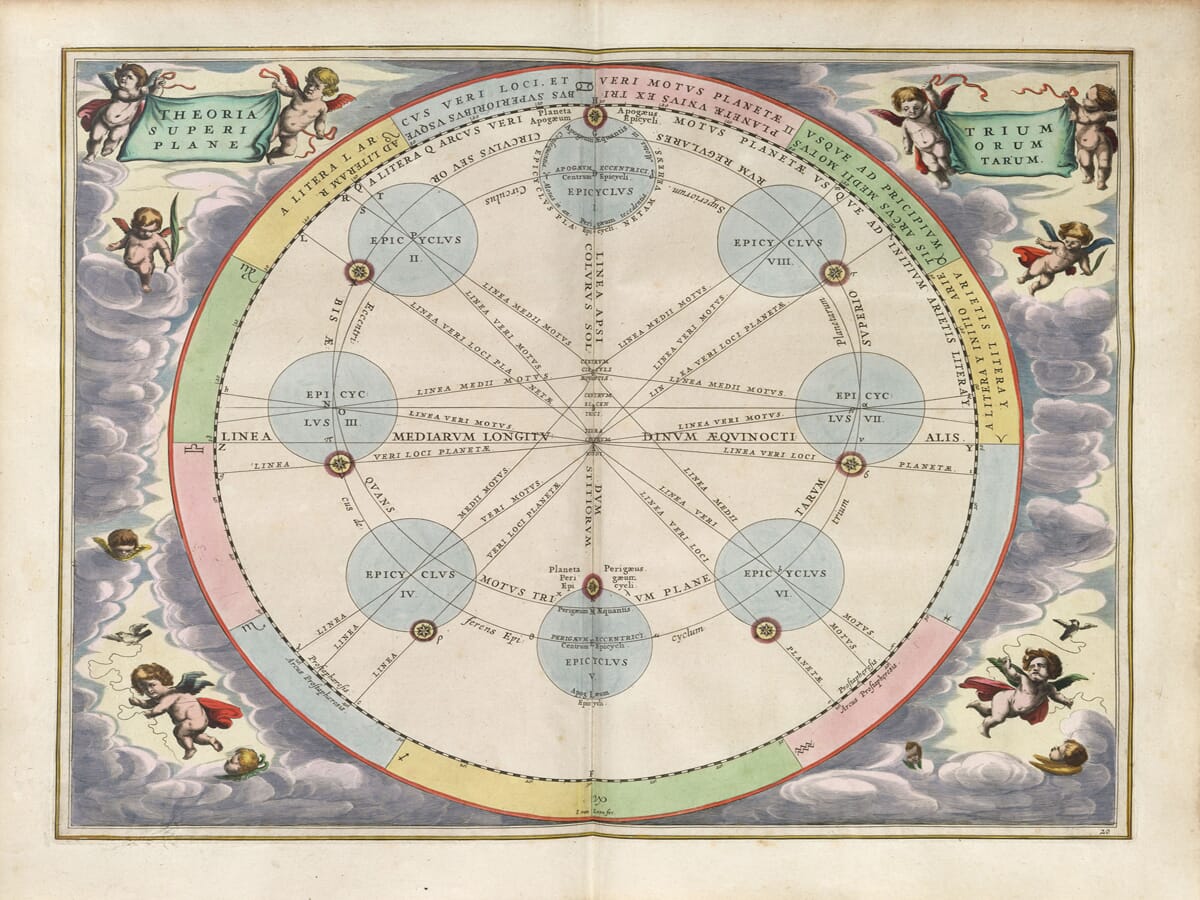
Eight blue circles give this antique astronomy chart a clear visual rhythm. They are epicycles: smaller circles used within an older geometric explanation of planetary motion. The title identifies the subject as the theory of the three superior planets, Mars, Jupiter and Saturn. Andreas Cellarius included this diagram in Harmonia Macrocosmica, with the engraving credited to Johannes van Loon. Its numbered positions, radiating lines and zodiac border make the sheet an explanation of motion rather than a portrait of the planets themselves.
Map Details
- Original title: Theoria Trium Superiorum Planetarum
- Chartmaker: Andreas Cellarius
- Engraver: Johannes van Loon
- Source atlas: Harmonia Macrocosmica
- First published: Amsterdam, 1660, by Johannes Janssonius
- Edition reproduced: Exact issue unconfirmed
- Subject: Historical models of the motions of Mars, Jupiter and Saturn
- Original format: Engraved atlas plate with colour
What “superior planets” means here
The historical grouping in the title distinguishes Mars, Jupiter and Saturn from Mercury and Venus. It is an astronomical category, not a judgement that these planets are better or more important. The chart considers their motions through a shared geometric scheme. A single diagram can therefore represent relationships common to the group without drawing three separate, recognisable modern planets.
That point is helpful when looking at the small golden discs around the blue circles. Their positions are markers within the construction. The plate is not showing a set of spacecraft views, surface features or accurate relative diameters. Its subject lies in the labelled paths and the geometry joining them. The decorative discs give the eye something to follow as it moves around the numbered positions.
Following the eight epicycles
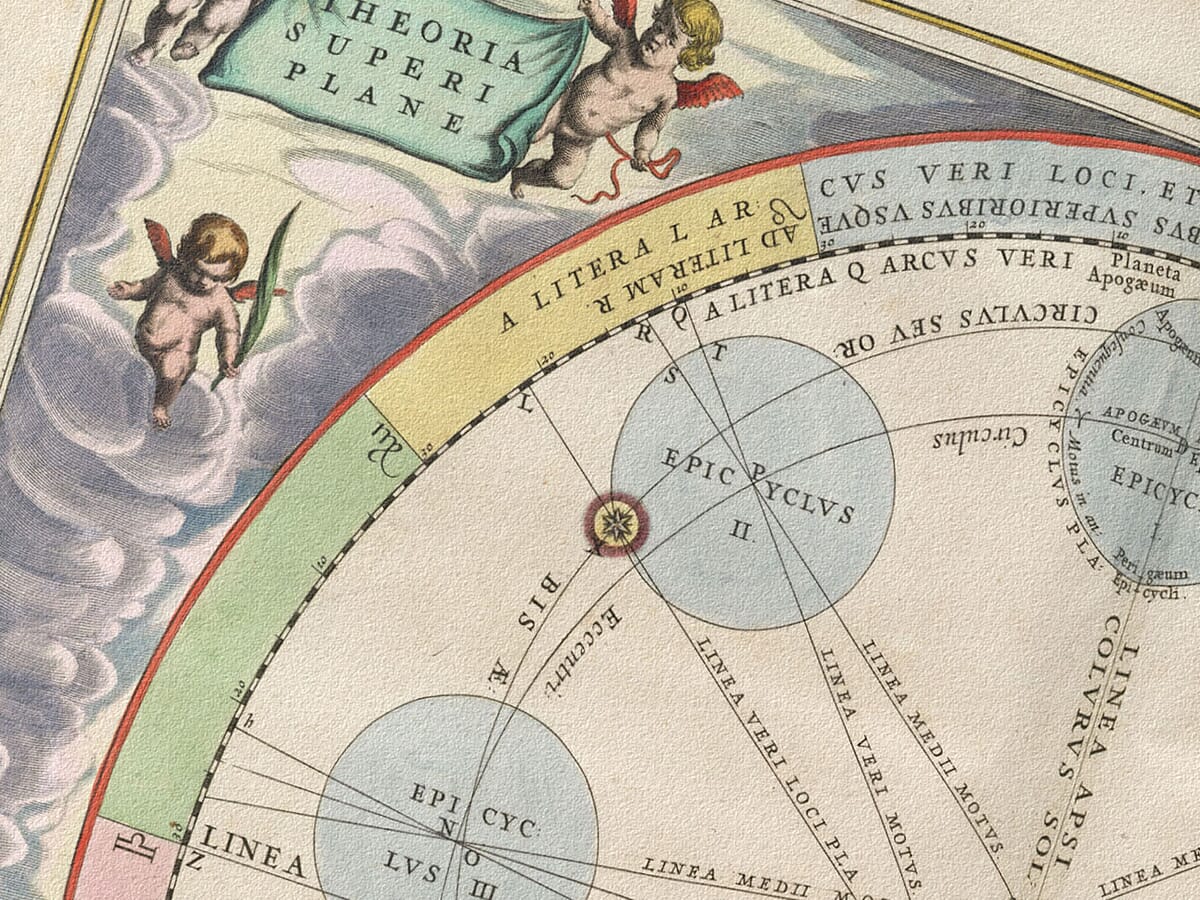
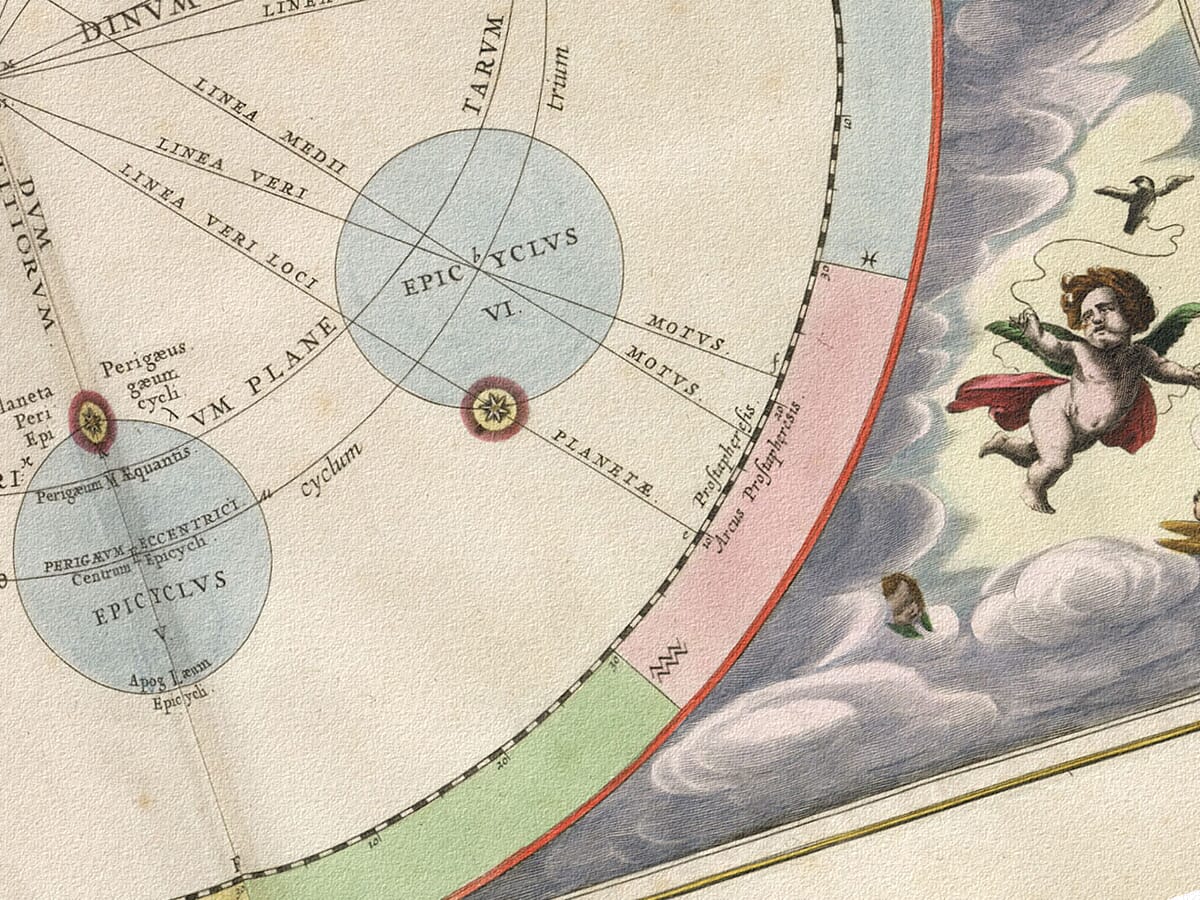
The pale blue circles are arranged at the top, bottom and intermediate points around the main field. Roman numerals identify the successive epicycles, while fine straight lines connect points on them to centres and reference lines within the diagram. Several of these lines cross close to the middle, creating a dense but carefully organised network. Across the central horizontal axis, larger lettering marks the line of mean longitudes and the equinoctial reference.
In a historical epicycle model, a body moves on a smaller circle whose centre itself follows a larger path. This combination could be used to account for changes in apparent planetary motion, including the backward movement seen against the stars. The smaller circle is therefore part of the explanatory machinery. It should not be confused with a modern planet’s moon orbit simply because the diagram contains circles within circles.
A historical theory on a printed page
The inscription includes words distinguishing true and mean motion, and other labels mark different parts of the construction. Such distinctions show the plate’s purpose: to connect an observed or apparent position with a geometrical model. The chart belongs to the history of calculating and predicting where a planet would appear in the sky. It does not describe the modern physical cause of orbital motion.
This is plate 20 of the atlas, where the caption identifies a common theory for the three superior planets. Its position within the series matters: Cellarius examines particular kinds of motion as well as presenting complete cosmological systems. The reader moves from broad pictures of the heavens to more specialised diagrams in which the paths, centres and reference lines become the main subject.
Colour and the surrounding figures
A pastel zodiac forms the outside ring, with names and symbols written in each compartment. Pink, green and yellow sections alternate around a narrow numbered border. Blue epicycles stand out inside this ring without overwhelming the fine lettering. The restrained central palette allows the diagram’s pattern to remain visible from a distance, while close inspection reveals its calculations and annotations.
The corners are more animated. Small winged figures hold the green title banners above, and others move through blue-grey clouds along the sides. The title is divided between the two upper banners to leave the large circular scheme uninterrupted. The combination of a precise diagram and a cloud-filled frame is characteristic of the way this atlas presents astronomical knowledge as both a subject of calculation and a visual spectacle.
Harmonia Macrocosmica first appeared in Amsterdam in 1660, published by Johannes Janssonius. The exact issue behind the source image has not been established. The reproduction is a modern fine art print, preserving the plate’s central fold, engraved lines and coloured epicycles. Its distinctive character comes from the relationship between those eight simple blue forms and the much finer geometry that connects them.




 Verified owner