
 Verified owner
Got there in time and loves it! Cheers David [Gift from US to UK]
 Verified owner
Thanks Lauren. We received it today - it's gorgeous! Thank you, Ellan
 Verified owner
Thank you for your prompt service. I have a gallery and framing business in South Wales. I'm so pleased it is printed in the UK
 Verified owner
My Isles of Scilly map arrived safely and I'm delighted with it!

The print arrived safely and we're delighted with it - a lovely reminder of our honeymoon 15 years ago.
 Verified owner
I have just received them! I'm sure our clients will be pleased with them and there could be more projects off the back of this one where we can use more. [Interior Designers]
 Verified owner
I just received my map of Ireland by Ewart today and, as usual, I am delighted by its quality. The crispness and fineness of detail is excellent and the colour reproduction surpasses my expectations. Please relay my thanks to Steve for another fine effort!
 Verified owner
Many thanks, Lauren. Very pleased with the map and the service: would recommend The Old Map Company to anyone interested in Old Maps.
 Verified owner
Many thanks, the map arrived safely this morning, and I’m really pleased with it. A stunning reproduction, just as I had hoped. I will keep browsing your website, and may yet be tempted by more of your items! Have a great weekend.
 Verified owner
Just arrived, wonderful map! Thanks very much!
 Verified owner
The map – beautiful – arrived safely, very many thanks.
 Verified owner
Thank you, I have already found the map. It’s wonderfull! Good luck! Rasa
 Verified owner
My apologies for the very late reply. I wanted to reach out to thank you so much for rushing my order. My partner absolutely loved it. I am amazed with the service so that is a five-star from me. I wish you all the best.
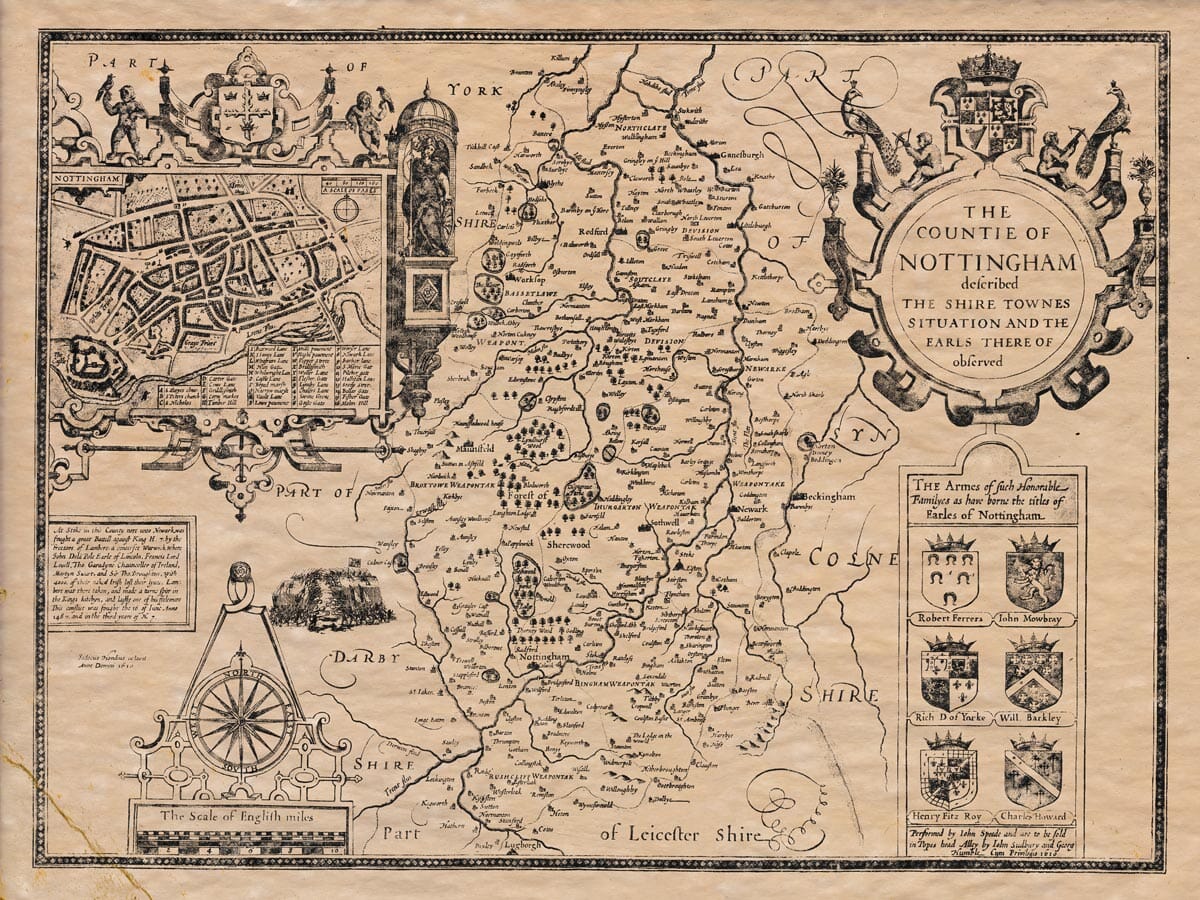
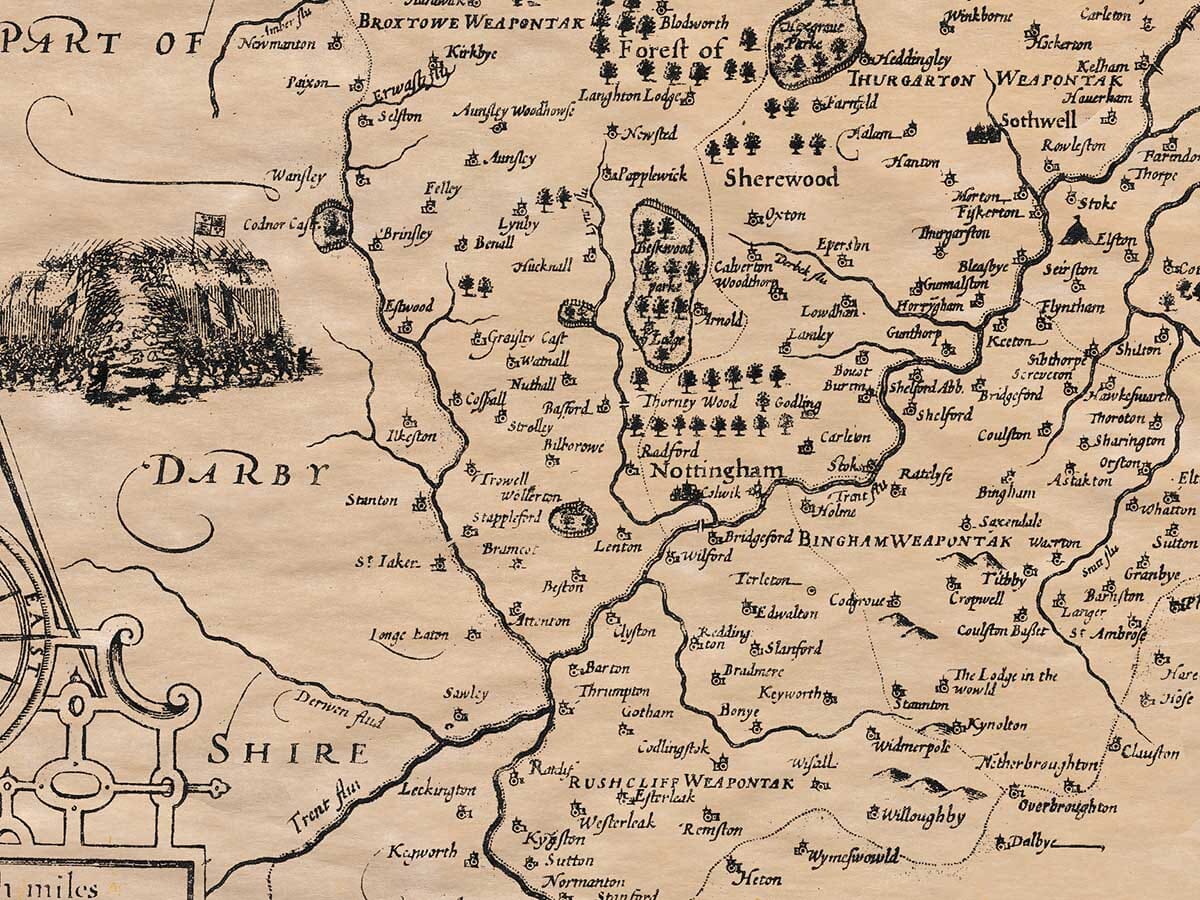
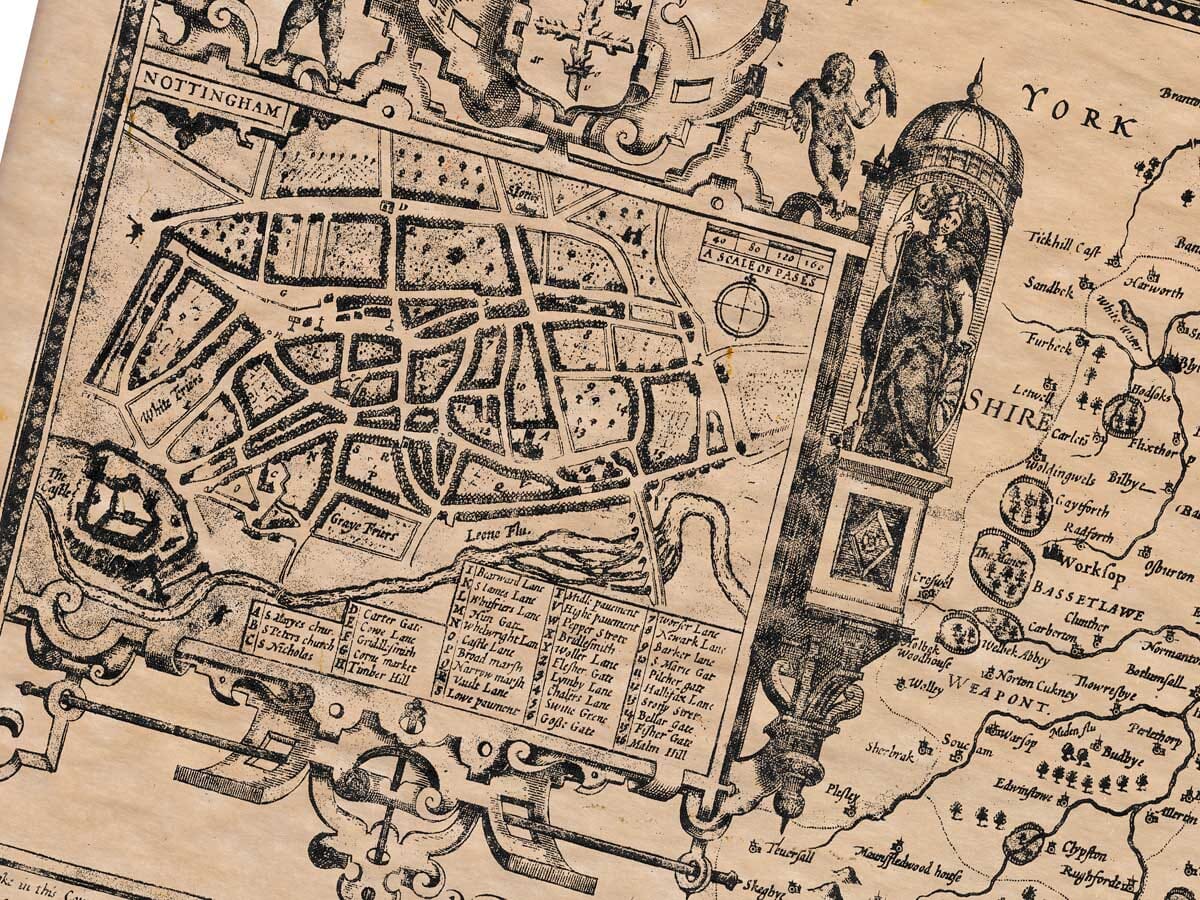
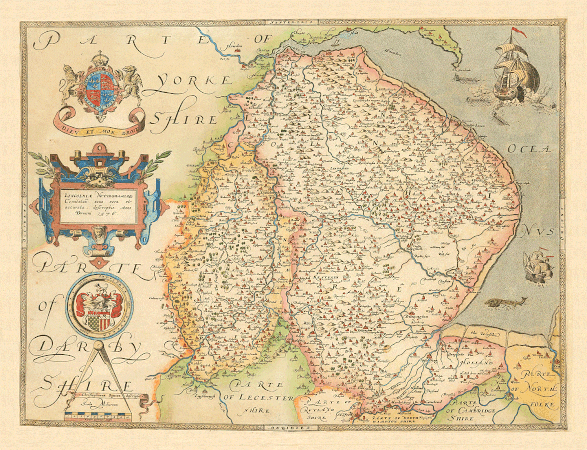
Speed’s Nottinghamshire gives Sherwood Forest a prominent place among the county’s river valleys and wapentakes. Nottingham, Newark, Mansfield, Worksop and Retford connect the dense settlement detail with familiar places. A separate Nottingham plan fills the upper-left corner; a battle scene, heraldic shields and peacock ornament add smaller details to examine around the map.
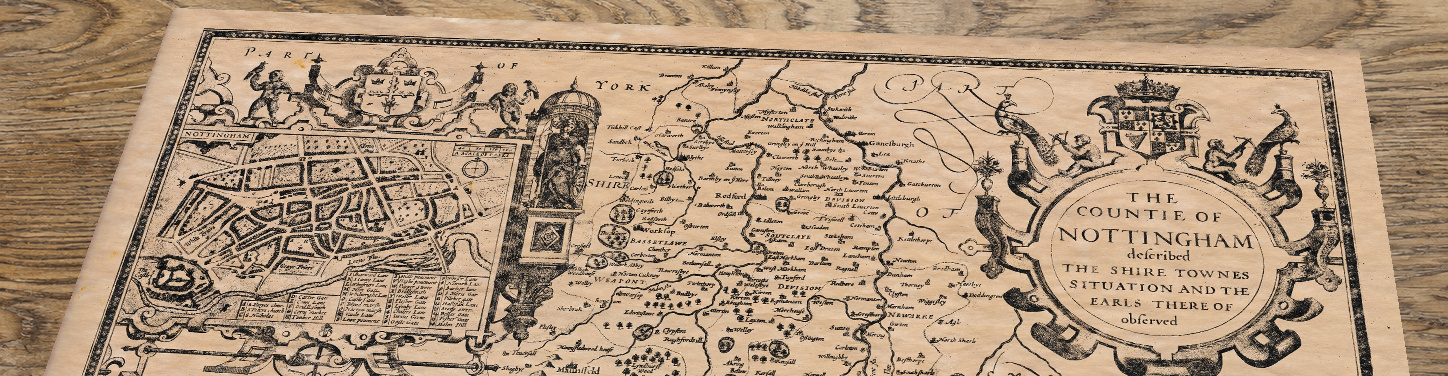
The county map follows the Trent past settlements including Newark and Nottingham, with Mansfield, Worksop and Retford elsewhere in the landscape. Woodland symbols distinguish Sherwood from the surrounding countryside. The inset provides a closer view of Nottingham’s streets and buildings, supported by a key. Near the lower left, the battle illustration recalls Stoke in 1487, an earlier conflict commemorated on the map. Peacocks and other ornamental figures around the cartouches give this sheet a recognisable decorative identity. These details make it useful to read the map at two scales: first as a county landscape, then as a collection of town and historical records.
John Speed’s published county map was accompanied by a detailed historical description of Nottinghamshire. The historical account below is retained in its existing adapted form, including any period wording. It reflects the beliefs and geographical knowledge of its period; historical claims and judgements should be read in that context.
(1) Nottinghamshire (from Nottingham, the chief town that gives the county its name; and possibly derived from the Saxons’ Snosengaham, due to the many dens or caves worked into its rocks and underground) lies bordered on the north and northwest by Yorkshire; to the east, at some distance by the River Trent, is Lincolnshire; to the south is Leicestershire; and to the west, by the River Erewash, it is separated from Derbyshire.

(2) The county is long and oval-shaped, doubling in length compared to its width. Its rivers are well-distributed and flow from Frinley in the north to Steanford in the south, about 38 English miles; west to east, from Teversal to Bebhop is a bit more than 19 miles, so the total circuit is about 110 miles.
(3) The air is good, wholesome, and pleasant; the soil is rich, sandy, and clayey. According to the names of the county divisions, it’s fruitful in corn and grass, with excellent woods, waters, and fields abundant in game.
(4) There is a kind of stone found here called Alablaster, used for plaster, and considered better than the one from Paris. It’s used for upper rooms and flooring, being tough and solid like mortar. In the west near Worksop, there’s an abundance of excellent liquor.
(5) Further south, in Stoke, in the reign of King Henry VII, a battle was fought between John de la Pole, Earl of Lincoln (supporting Richard III) and the king’s forces. John died in the battle, and Lambert Simnel, whom they had tried to set up as king, was taken. After several more troubles, King John made peace at Newark.
(6) Trade and commerce are active, with 10 market towns. Nottingham is the greatest and best of them: a beautiful town, seated on a hill with strong buildings and broad streets. Its market is spacious and among the best in the land. Many storage vaults have been carved into the rocks of the town. The castle has special note, with engravings of Christ’s Passion, and was once the prison of David II, King of the Scots. Another legend tells how Lord Mortimer was captured there during King Edward III’s reign, giving the name Mortimer’s Hole to the staircases and rooms made within the rock. There are houses with winding stairs, windows, and chimneys all carved from solid rock.
The castle is strong, and once kept by the Danes against Burhred, Ethelred, and Alfred the Great, with a stone raised by King Edward the Elder, believed to mark the foundation. Nearby, the River Trent runs, and one may see how the castle and streets are built on stone. The entire circuit of the town is about two miles.
(7) In the wars between Stephen and Maud the Empress, Robert, Earl of Gloucester, destroyed the castle walls. Though it suffered during the Wars of the Roses, it has since regained beauty and wealth. Now, it is governed by a mayor and aldermen, with several officers including sheriffs, sergeants, and others. The town holds significant status in this region.
The county contains several religious houses, especially in Newstead, Lenton, Shelford, Southwell, Thurgarton, Blyth, Welbeck, and Radford. In Nottingham itself are both white and gray friars, and a chapel dedicated to St. John.
(8) The shire’s land is mostly sand and clay. For government purposes, it is divided into eight Wapentakes (or Hundreds), with 168 Parish Churches.