
Chapter 4
The seventeenth and early eighteenth centuries transformed mapmaking in Britain. Publishers became increasingly influential, Dutch engraving set an international standard, and new surveys brought roads, estates, coastlines and entire counties into sharper focus. Between 1601 and 1755, maps developed from decorative adaptations of earlier work into increasingly practical tools for travel, navigation, land management and government.
Publishers and County Maps, 1601–1610
In 1601 a group destined to dominate English cartography for more than two centuries began to emerge: the commercial map publishers. Between 1601 and 1603, a map of the British Isles and maps of twelve English counties were offered for sale. Most bore neither date nor imprint, but they were probably engraved and printed in Antwerp and published by Hans Woutneel, a Flemish engraver living in London and a friend of Abraham Ortelius.

Hans Woutneel’s Map of Hertfordshire
Although closely based on the maps of Christopher Saxton and John Norden, Woutneel’s county maps were presented as a consistent series. Roads and hundreds appeared throughout, and several of Norden’s symbols were adopted. English publishers soon followed. The 1607 edition of William Camden’s Britannia included a complete set of smaller county maps, mostly copied from Saxton and Norden. Many were finely engraved by William Hole, one of the earliest English engravers also known for engraving music.
John Speed and The Theatre of the Empire of Great Britaine

The Theatre of the Empire of Great Britaine
John Speed’s The Theatre of the Empire of Great Britaine, first published in 1611–12, became the best-known early English atlas. Speed was a member of the Merchant Taylors’ Company with a strong interest in history and cartography. With the support of Sir Fulke Greville, he wrote a History of Great Britaine; the maps originally intended to illustrate it became the more enduring achievement.
Many of Speed’s county maps drew heavily upon Saxton and Norden. Their appeal lay in the way existing geography was combined with coats of arms, historical notes, decorative figures and inset town plans. The plans are especially valuable because they preserve early views of many English and Welsh towns. Descriptive text printed on the reverse gave readers a compact history and geography of each county.
Speed used the best information available to him. He revised several counties with help from local antiquaries and included maps of the Isle of Man and Isle of Wight derived from earlier surveys. For Ireland and Scotland he drew upon maps published in Mercator’s atlas.
The maps were engraved in Amsterdam by Jodocus Hondius, whose workshop possessed the skill, presses and copperplates required for such an ambitious publication. The success of the Theatre demonstrated the commercial life of an engraved plate: it could pass between publishers and be reissued for decades, sometimes with little more than a new imprint or altered cartouche.

John Speed’s Map of Gloucestershire, Showing the Forest of Dean
Samuel Pepys referred to “Speede’s Mapps” in 1662 while considering timber supplies for the Navy. The maps remained popular long after Speed’s lifetime. Modern reproductions later introduced another generation to their decorative county views, including The Old Map Company’s “Your County in 1610” series.
Explore our reproduction of John Speed’s old map of Gloucestershire.
Dutch Atlases and the Golden Age of Map Publishing
While England was moving towards civil war, the Dutch Republic was becoming the centre of the European map trade. By about 1640, Dutch workshops supplied customers across Europe with richly engraved atlases, sea charts, town plans and books of views. By 1650, Joan Blaeu and Johannes Janssonius were issuing rival atlas maps derived from Speed and other earlier authorities.
Copyright protection was limited, and mapmakers freely copied and adapted one another’s work. Skilled Dutch engravers often reorganised the crowded decoration of earlier English maps into clearer and more balanced compositions. During the Civil War, older English plates also returned to service: Saxton’s atlas was reissued in 1645, Speed’s in 1646, and a version of Saxton’s large map of England appeared in 1644 with military usefulness in mind.
Estate Maps and Practical Surveying

Thomas Martyn’s Map of Cornwall
Manuscript estate maps multiplied rapidly after 1603. Merchants establishing country estates, colleges examining their scattered properties, and landowners resolving boundaries and rents all needed reliable surveys. Enclosure disputes created further demand.
These working maps gradually became more informative. From the 1630s, surveyors often included small figures of people ploughing or harvesting, cattle grazing and carts travelling along roads. Such scenes could help distinguish arable fields from pasture and major roads from lanes. Surveying also became more consistent after Edmund Gunter’s chain, measuring 22 yards, came into use during the 1620s, although local or “customary” miles remained common.
Sea Charts and Robert Dudley’s Arcano del Mare

Manuscript Chart by William Hack, c. 1687
Dutch chartmakers continued the work begun by Lucas Waghenaer, and their great sea atlases became essential to mariners of many nations. Important English manuscript charts also survived, including records associated with the voyages of Henry Hudson and William Baffin.
The most remarkable English chartmaker of the period was Robert Dudley. The son of Robert Dudley, Earl of Leicester, and Lady Douglas Sheffield, he left England in 1605 after failing to establish his legitimacy and spent the rest of his life in Florence.
Dudley’s Arcano del Mare—The Secret of the Sea—was published in 1646–47. It was the first sea atlas to present all its charts on the Mercator projection. It also recorded prevailing winds, currents and magnetic declination, although the declination figures were not always reliable. Its elegant engraving, abundant compass roses, ships, soundings and coastal shading made it both a practical and visually impressive work.

Chart of the Arabian Sea from Robert Dudley’s Arcano del Mare, 1646
John Ogilby and Britain’s First Road Atlas
After the Restoration, scientific enquiry and practical surveying flourished. John Ogilby—at different times a dancing master, theatrical impresario, translator and publisher—brought exceptional organisational skill to cartography.
His county maps of Kent, Essex and Middlesex revived several of Norden’s principles, including roads shown by double lines, indexed place names and defined symbols. His greatest contribution, however, was Britannia, published in 1675. Across 100 engraved plates it presented the principal roads of England and Wales as continuous strip maps at a scale of one inch to the mile.

Section of Ogilby’s Road from London to Holyhead
The routes generally began at the Standard in Cornhill, London. Crossroads, bridges, hills, county boundaries, inns and other landmarks appeared in sequence, while dots marked furlongs and compass roses showed changes of direction. Surveyors measured the roads with wheeled perambulators whose revolutions recorded distance. Britannia was the first engraved road atlas to use the statute mile consistently.
Its influence was immediate. Roads became standard features on later county maps, and reduced road books based on Ogilby’s survey remained in circulation throughout the eighteenth century.
Seller, Collins and the Mapping of Britain’s Coasts

From Greenvile Collins’s Great Britain’s Coasting Pilot, 1693
After 1675 the history of British cartography became increasingly intertwined with publishers and their ability to combine advances in surveying, navigation, engraving and geographical knowledge. John Seller produced maps and charts for a growing market, while Captain Greenvile Collins’s Great Britain’s Coasting Pilot provided a systematic printed survey of the coasts of Great Britain and Ireland.
Map symbols also became more elaborate. Cities, market towns, villages, bishoprics, post towns, medicinal springs, Roman sites, mills and parliamentary boroughs could all be distinguished. Lettering, reference grids and scales improved, though publishers did not yet follow a completely uniform system.
London Surveyed: Morgan and Rocque
Town plans flourished in the late seventeenth and early eighteenth centuries. The great plan of London surveyed by John Ogilby, William Morgan and their associates, and published by Morgan in 1682, was among the most impressive engraved in England. At approximately one inch to 300 feet, it recorded streets, lanes, churches, hospitals, inns, yards, courts and alleys in remarkable detail.

London Actually Surveyed by William Morgan, 1682
John Rocque, a French-born surveyor and engraver active in England from the 1730s, developed a distinctive style. His plans carefully differentiated gardens, fields, pasture, heath and other land uses as they appeared from above. He also depicted hills in plan, using denser shading for steeper slopes.
Rocque’s celebrated large-scale plan of London appeared in 1746, accompanied by a detailed index. His county maps of Middlesex, Berkshire, Shropshire and Surrey brought the close observation of manuscript estate surveys to a wider printed audience.

Detail from John Rocque’s Map of Middlesex, 1754
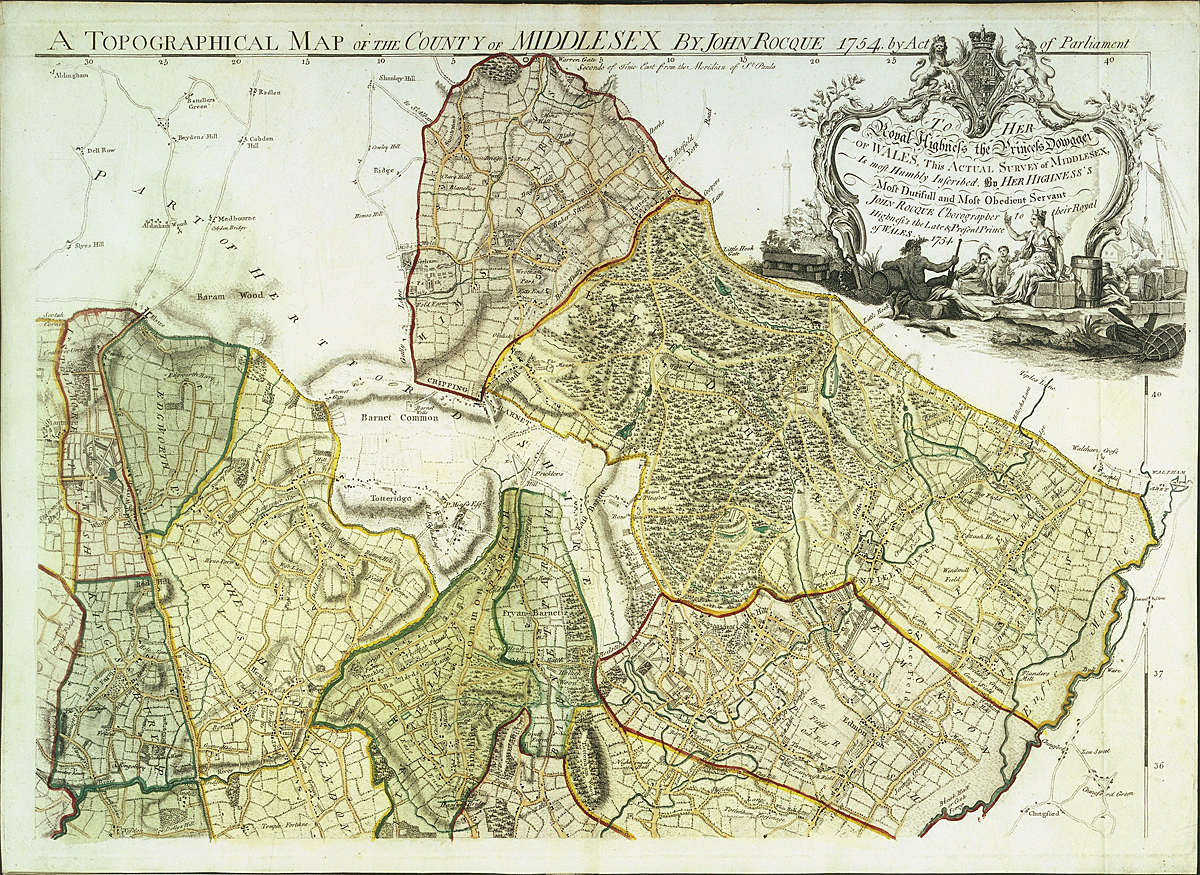
Tottenham and North-East Middlesex from John Rocque’s Map of 1754
See the related Middlesex map by John Rocque.
Enclosure, Decoration and the Eighteenth-Century Landscape

Dodderhill, 1770
Estate surveyors played an important role in recording enclosure. Their manuscript plans were often large and richly lettered, reflecting the fact that provincial surveyors frequently taught writing and mathematics as well as measuring land. These documents preserve field names, boundaries, roads, buildings and patterns of ownership that may otherwise have disappeared.
Printed maps also reflected changing artistic taste. Seventeenth-century baroque cartouches were filled with fruit, flowers, cherubs, ribbons and classical sea gods. During the eighteenth century, allegorical figures and scenes of local work became fashionable. Bowen and Kitchin’s Large English Atlas is a notable example, with decorative groups representing the agriculture or industries of individual counties.

Detail from Hertfordshire in Bowen and Kitchin’s Large English Atlas
Mapping Ireland
After the Cromwellian conquest, Sir William Petty directed the Down Survey to measure land intended for redistribution. It was the most extensive scientific survey of a large territory yet undertaken under English administration. County and provincial maps based upon Petty’s work were published in Hiberniae Delineatio in 1685 and remained influential for generations.
In 1752 John Noble and James Keenan published a large-scale map of County Kildare, an important work produced by Irish surveyors. Rocque went to Ireland during the 1750s and published detailed plans of Dublin and Cork, together with maps of counties Dublin and Armagh. Although indebted to earlier surveys, his maps were larger and more artistically presented.
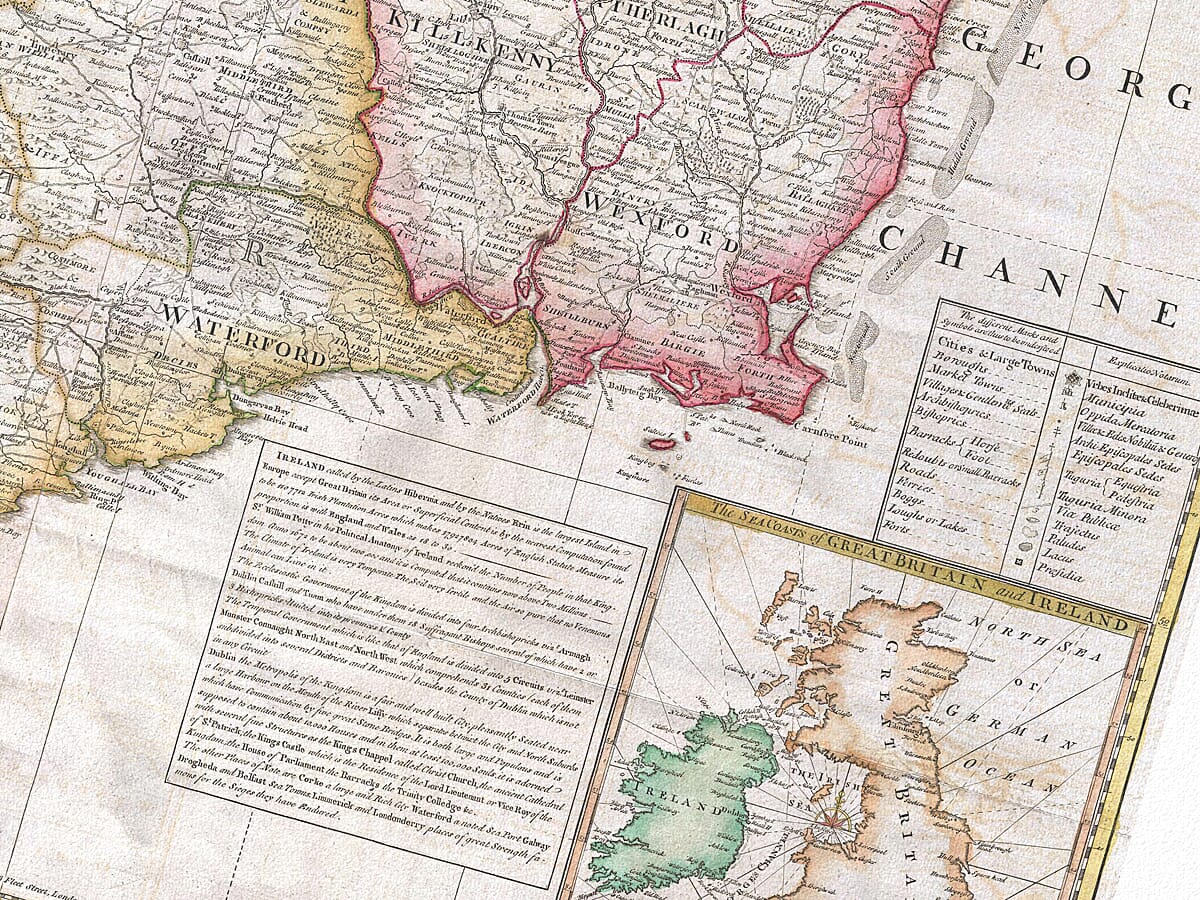
Detail from John Rocque’s Map of Ireland
Explore our reproduction of John Rocque’s old map of Ireland.
Scotland: From Timothy Pont to William Roy
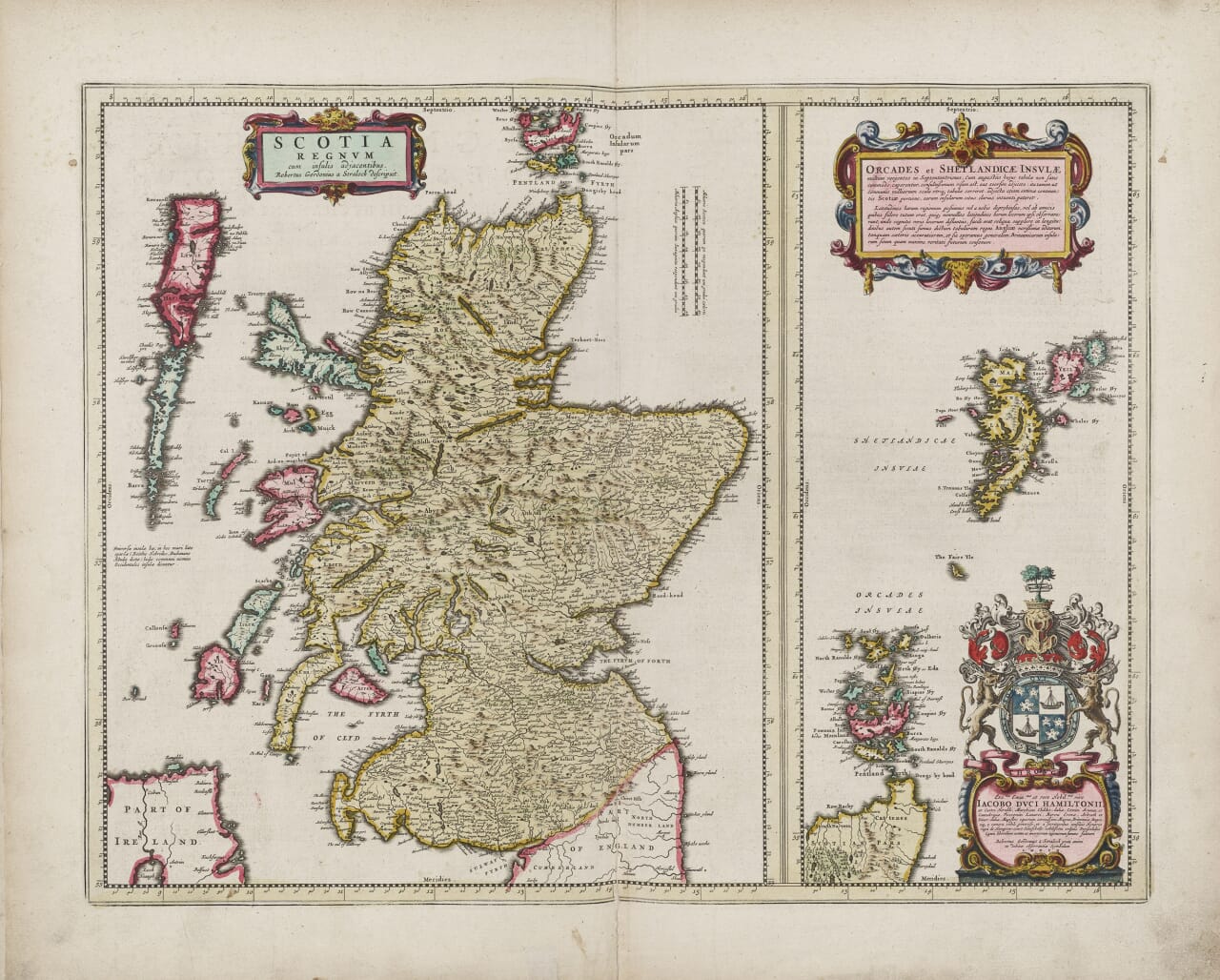
Timothy Pont travelled widely through Scotland between about 1583 and 1601, making topographical sketches that became the foundation for later mapping. After Pont’s death, Robert Gordon of Straloch worked to turn the surviving manuscripts into publishable maps. With support from Sir John Scott of Scotstarvet, they were engraved in Amsterdam and included in Joan Blaeu’s atlas of Scotland, published in 1654.
The Union of 1707 created a larger market for maps of Scotland. Herman Moll’s The North Part of Great Britain Called Scotland, published in 1714, offered an improved national outline. Government interest increased after the Jacobite risings. General George Wade began building military roads through the Highlands in 1725, creating a need for better topographical information.
Following the rising of 1745, a detailed military survey began in 1747 under Lieutenant-Colonel David Watson. Much of the fieldwork was carried out by William Roy, who rose from a junior role to become a leading figure in British surveying. Completed in 1755, the survey covered much of mainland Scotland at a scale of one inch to 1,000 yards and anticipated the systematic work of the Ordnance Survey.
Browse our collection of old maps of Scotland.
Explore Historic British Maps
Between 1601 and 1755, British maps became more numerous, more specialised and increasingly accurate. Speed and the Dutch atlas publishers established a market for decorative county maps; Dudley and Collins advanced the printed sea chart; Ogilby transformed road mapping; and the surveys of Petty, Rocque and Roy pointed towards a new era of measured national cartography.