
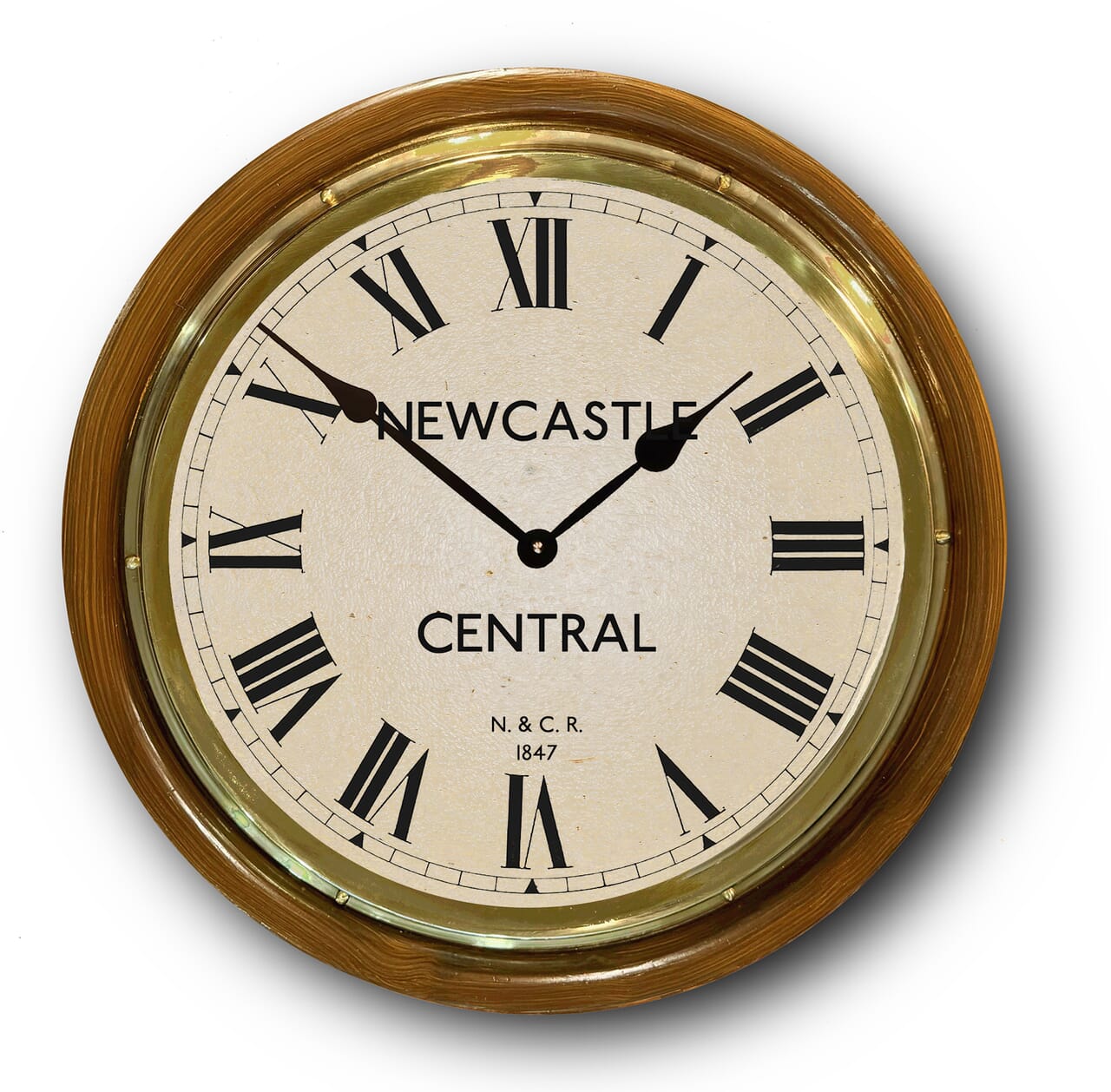
Traditional railway character, individually made for your home.
A closer look at the Newcastle Central Railway Station Clock. Click the photograph to enlarge.
UK delivery £4.95 per order · International delivery calculated at checkout.
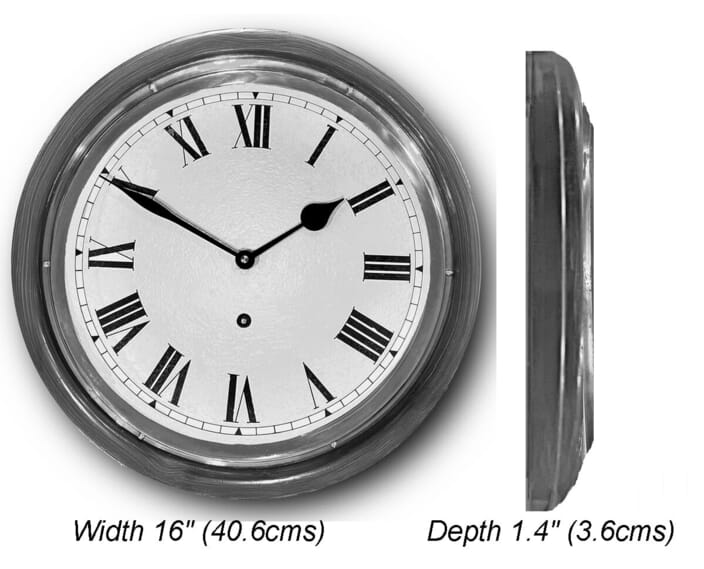
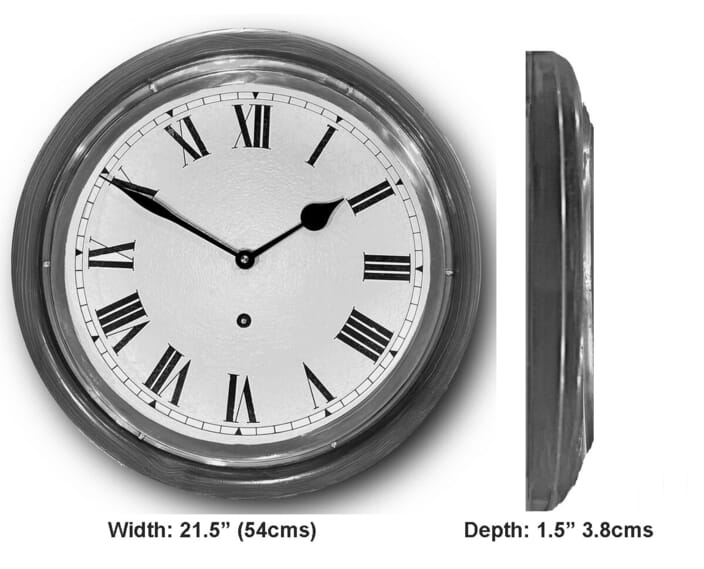
The historically correct substantial case provides further authenticity to the design, complemented by a protective glass lens secured by a traditional solid brass bezel.
Available in Medium 16″ and Large 21.5″, with Hand Grained or Black case finish. Made to order in the UK.
Newcastle Central Railway Station, located in the heart of Newcastle upon Tyne, England, has a fascinating history that dates back to the 19th century. Here's an overview of its history:

Picture Courtesy of Pictures of Gateshead
Before the construction of the current station, Newcastle had several smaller stations. The first significant station was Newcastle's Westgate Station, which opened in 1839 and was part of the Newcastle and Carlisle Railway. However, as the city's importance grew and the rail network expanded, a larger, more centrally located station became necessary.
The need for a new, central railway station in Newcastle was recognized in the mid-19th century. Construction of Newcastle Central Station began in 1850 and was completed in 1851. The station was designed by architect John Dobson and was built to accommodate the increasing number of passengers and freight traveling to and from the city.
Newcastle Central was originally designed with a large central train shed, which was a hallmark of railway stations of the time. The design featured a railway viaduct, which still forms part of the station's structure today, and a series of platforms connected by a grand concourse. The station also included extensive facilities for passengers, including waiting rooms and restaurants.
Over time, the station underwent several major expansions and renovations to keep up with the growing demand for rail services. Notably, in 1870, the original roof was replaced with a larger one, and the station was further expanded to accommodate trains traveling along new routes.
In 1906, the station’s impressive glass roof was again altered to accommodate modern trains and signals.
In 1923, following the grouping of various railway companies, Newcastle Central became part of the London and North Eastern Railway (LNER) network. This marked a new chapter for the station, as it became a key part of the intercity routes connecting London to the North of England and Scotland.
During the World War II, the station played an important role in transporting troops and war materials. Despite the damage caused by bombing raids during the war, the station continued to serve as a vital transport hub.
After the war, the station was modernized in several phases. In the 1960s, the station underwent a major transformation, with new platforms and an updated concourse.
In 1980, the station's main roof was replaced with a lighter and more modern design, which preserved the grandeur of the station's original architecture while introducing new materials and technology.
In the 2000s, Newcastle Central underwent further restoration, with the iconic roof and station buildings being carefully restored. The station now stands as a Grade I listed building, reflecting its architectural and historical significance.
In recent years, the station has continued to serve as a major transportation hub, with services to major cities including London, Edinburgh, and Manchester, as well as local and regional services. It remains one of the busiest railway stations in the UK.
Today, Newcastle Central Railway Station is known for its historical charm, combining elements of Victorian railway architecture with modern updates. The station is also part of the local city's skyline and a focal point for travelers heading both north and south. The station's design and historical importance make it a proud symbol of the development of rail travel in the North of England.
The station's continued importance in the UK rail network and its preserved Victorian charm make it a key part of Newcastle's identity and history.