

Traditional railway character, individually made for your home.
A closer look at the London Waterloo Railway Station Clock. Click the photograph to enlarge.
UK delivery £4.95 per order · International delivery calculated at checkout.
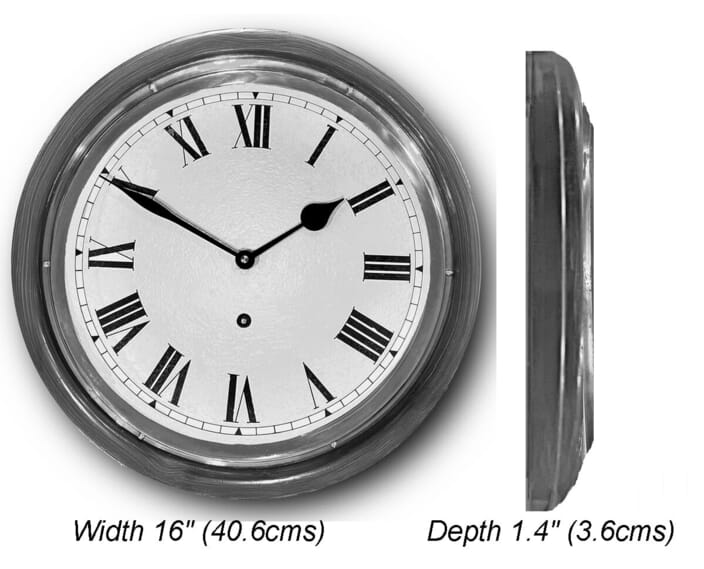
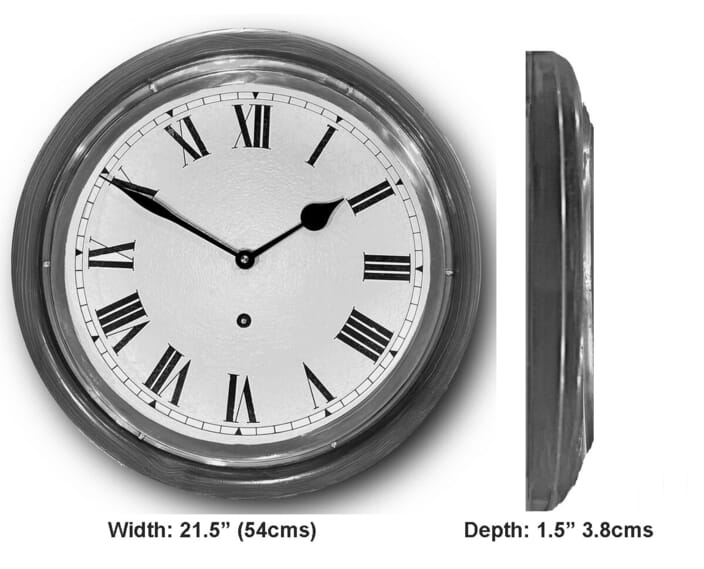
The historically correct substantial case provides further authenticity to the design, complemented by a protective glass lens secured by a traditional solid brass bezel.
Available in Medium 16″ and Large 21.5″, in Hand Grained or Black finish. Made to order in the UK.
London Waterloo Station, one of the busiest railway terminals in the United Kingdom, has a history dating back to the mid-19th century. Initially conceived as a solution to the growing demand for railway services, the station underwent several expansions and changes before becoming the major transport hub it is today.
Before Waterloo Station was built, the London and South Western Railway (LSWR) operated from Nine Elms Station, which had opened in 1838 as the railway’s first London terminus. However, as rail traffic increased, Nine Elms became inadequate, particularly because of its inconvenient location on the south bank of the Thames, away from central London.
To address this issue, LSWR planned a new terminus closer to the city. Their original intention was to extend the railway further into central London, but political and financial obstacles prevented this. Instead, they settled on a site near Waterloo Bridge, and in 1848, the new station, known as Waterloo Bridge Station, opened to the public.
When Waterloo Bridge Station opened on July 11, 1848, it featured a modest design with just four platforms, a small train shed, and a booking hall. LSWR ran services to Woking, Southampton, and other destinations in the south of England, catering primarily to business commuters and travellers heading to the coast.
The station was initially intended as a temporary solution, as LSWR still hoped to extend further into central London. This uncertainty led to a series of disorganized expansions rather than a well-planned development.
As demand for railway services grew, Waterloo underwent multiple expansions. However, instead of following a structured redevelopment plan, LSWR added new sections to the station in a piecemeal fashion.
In 1853, an extension added five new platforms, increasing the total to nine. Over the next few decades, further expansions took place, including additional platforms and new facilities. By 1875, Waterloo had more than a dozen platforms, but they were not numbered in sequence, making navigation difficult.

By 1885, the station was officially renamed London Waterloo, dropping the word "Bridge" from its name. However, the growing complexity of the station created confusion for passengers. Different sections of the station operated almost independently, and some areas had their own ticket offices, leading to inefficiency and frustration. By the 1890s, Waterloo had become notorious for its chaotic layout, with some passengers describing it as a "rabbit warren" of platforms and passageways.
By the end of the 19th century, it was clear that Waterloo needed a complete overhaul. The station’s disorganized layout and inefficient operations were no longer sustainable. In 1899, LSWR announced a £2 million redevelopment plan to transform Waterloo into a single, unified terminus. This ambitious project would take more than two decades to complete and would ultimately result in the modern Waterloo Station that stands today.

Although it began as a temporary solution, Waterloo Station quickly became an essential part of London’s railway network. Its early years were marked by rapid growth, unplanned expansion, and increasing congestion, all of which eventually led to the large-scale redevelopment that shaped the station into the landmark it is today.