

Traditional railway character, individually made for your home.
A closer look at the London Victoria Railway Station Clock. Click the photograph to enlarge.
UK delivery £4.95 per order · International delivery calculated at checkout.
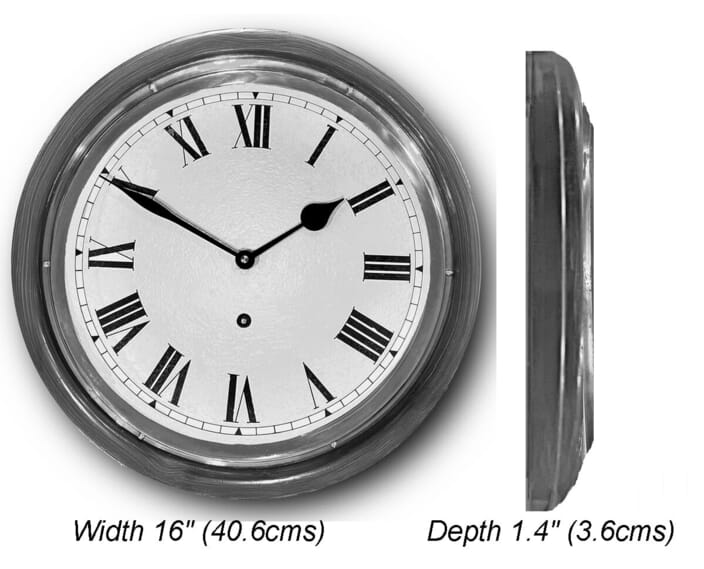
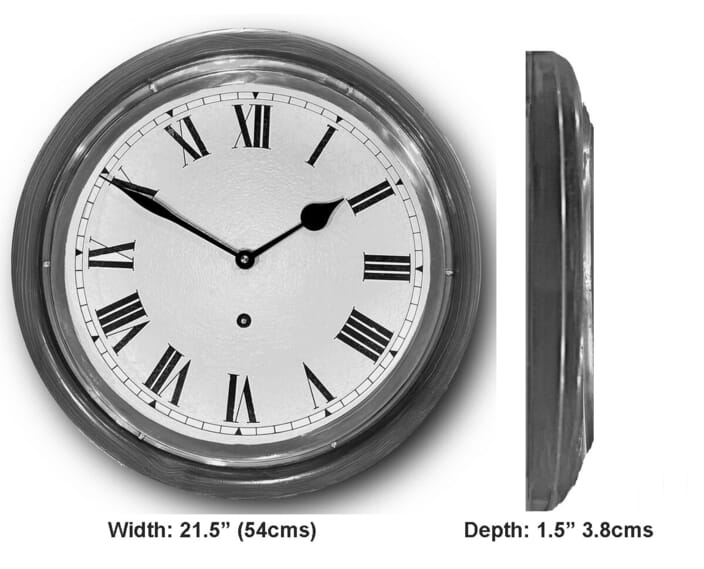
The historically correct substantial case provides further authenticity to the design, complemented by a protective glass lens secured by a traditional solid brass bezel.
Available in Medium 16″ and Large 21.5″, in Hand Grained or Black finish. Made to order in the UK.
Victoria Station: A Historical Overview
By 1850, railways serving destinations south of London had three termini: London Bridge, Bricklayers' Arms, and Waterloo. However, all were inconvenient for passengers heading to the City of London, the West End, and Westminster, as they terminated south of the River Thames. To address this, Victoria Station was developed for the London Brighton and South Coast Railway (LB&SCR) and the London Chatham and Dover Railway (LC&DR). Initially, it consisted of two separate, unconnected mainline stations.
The London and Brighton Railway's terminus at London Bridge provided access to the City but was inconvenient for Westminster travellers. In 1842, John Urpeth Rastrick proposed a branch line to the West End, but it was rejected. However, the relocation of the Crystal Palace to Sydenham Hill (1851–1854) created a major tourist attraction, prompting the LB&SCR to open a branch line from the Brighton Main Line at Sydenham to the site in 1854.
The West End of London and Crystal Palace Railway also planned a line from Crystal Palace to a new station at Battersea Wharf, near Chelsea Bridge. Despite its location, it was called Pimlico Station and opened on 27 March 1858. It was considered temporary, consisting of wooden huts next to a planned bridge over the Thames. Shortly after, the LB&SCR leased most of this railway’s lines and built another connection to Norwood Junction, establishing a route into West London. However, a terminus north of the Thames was still needed.
In the summer of 1857, plans emerged for an independent "Grosvenor Basin Terminus" in the West End for southern railways. Initially called "Grosvenor Terminus," it was later renamed Victoria Station, as it stood at the end of Victoria Street. Several railway companies sought a Westminster terminus, including the Great Western Railway (GWR), London & North Western Railway (LNWR), and East Kent Railway (EKR). These companies joined forces, forming the Victoria Station and Pimlico Railway (VS&PR) on 23 July 1859.
The new line followed part of the former Grosvenor Canal route, requiring the construction of a bridge over the Thames—Victoria Bridge (later renamed Grosvenor Bridge). Designed by John Fowler, the bridge spanned 930 feet (280 m) to clear river traffic. The line was built as mixed gauge to accommodate GWR trains and featured a steep climb and tight turn from the LSWR main line.
The LB&SCR hoped to merge with VS&PR and introduced a parliamentary bill in 1860, but it was opposed by the GWR and LC&DR and rejected. As a compromise, the LB&SCR leased Victoria Station but agreed to accommodate other railways until they built their own terminus nearby.
The LB&SCR station at Victoria opened on 1 October 1860, replacing Pimlico Station. Designed by Robert Jacomb Hood, it featured six platforms and ten tracks, covering 8.5 acres (3.4 ha). The roof, built with wrought iron girders, had an extra safety row for reinforcement. Adjacent to the station, the 300-room Grosvenor Hotel opened in 1861.
The LC&DR and GWR opened their own Victoria station on 25 August 1862. It had eight platforms, five of which were mixed-gauge for GWR services. Victoria quickly became popular, and by 1862, congestion at Stewarts Lane Junction prompted the construction of a new high-level route to bypass it, completed in 1867/68. The South Eastern Railway (SER) considered using Victoria but opted for Charing Cross instead due to high tolls.
Victoria also became known for luxury Pullman train services. The LB&SCR introduced the UK’s first Pullman service to Brighton in 1875 and the first all-Pullman train in 1881. The prestigious Southern Belle launched in 1908, later becoming the Brighton Belle in 1934.
Between 1898 and 1908, the LB&SCR station was rebuilt in a red-brick Renaissance style, designed by Charles Langbridge Morgan. The project extended platforms and added crossovers to handle more trains. At the same time, the LC&DR side was reconstructed, finishing in 1908. By then, Victoria covered 16 acres (6.5 ha) with 2.25 miles (3.62 km) of platforms.
In 1923, both Victoria stations came under the Southern Railway (SR) as part of the Big Four railway grouping. In 1924, SR integrated the two stations, renumbered platforms, and built connecting passages. Electrification of suburban services began, with lines to Orpington electrified in 1925 and the Brighton Main Line by 1932. The SR also introduced the Golden Arrow in 1924 and the Night Ferry in 1936, both luxury cross-Channel services.
During World War II, night train services ended, and the station was bombed multiple times but remained operational. A notable incident occurred on 15 September 1940 when a plane crashed into the eastern side. A flying bomb also caused damage on 27 June 1944.
After the war, British Railways (BR) took over on 1 January 1948. The 1950s saw extensive electrification, eliminating steam services by 1964. Victoria remained a major departure point for international travel, with services to Paris and the continent via Dover and Folkestone.
The Gatwick Express service launched in 1984, providing direct trains to Gatwick Airport in just 30 minutes. A dedicated rail-air terminal was introduced, allowing passengers to check in for flights at Victoria. However, with the launch of Eurostar in 1994, Victoria lost its international role.
In the 1980s, Victoria was redeveloped with the "Victoria Place" shopping center and office spaces. Platforms 16 and 17 were added in 1987. Today, Victoria remains a vital hub for Southern and Southeastern services, Gatwick Express, and the London Underground.
Despite its evolution, Victoria has retained its historic significance, welcoming royalty and international dignitaries more than any other London station. It remains a key gateway to London and beyond.
London Victoria Station stands as one of the most significant railway terminals in the capital, blending Victorian, Edwardian, and modern architectural influences. Originally constructed in the 1860s, the station has undergone numerous transformations, each contributing to its unique character and functionality. This article explores the architectural journey of Victoria Station, from its origins to its present-day form.
Victoria Station was initially built as two separate stations by competing railway companies:

Each company designed its own station, resulting in two distinct architectural styles. To the left is the London, Chatham & Dover Railway frontage and centre the Brighton & South Coast Railway (LB&SCR) both dwarfed by the Grosvenor Hotel to the rear. Early features included red brick and stone façades, large iron and glass train sheds, and separate booking halls, reflecting the fragmented nature of early railway development.