


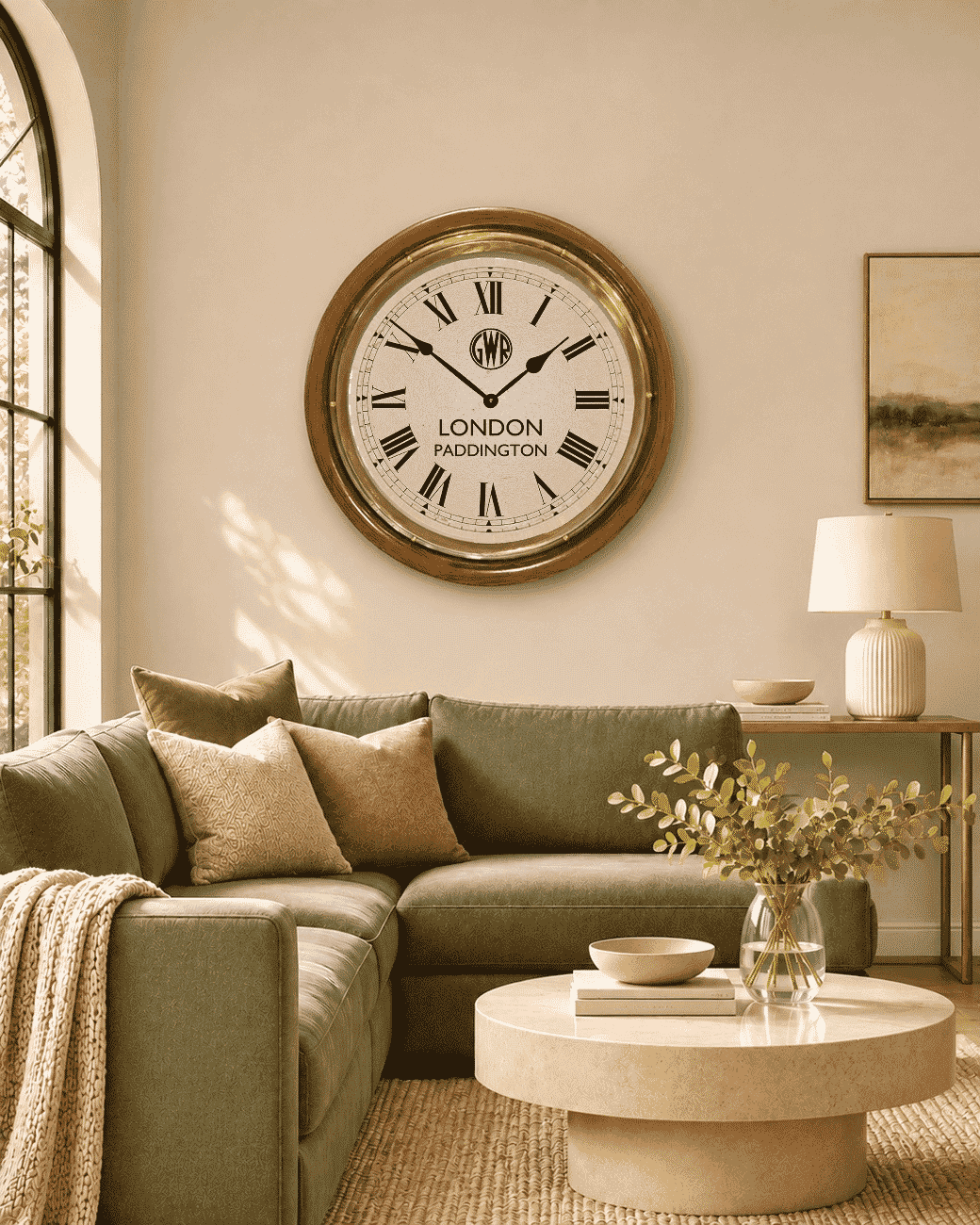
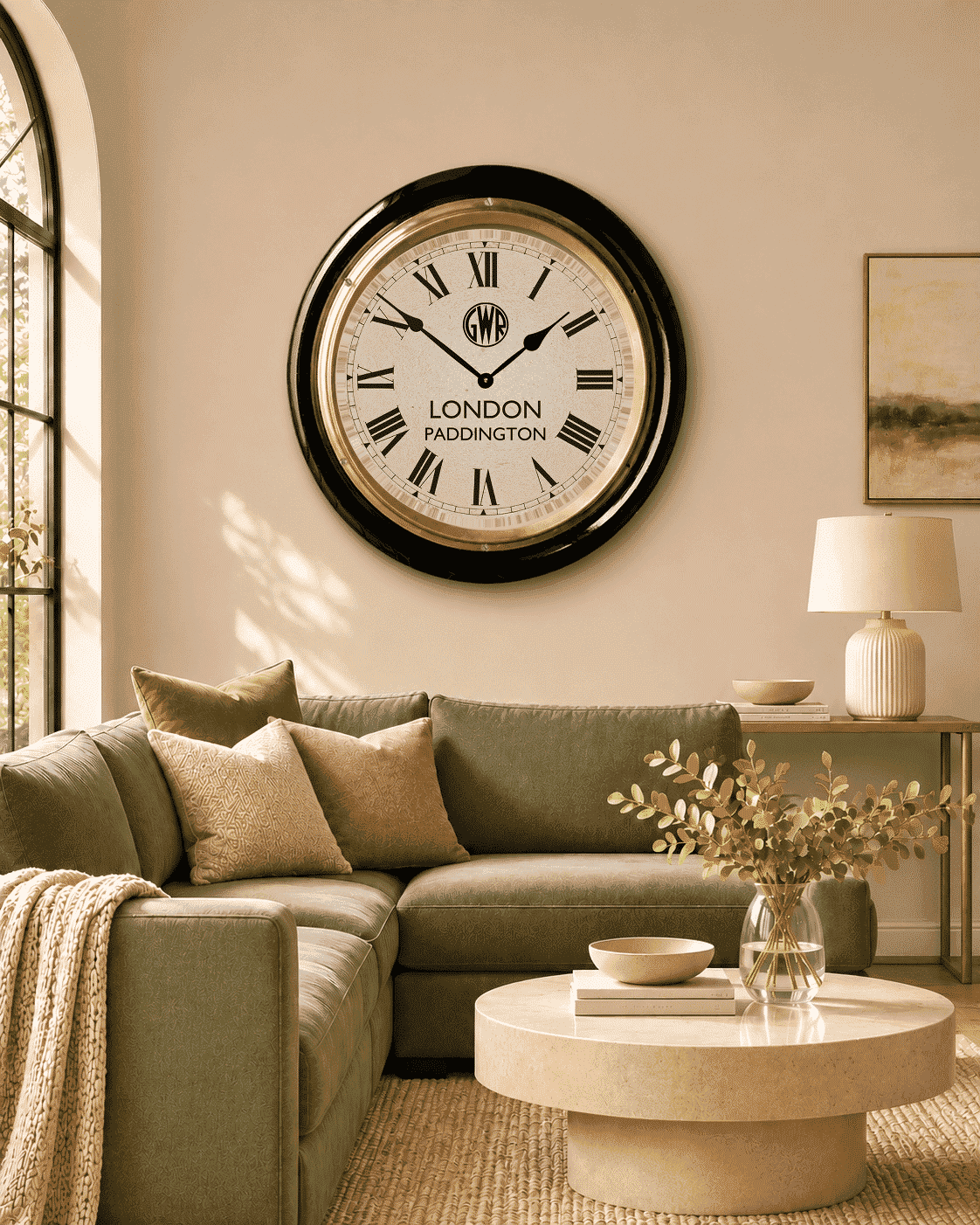
Description
The Cased Railway Clock
The historically correct substantial case provides further authenticity to the design, complemented by a protective glass lens secured by a traditional solid brass bezel.
Choose Medium 16″ or Large 21.5″, in Hand Grained or Black finish. Made to order in the UK.
Station History
London Paddington and the Great Western Railway
Paddington has been the London gateway to the Great Western Railway since its earliest years. A temporary terminus opened at Bishop’s Bridge Road on 4 June 1838, serving the new railway westwards from London. The line to Bristol opened throughout in June 1841, connecting the capital with towns and cities across western England.
Brunel’s Great Terminus
The growing railway soon needed a more ambitious station. Isambard Kingdom Brunel designed the permanent terminus, with architectural and decorative contributions from Matthew Digby Wyatt. Fully opened in May 1854, Paddington’s remarkable wrought-iron and glass train shed was arranged in three spans. Its design reflected the engineering optimism of the age and the influence of the Crystal Palace of 1851.
The Great Western Hotel opened beside the station in 1854, while the station’s offices and passenger facilities established Paddington as the public face of the railway. The original broad-gauge era gradually gave way to mixed-gauge operation, and the final broad-gauge express departed Paddington in May 1892.
A Working Station Across Generations
Growth brought further changes. Additional platforms and a fourth roof span were built in the early twentieth century, followed by remodelling in the 1930s. Paddington remained a major departure point for the West Country and Wales, its name closely associated with the Great Western Railway.
The clock design pays tribute to that railway heritage through its GWR emblem, Roman numerals and the station name on the dial. It is a modern reproduction inspired by historic railway timepieces, rather than an original station clock.
Historical background: Network Rail, The history of London Paddington station.