
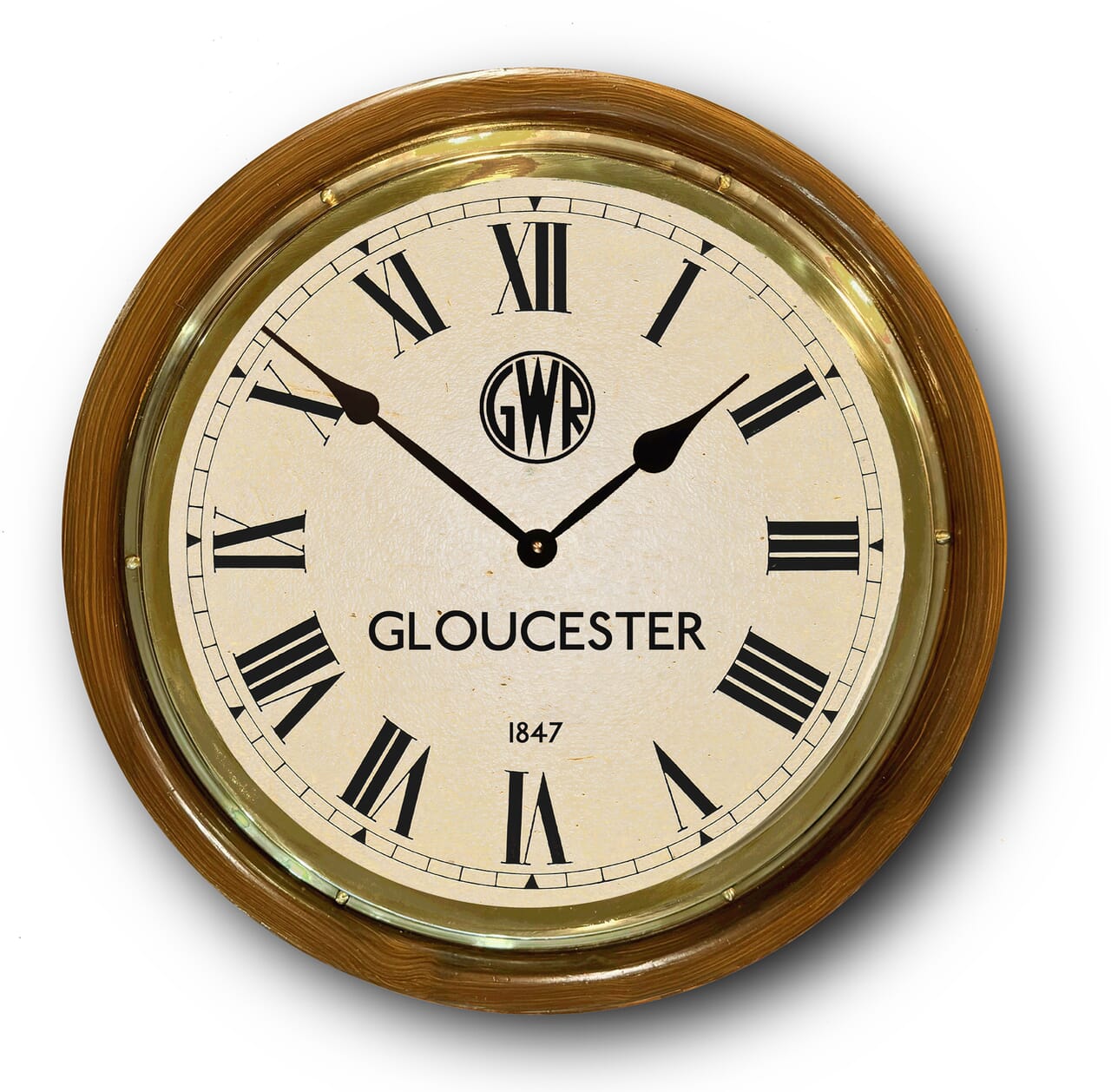
Traditional railway character, individually made for your home.
A closer look at the Gloucester Railway Station Clock. Click the photograph to enlarge.
UK delivery £4.95 per order · International delivery calculated at checkout.
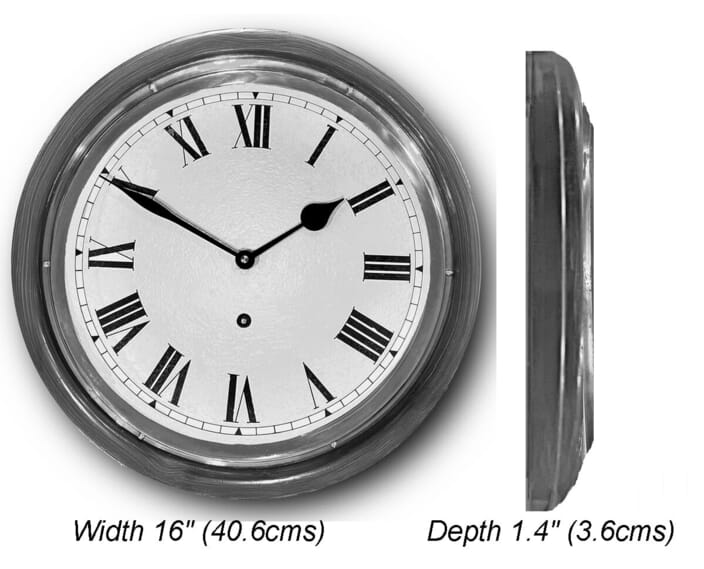
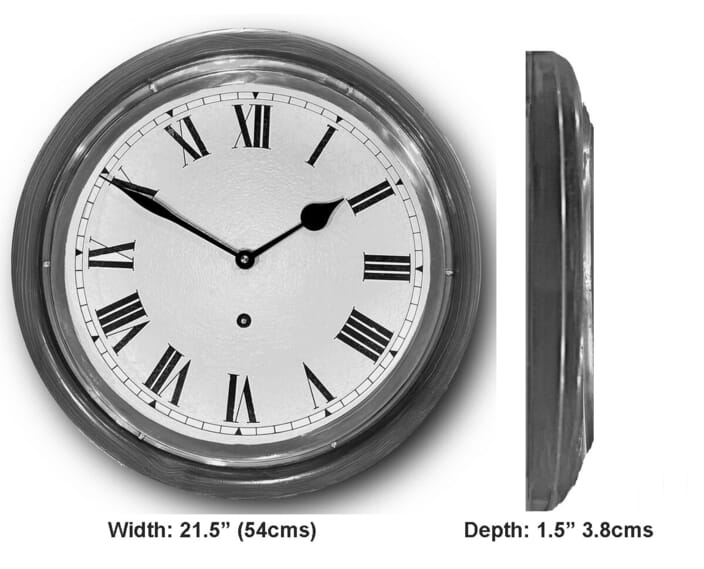
Choose either a wood-effect or gloss black case, each finished with a brass-tone inner bezel surrounding the reproduction Gloucester station dial. Metal hands and a glass lens complete the traditional appearance.
The development of railways in Gloucester was a complex process involving four different railway companies and five distinct stations. The first railway to open was the Birmingham and Gloucester Railway, a standard gauge line that commenced operations on 4 November 1840. This line from Cheltenham utilized a formation constructed by the Cheltenham and Great Western Union Railway (C&GWU). The initial station was a temporary terminus near the cattle market, intended to be replaced by a more permanent structure closer to the docks, but this relocation never occurred. Consequently, this station's location determined the site of Gloucester’s current station.
On 8 July 1844, the C&GWU opened a 7 ft (2,134 mm) broad gauge line from Swindon to Gloucester, constructing its station adjacent to the Birmingham and Gloucester station. To facilitate shared operations, the Gloucester-to-Cheltenham section was converted to mixed gauge, requiring trains to reverse at Gloucester.
At the same time, the Bristol and Gloucester Railway opened a broad gauge line from Bristol to Standish Junction, just south of Gloucester, sharing tracks with the C&GWU. In 1845, the Midland Railway absorbed both the Birmingham and Gloucester Railway and the Bristol and Gloucester Railway, while the Great Western Railway (GWR) took over the C&GWU. This led to the establishment of a jointly owned, mixed-gauge station, with trains running on shared tracks both northward and southward.
In 1847, the GWR completed the Cheltenham Loop, forming a triangle junction east of Gloucester station. This allowed GWR trains to bypass Gloucester without reversing. However, to ensure passenger access, a link line was built to a station on the loop known as Gloucester T station. Carriages were detached at Gloucester T, turned on turntables, and taken to the main station. This process proved inefficient and was abandoned in 1851, along with the loop line. Consequently, GWR trains from London to Cheltenham continued to reverse at Gloucester, a practice still in place today.
On 19 September 1851, the Gloucester and Dean Forest Railway and the South Wales Railway opened a line southwest from Gloucester towards the Forest of Dean, Chepstow, and South Wales. A new two-platform through-station was built north of the existing station, but it was rebuilt in 1855 with a longer single platform, as the original proved too small.
On 22 May 1854, the Midland Railway opened a standard gauge line between Gloucester and Standish Junction, avoiding the ex-CGWU line. This new route ran parallel to the old one until Tuffley, where the Tuffley Loop curved into Gloucester before rejoining the Bristol-to-Birmingham main line. The Midland Railway also expanded the 1840 station, but as it remained a terminus and required train reversals, operational inefficiencies persisted. In 1896, a new station was built southeast of the existing one, on the Tuffley Loop. The original station was demolished and replaced with sidings, and a 250-yard covered footbridge linked the new station with the GWR station.
In 1901, the Cheltenham Loop was reinstated as the Gloucester Avoiding Line, mainly for goods but also for passengers from 1908. Between 1914 and 1920, the GWR station was expanded, adding a second long platform north of the tracks, two center through-tracks, and bay platforms. The two main platforms were also divided with a scissors crossing. In 1951, the Western station was renamed Gloucester Central and the Midland station became Gloucester Eastgate.
By the mid-1960s, rationalization efforts began. Gloucester Central’s 1914 platform was reduced to a parcels-only platform, while Eastgate was downsized to two platforms. Proposals for a new station at the triangular junction east of the city were considered but ultimately abandoned. Despite Eastgate’s through-platforms easing the reversal issue, the Tuffley Loop’s five level crossings caused significant traffic disruptions. Consequently, on 1 December 1975, Gloucester Eastgate and the Tuffley Loop were closed, with all operations consolidated at Gloucester Central. The station was redeveloped and reopened in 1977 with new buildings and an extended 1,977-ft platform, accommodating two Inter-City 125 trains. In 1984, the 1914 parcels platform was reinstated for passenger use, and a new footbridge was added for improved accessibility.
Also planned in a black case finish.