
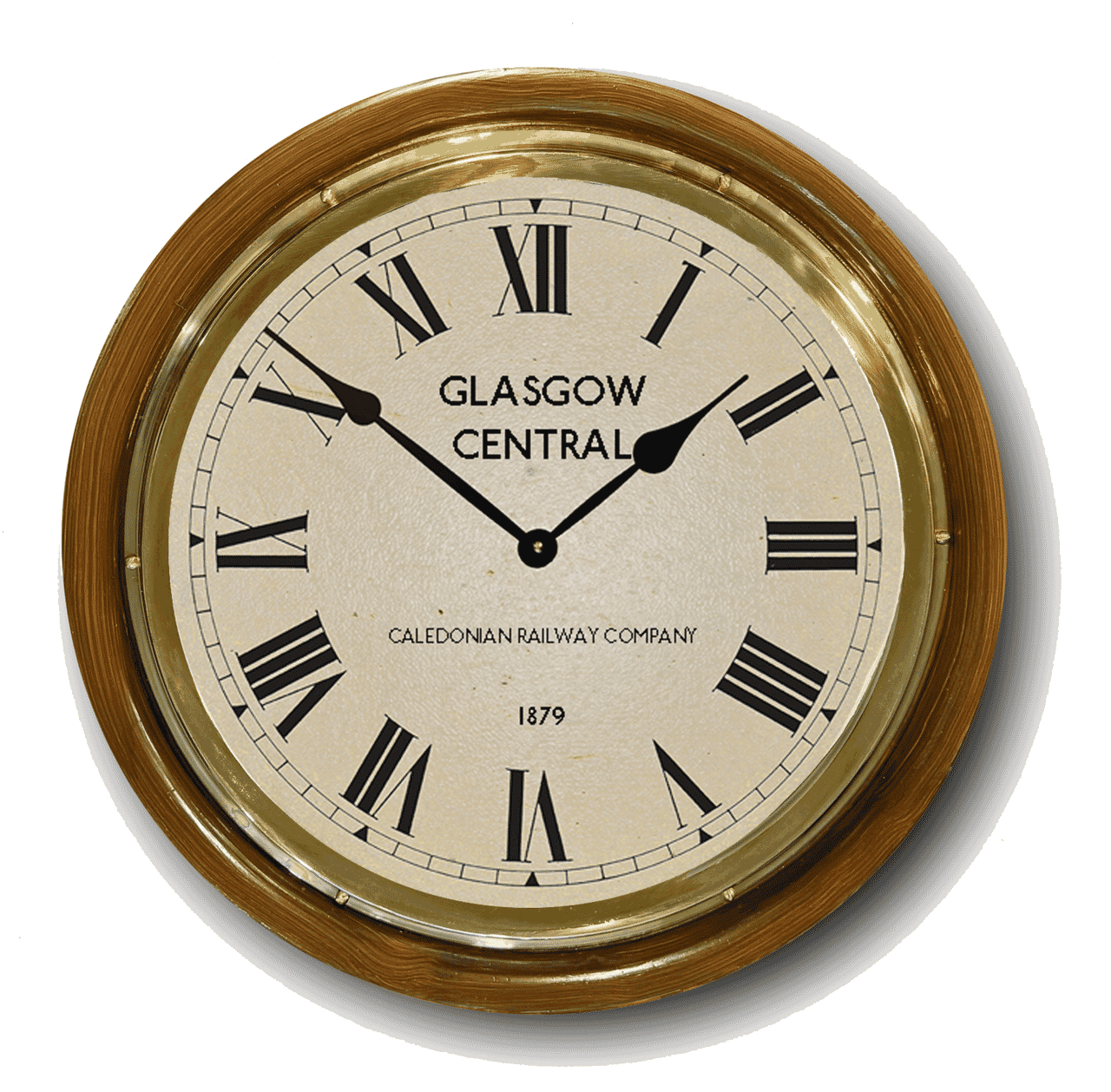
Traditional railway character, individually made for your home.
A closer look at the Glasgow Central Railway Station Clock. Click the photograph to enlarge.
UK delivery £4.95 per order · International delivery calculated at checkout.
The Caledonian Railway (CR) was a major force in shaping Scotland’s railway system, established in 1845 with the aim of linking Glasgow to the expanding English railway network. Over time, the CR grew into one of Scotland’s largest and most influential railway companies, connecting cities across the country, including Edinburgh, Aberdeen, and Dundee. Its primary line between Carlisle and Glasgow still forms a vital part of today’s West Coast Main Line.
The CR’s formation was driven by the need for a fast and reliable connection between the bustling industrial heart of Glasgow and England’s railways. Opening its main line between Glasgow, Edinburgh, and Carlisle in 1848, the company formed an alliance with the London and North Western Railway, creating a vital cross-border link to England. Despite being predominantly backed by Scottish investors, the CR attracted a significant portion of its capital from England, showcasing the broader economic interest in the railway’s success.
The Caledonian quickly set about expanding its network, initially competing fiercely with other Scottish railway giants such as the North British Railway and the Glasgow and South Western Railway. Its strategy of absorbing smaller companies helped it grow its network and gain control over key routes, though this process wasn’t without its challenges and controversy. For instance, the CR repeatedly attempted to absorb the Edinburgh & Glasgow Railway, which would have given it a near-monopoly on Scottish rail routes, though this ambition ultimately failed.
Beyond the fierce competition for land and influence, the Caledonian Railway also formed key partnerships, such as with the Caledonian Steam Packet Company. This allowed the CR to dominate passenger traffic on the Firth of Clyde, running fast trains to steamer piers without having to own its own steamships. This partnership helped cement the CR’s position as a crucial player in Scottish transport.

The CR’s expansion wasn’t limited to intercity travel. The company’s network spanned from Aberdeen to Portpatrick, with branches reaching as far as Oban and Carlisle. It also provided essential services for mineral traffic, particularly in the Scottish Lowlands, where it competed with the Glasgow and South Western Railway (G&SWR) and the North British Railway, though the CR largely dominated the routes north of the River Clyde.
The technical achievements of the Caledonian Railway were impressive, especially in the face of Scotland’s challenging geography. One of the most innovative aspects of the company’s operations was its construction techniques, particularly in its use of inclined planes for moving earth and rock during the building of tunnels and cuts. The CR also employed unique machinery to aid in blasting and drilling through tough rock, a process that greatly sped up construction. An intriguing example of this ingenuity was the creation of an iron tank to serve as an early form of aqueduct, designed by Isaac Dodds to carry water across the line. This innovative structure, combining the functions of both an aqueduct and a bridge, was a notable achievement of the time.
By the time of the 1923 railway grouping under the Railways Act, the Caledonian Railway had become a key part of the newly formed London, Midland and Scottish Railway (LMS). This marked the end of the CR as an independent entity, though its routes and legacy continue to influence the UK railway system to this day. The LMS, which incorporated the CR, played a crucial role in the development of British railways, helping to shape the modern rail network that remains in use today.
The story of the Caledonian Railway is one of innovation, competition, and strategic expansion. Its efforts to build a comprehensive network across Scotland and into England laid the foundation for many of the railways we rely on today, and its engineering feats continue to be celebrated as key milestones in the history of railway construction.