Oldest Map of Great Britain

Early Map of the British Isles (Britannia)

Price range: £35.55 through £59.95

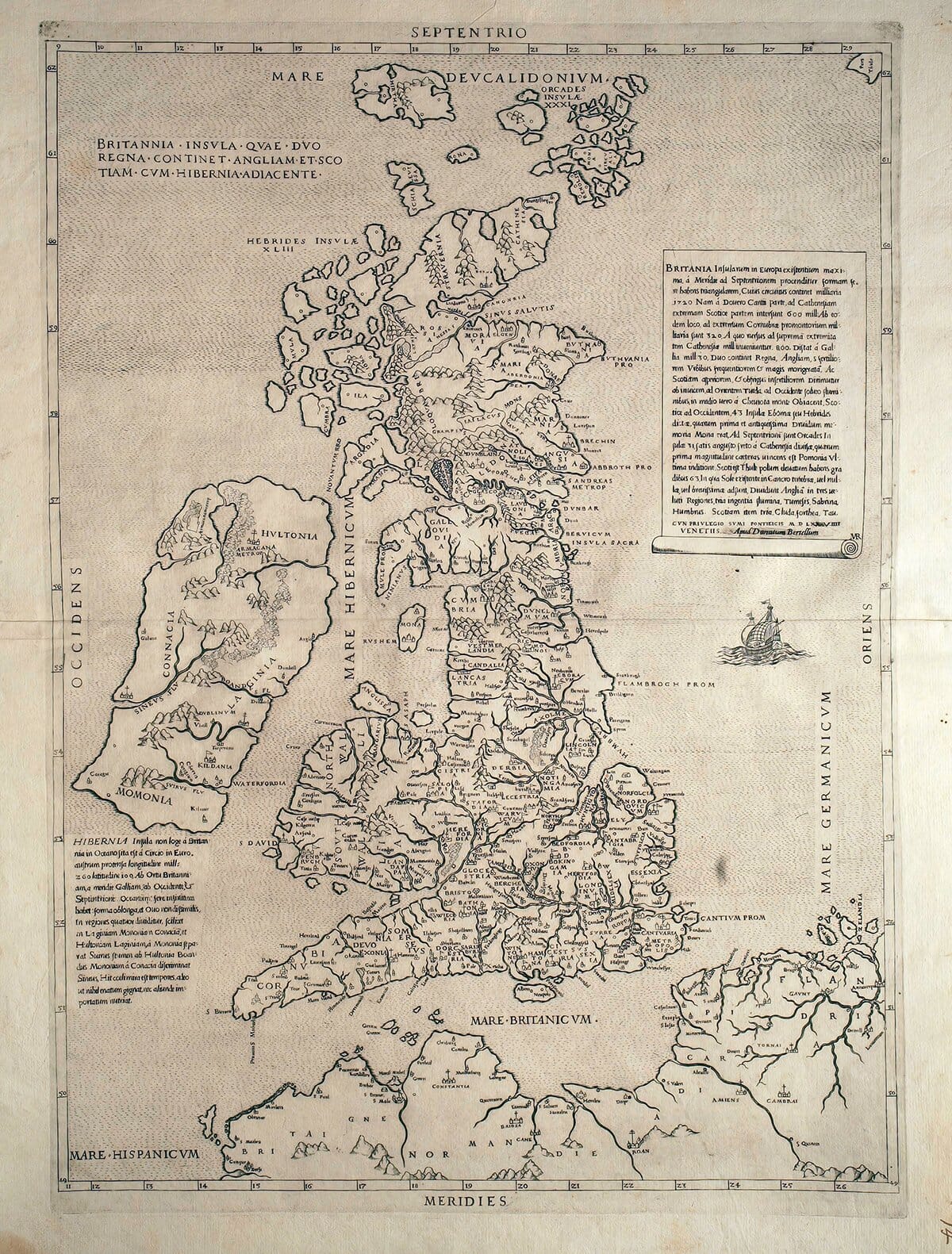
The British Isles by George Lily 1546 (Britannia)

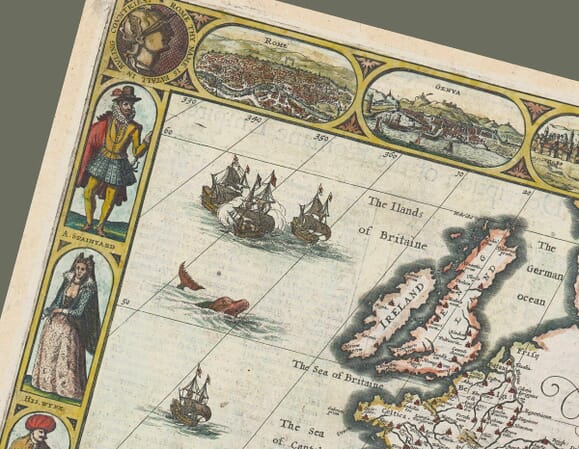
  •  A faithful reproduction of Lily’s original 16th-century map, considered to be the earliest map of Britain of any significant importance.

  •  A perfect gift for history buffs, educators, or collectors who appreciate the artistry and significance of historical maps.

  • A fascinating fine art print on authentically aged heavy textured paper. Although the original was produced in black and white we have reproduced it in colour to impart the age and condition of the original.
  • Guaranteed to pass or exceed museum quality standards •  Free UK Courier Delivery with tracking
  • Available in two sizes: Large: 24″ x 31″ (61 x 79 cms)   Medium: 18″ x 24″ (45.5 x 61cms) Small 17″ x 12″ (43 x 30.5 cms) Sizes approximate.We have made an attempt at translation from the latin text panel (cartouche ) to the left of the map but the result must be taken as approximate.
  • Hibernia (Ireland), not far from Britain, lies in the ocean to the northwest of Europe. It stretches out in length about 260 miles, and in width about 100.To the east, it faces Britain; to the south, Gaul (modern-day France); to the west and north, it is bordered by the almost infinite ocean.It has an oblong shape, not unlike an egg. The island is divided into four regions: Leinster, Munster, Connacht, and Ulster.Leinster is separated from Munster by the River Suir, and Munster is separated from Connacht by the Shannon Estuary. The climate is very mild, to such an extent that nothing that grows is stunted, and anything imported from elsewhere is easily sustained.
+ read more

A stunning certified FINE ART PRINT on heavy textured art paper — not a poster

  • Direct from the publisher — no middlemen
  • Printed in-house in Cornwall
  • Free UK delivery — international shipping available
  • Produced to meet — and often exceed — museum-quality standards
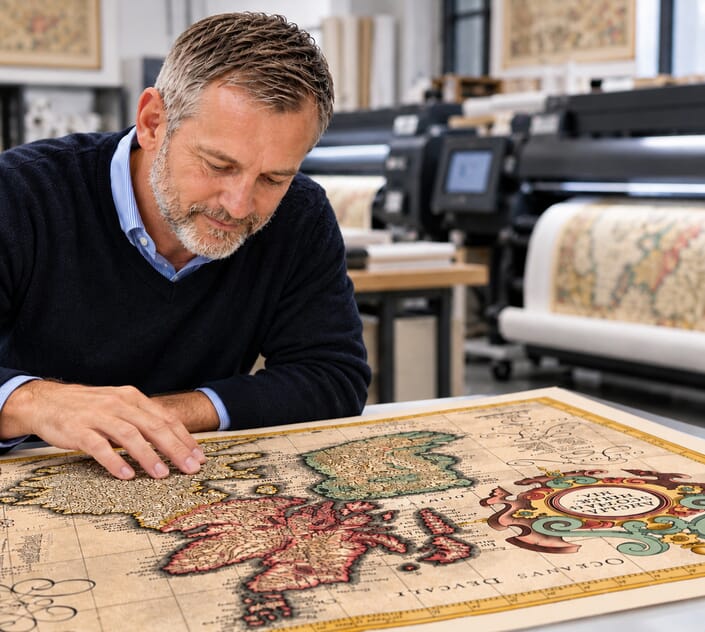
Inspecting Vintage Map Reproduction

Fine Art Map Reproductions – Museum-Quality Printing

Unlike most online offerings, our maps are produced entirely in-house, not outsourced to print-on-demand or drop-shipping services. This allows complete control over quality while offering better value. Each map begins with a high-resolution original, carefully enhanced and printed to order using archival papers and pigment inks for exceptional clarity, depth, and longevity. Every piece is personally overseen — no map leaves our workshop unless it is of a quality we would be proud to display ourselves.

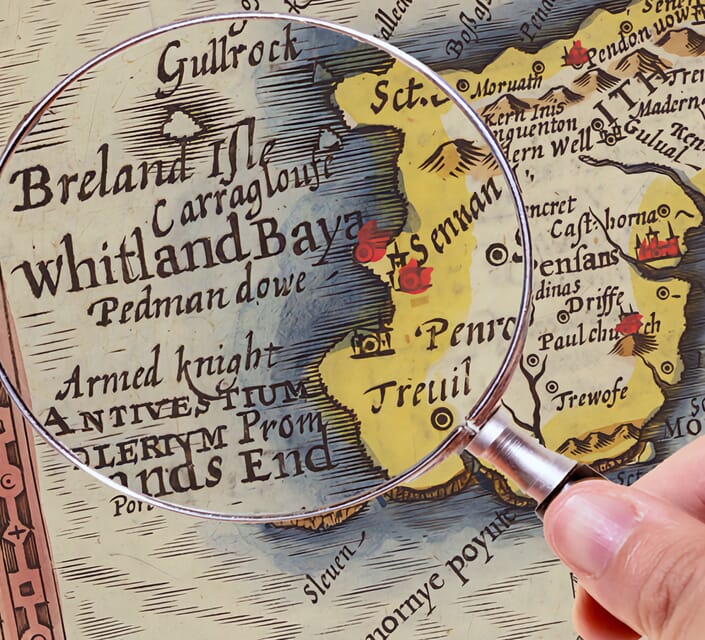
Hand hold a magnifying glass over West Cornwall Map

Authentic Old Map Paper & Accurate Colour Reproduction

Paper choice is essential to the authenticity of our maps. We use specially sourced 190gsm paper made in the UK from pure materials and traditionally pressed with natural woollen felts. This process creates a subtle, randomly textured surface that closely resembles an original antique document. Likewise the use of premium quality ink fully saturates the paper, producing remarkable clarity, depth, and historical character. Colour fastness and sharpness will remain good for in excess of 100 years!

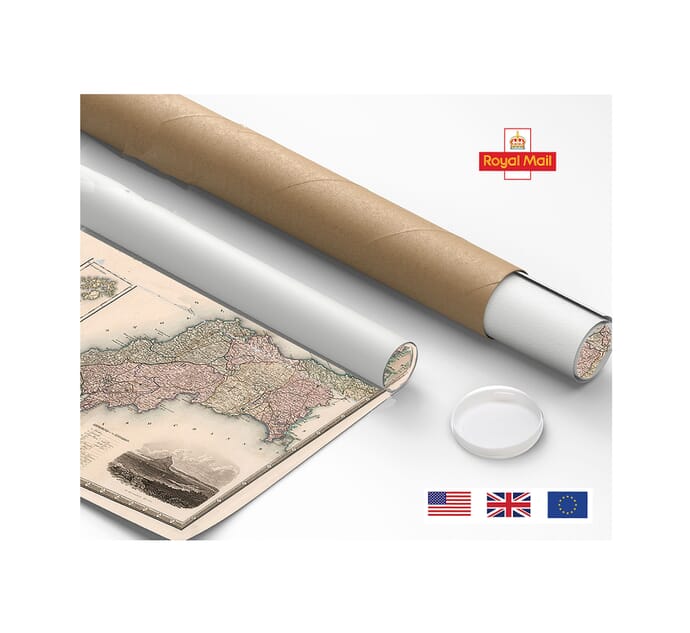
Map in Postal Tube
Buy Old Maps Online in the UK Today Trading online since 1999

The Old Map Company of Great Britain offers a vast and carefully curated collection of the very finest expertly reproduced vintage maps. Our range includes works by renowned cartographers such as John Speed and Willem Blaeu, covering Scotland, England, and beyond. Free UK courier delivery is included, with EU, USA, and worldwide shipping available at cost and calculated at checkout. If you need assistance, our team is always happy to help you choose the perfect map.

RECENT REVIEWS

M.F. Leicestershire
M.F. Leicestershire
Very impressed . . . exceeded my expectations. My son would now like one for Christmas!
Julia Ballester
Julia Ballester
Very pleased with the quality of the map and it even arrived before it was supposed too.
Nikki
Nikki
Amazed to find the church where we married on a 400 year old map. Bought as a 1st anniversary gift.
K.H. Middlewhich
K.H. Middlewhich
I am absolutely delighted with the my antique map. It is so interesting. I would now like to purchase another Map for my sister as a Christmas present.

In a large cartouche lower right there is a panel of descriptive text in Latin which we have done our best to translate into modern day English.

BRITAIN
Of the islands that belong to Europe, Britain is the largest. It stretches from south to north and is shaped like a triangle. From the southern cape that faces the Isle of Wight, up to Caithness—the farthest part of Scotland, which is separated from the Orkney Islands by a not very wide strait—it measures 600 miles. From Dover, the farthest point of Kent, which is no more than 30 miles from France, to the farthest tip of Cornwall, which faces Brittany (Armorica), it is 320 miles. From there, moving north again through the Irish Sea to Caithness, the northernmost part of the whole island, it is 800 miles.

The total circumference of the island is about 1,720 miles—somewhat less than what Caesar estimated, which was 2,000 miles.

The island is divided into two kingdoms. The southern part, which is more fertile, more densely populated with towns, and more civilized in its customs, is called England. The northern part, which is harsher in its ways and less fertile due to extreme cold, is called Scotland.

England is separated from Scotland by the rivers Tweed (to the east) and Solway (to the west), and in the interior by the Cheviot Hills.

To the west of Scotland, in the Irish Sea, lie 43 islands called the Hebrides (or Eboniae). The most prominent of these—both for its bishop’s seat and for its ancient association with the Druids—was Mona (now Anglesey), which today belongs to England.

To the north are the Orkney Islands, numbering 31. These abound in barley, fish, and rabbits. The most important of them is Pomona, which is the largest, has a bishop’s seat, and a royal castle.

The northernmost land under Scottish control is Thule, where the pole is elevated 63 degrees. When the sun enters Cancer there, the darkness is either non-existent or extremely brief.

The languages spoken by the island’s inhabitants are five:

  • Cornish, spoken in Cornwall

  • Welsh, spoken in Wales

  • English, spoken by the English and much of southern Scotland

  • Irish, spoken in the Hebrides and the northern part of Scotland

  • Gothic (Norse), spoken only in the Orkney Islands

England has 22 bishoprics, 18 of which are under the Archbishop of Canterbury, and 2 under the Archbishop of York. It also has two renowned universities: Oxford and Cambridge.

England is divided into 22 counties, and it is rich in tin, lead, iron, excellent wool, livestock, and grain. Scotland is rich in fish, livestock, and wool. England has no wolves, but Scotland has many.

England is divided by three great rivers: the Thames, Severn, and Humber. Scotland likewise has three: the Clyde, Forth, and Tay.

The capital of England is London; the capital of Scotland is Edinburgh.

The English use only their own local laws; the Scots use civil law. Both peoples are equally fierce in war: the English excel with bows, the Scots with long spears in hand-to-hand combat.

There is rarely peace between them, since the English seek to expand their empire, while the Scots aim to preserve theirs.

Written in Rome, through the effort and diligence of the English, in the year 1546.

You may also like…

×
Product added to cart
No products in the cart.