John Speed wrote:
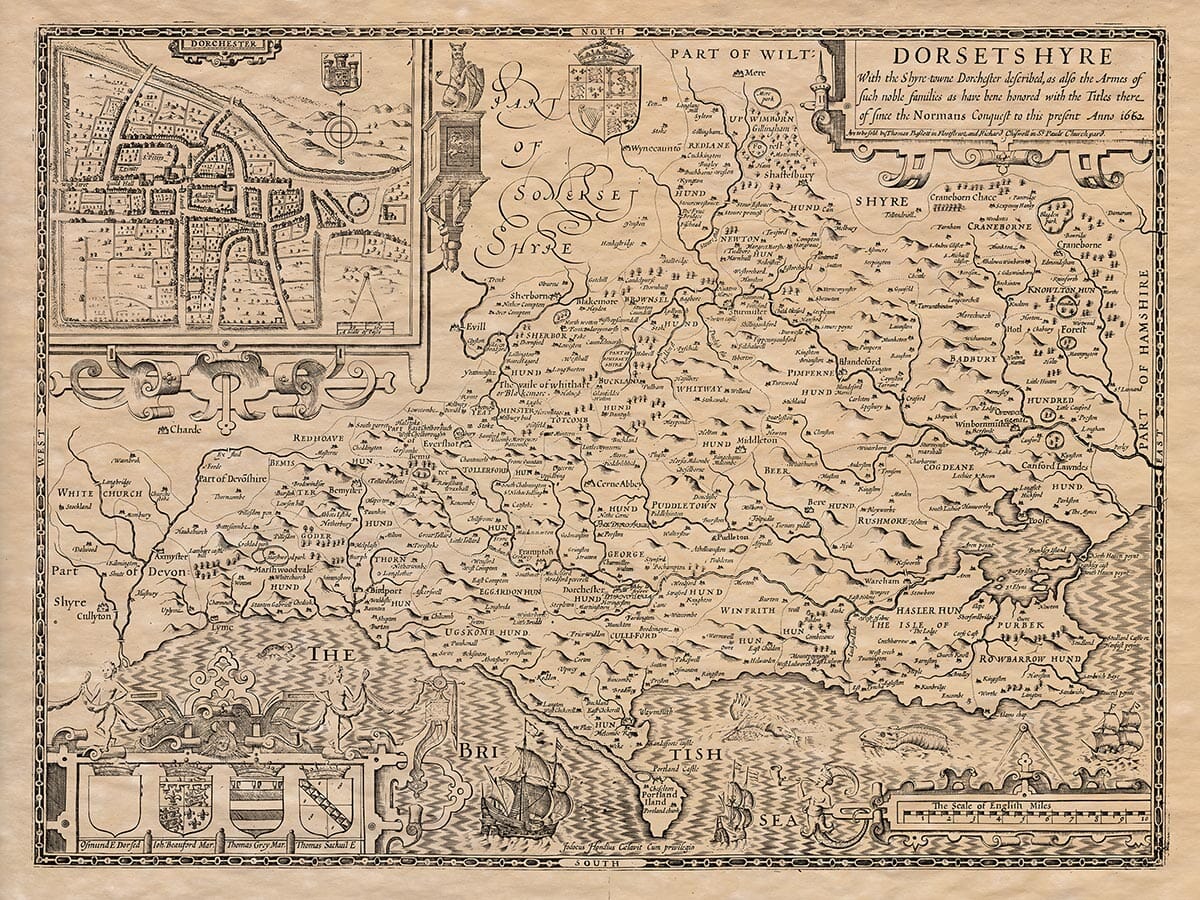
(1) DORCESTER, from her ancient people DUROTRIGES, is most likely to have received that name; by the Britains called Dwrgweir, & by the Saxons Dornceaster, lieth bounded upon the North side with Somerset and Wiltshire, upon the West with Devonshire, and some part with Somerset; upon the East altogether with Hampshire; and her South part is wholly bounded with the British Seas.
(2) Her form grows wider from the West, and spreads her self the broadest in the midst, where it extends to twenty four miles, but in length is not less than forty four: the whole in circumference about, is one hundred and fifty miles.
(3) The Air is good, and of an healthful constitution: the Soil is fat, affording many commodities, and the Country most pleasant in her situation: for the In-land is watered with many sweet and fresh running springs, which taking passage thorow the plain Valleys, do lastly in a loving manner unite themselves together, and of their many branches make many big-bodied streams: neither doth the Sea deny them entrance, but helpeth rather to fill up their banks, whereby Vessels of burden discharge their rich treasures, and her self with open hand distributeth her gifts all along the South of this Shore.
(4) Anciently it was possessed by the Durotriges, whom Ptolemy placeth along in this Tract, who being subdued by the Romans, yielded them room, and unwilling subjection. After them the Saxons set foot in these parts, whereof Portland seemeth from that Port to take name, who in this place arrived in Anno 703, and did sorely infest and annoy all the South Tract. And at Bindon, before him, Kenegils King of the West-Saxons, in the year of Christ 614, in a doubtful and dangerous Battle vanquished the Britains. Neither were the Saxons so surely herein seated, but that the Danes sought to defeat them thereof: for twice these bold Rovers landed at Charmouth; the first was in 831, and again in the reign of King Egbert, and the other eight years after, when Ethelwulf was King: in both which they went away Victors. Yet when the Iron-side wore the English Diadem, and these fierce people fought to pluck it from his Helmet, he met them at Penham in Gillingham Forest, and with a small power obtained a great victory, causing their King Canute with discouragement to retire.
(5) Commodities arising in this Country are chiefly Wools and Woods in her North, where the Forests are stored with the one, and the pleasant green Hills with the other. The inner part is overspread both with corn and grass, and the Sea yieldeth the Ictis Ploceamos, a shrub growing not unlike the Coral, without any leaf; besides her other gifts, turning all to great gain: which the more is made manifest by the many Market-Towns in this Shire, whereof Dorchester is the chief, in Antonius his Itinerarium termed Durnovaria, situated upon the South side of Frome, and the Roman Causey called Fosse-way, wherein some of their Legions kept, as by the Rampiers and Coins there daily digged up, is probably conjectured; at which time it seemeth the City was walled, whereof some part yet standeth, especially upon the West and South sides, and the Tract and Trench most apparent in a Quadrant-wise almost meeteth the River, containing in circuit one thousand and seven hundred paces, but were cast down by the Danes, whose trampling feet destroyed all things wheresoever they came, and hands here razed the Trenches Maidenbury and Poundbury, the seals of their siege, and signs of times misery.
About three hundred paces Southward from hence standeth an old fortification of Earth trenched about, and mounted above the ordinary plain thirty paces, containing some five acres of ground, wherein (at my there-being) plenty of Corn grew. This the Inhabitants call The Maiden Castle, having entrance thereunto only upon the East and West. This is thought to have been a Summer-Camp or Station of the Romans, when their Garrisons kept the frontiers of this Province.
The Government of this City is yearly committed to two Bayliffs, elected out of eight Magistrates or Aldermen, a Recorder, Town-Clerk, and two Sergeants attending them: whence the North-pole is elevated 50 degrees 48 minutes in latitude, and for longitude is removed from the first West-point unto the Meridian of 18 degrees.
(6) Other places also are memorable through the Actions therein happening, or Antiquities there yet remaining: such is Badbury, now nothing but a Trench and decayed Castle, hardly seen, though sometimes it was the Court of the West-Saxons King. Such also is Cerne, where Augustine the English Apostle brake down the Altars and Idols of the Saxons God HEIL, whom they devoutly honoured as the only conserver of their health. Shaftsbury also, wherein one Aquila (whether a Man or Eagle I know not) by our Historians report, is said to have prophesied the future times of this our Empire, and that after the reigns of the Saxons and Normans it should again return unto the Government of the British Kings. But with such vain predictions our Nation is more than once taxed by Philip Commines the famous French Writer. In this City Edward the Son of great Edgar, and one and thirtieth Monarch of the English-men, was interred, being murdered at Corfe, a Castle seated in the Isle of Purbeck, by his Step-mother Elfrith, to make way for her Son to enjoy his Crown: in repentance whereof, and to pacify Heaven for his blood, she built the Monasteries of Ambresbury and Whorwell, in the County of Wiltshire and Southampton. In the former of which, with great penitency, she spent the rest of her life.
(7) As upon the like occasion the Monastery of Middleton was laid in this Shire by King Athelstan to appease the Ghost of Edwin his innocent Brother, and to expiate the sin of his own soul for the blood of that just Prince, whom most unjustly he caused to die: and with the like devotion, though not to satisfy for the like bloody sins, did Queen Cuthburga sue a Divorce from her second Husband the Northumberland King, and at Winburn built her a Nunnery, whereof her self became Abbess, where afterward was raised a most stately Minster, which added not only more glory to the place, but withal enlarged the name, and made it to be called Winburnminster, where King Etheldred, a most virtuous Prince, after much disquietness had with the Danes, in peace here resteth, with his Tomb and Inscription, as in his History (Christ assisting) shall be further seen. Neither among these may I omit Sherborn, which in the year of Grace 704 was made a Bishop’s See, in whose Cathedral Church were interred the bodies of Ethelbald and Ethelbert brethren, both of them Monarchs of the English-men.
(8) Seven more besides these were set apart from worldly employments, consecrated only to God and his service in this Shire, which were Camester, Cranborn, Abbotsbury, Bindon, Sturminster, Tarrant, and Wareham. These with the others came to their full period under the hand of King Henry the Eighth, which lay with such weight upon their fair buildings, that he crushed the juice thereof into his own coffers.
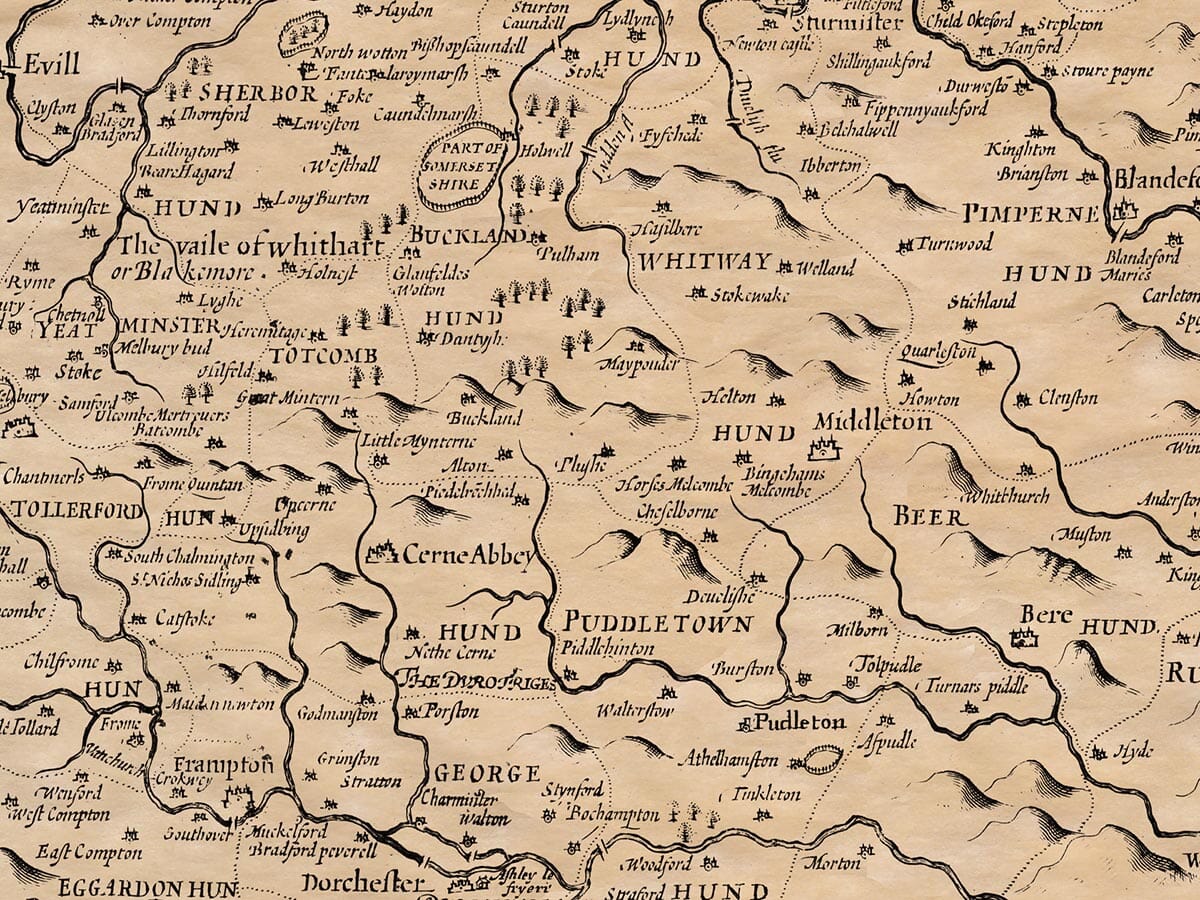
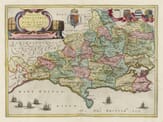
(9) Castles for defence in repair, and decayed, were at Sherborn, Dorchester, Branksey, Portland, Corfe, Newton, Woodford, and Wareham. So that with these and others the County hath been strengthened, with twelve Religious Houses their poor relieved, with eighteen Market-Towns at this day is traded; and principally into five divisions parted, subdivided into 34 Hundreds, and them again into 248 Parishes, as in the Map and Table adjoining is to be seen.