Description
PLEASE NOTE
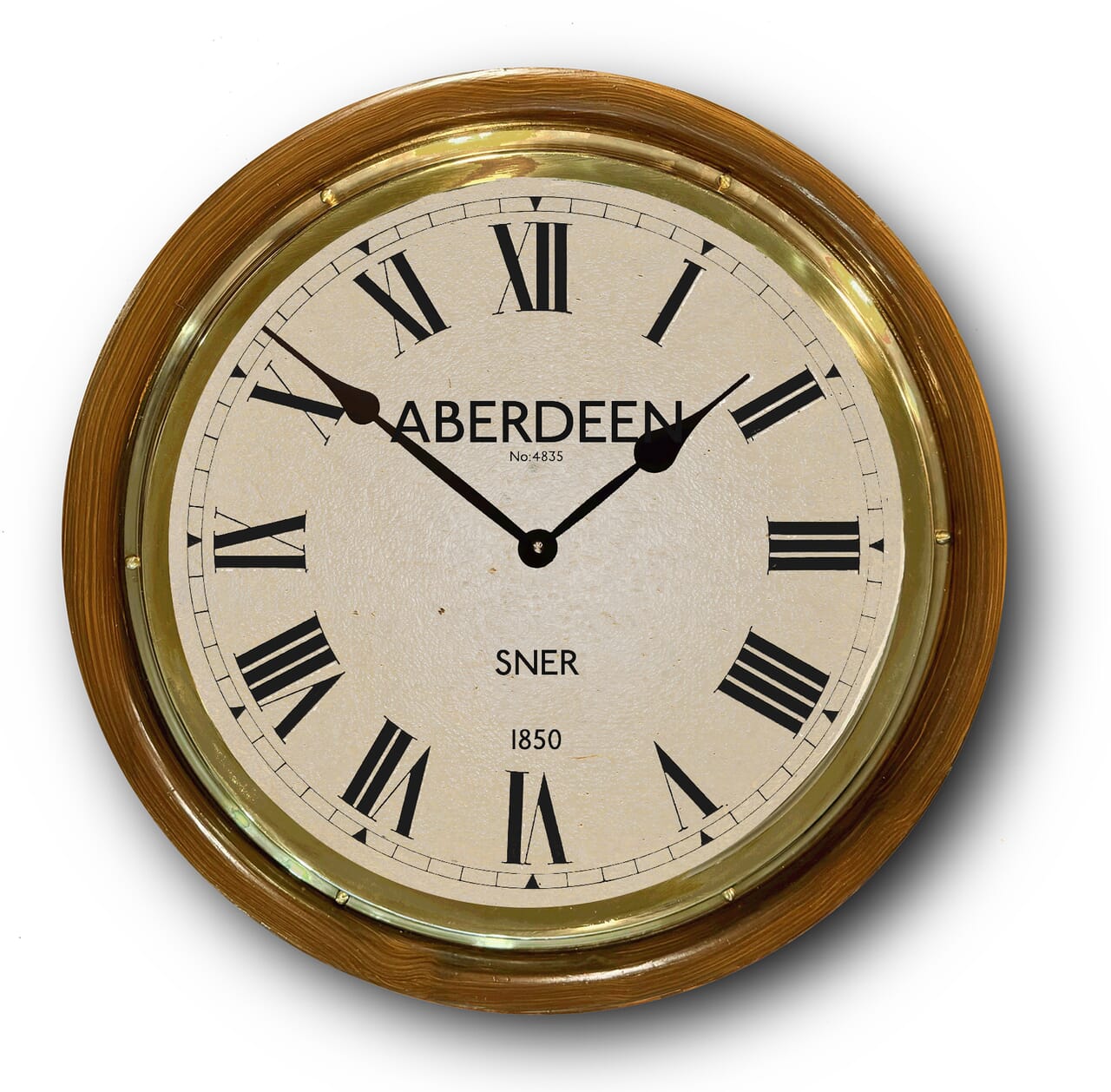
We are a small family operation and each and every clock we produce is made to your individual design choice.
Delivery time is subject to availability.
Current lead time is 2–3 weeks
Aberdeen Railway Station: A Granite Gateway Through Time
Standing proudly in the heart of Scotland’s “Granite City,” Aberdeen railway station is more than a transport hub — it is a living chronicle of industrial ambition, architectural elegance, and the evolving face of Scottish travel. Though today’s passengers may hurry through its modern concourse, the station’s granite walls and graceful ironwork whisper stories stretching back over 170 years.
The first railway station on the site opened in 1854, born from the rivalry and cooperation of two powerful companies: the Caledonian Railway and the Great North of Scotland Railway (GNSR). Their shared terminus was aptly named the “Aberdeen Joint Station.” This partnership was rare in the Victorian age, when railways were competitive enterprises jealously guarding their routes. Yet the city’s geography — hemmed in by river, harbour, and hills — made one grand station a practical necessity.
As rail travel expanded, the early station soon proved inadequate. Between 1913 and 1916, the site underwent a remarkable transformation under the direction of James Robb Scott, a young Scottish architect later famed for his work on London’s Waterloo Station. Scott’s design was both functional and monumental, embodying the Edwardian belief that railway architecture should inspire civic pride. The new Aberdeen Station combined classical symmetry with the lightness of modern engineering — a marriage of granite solidity and iron grace.
True to the city’s nickname, “The Granite City,” the station’s façade and walls were hewn from locally quarried granite, their silvery tone harmonising with Aberdeen’s grand civic buildings nearby. Inside, Scott introduced a vast steel-and-glass trainshed, a marvel of its era. Sunlight streamed through the high, curved canopy, illuminating platforms bustling with travellers, porters, and the rhythmic hiss of steam. The structure remains one of the most distinctive surviving examples of early 20th-century railway architecture in Scotland.
Adjoining the main building stood the Station Hotel, opened slightly earlier in the late 19th century to host well-heeled visitors and royal travellers journeying to Balmoral Castle. Behind its elegant façade lay oak-panelled lounges, stained glass windows, and marble fireplaces — a reminder that the railways once represented luxury as much as mobility.
During World War II, Aberdeen station endured bomb damage in the 1943 air raids, yet its granite resilience kept it standing and operational. Even today, hints of that endurance linger in the carefully repaired stonework and canopy rivets.
Through the late 20th century, modernization brought electric lighting, new platforms, and expanded concourses, but the station’s historic heart remained intact. Recognizing its national significance, it was granted Category A listed status, ensuring that every renovation — including the major 2020–2022 restoration — respected its original detailing. The recent works revitalized the glass roof, restored Victorian ironwork, and improved accessibility, blending past craftsmanship with present needs.
Few know that Platform 7 is one of Scotland’s longest, stretching over 400 metres, or that remnants of the pre-1913 structure still rest beneath the current platforms — silent traces of Aberdeen’s first age of steam.
Today, Aberdeen Station stands as a testament to the enduring marriage of engineering and artistry. Its granite walls do more than hold up a roof — they uphold a legacy of connection, resilience, and civic pride that has carried the people of the north-east across generations.