
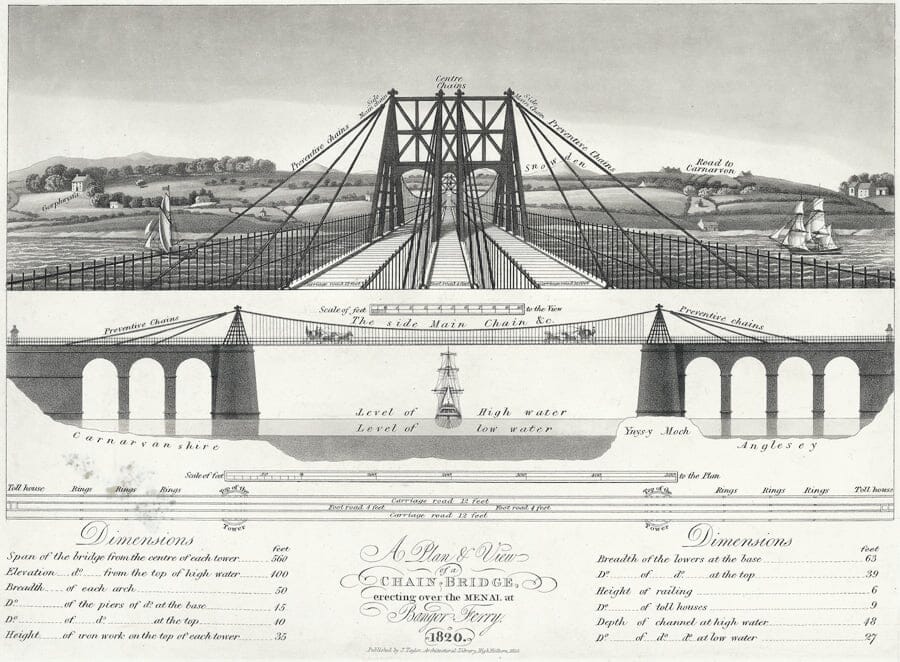
In January 2026, one of Britain’s most remarkable engineering achievements will quietly reach a milestone few structures ever attain: the Menai Suspension Bridge will be 200 years old. Spanning the tidal waters of the Menai Strait between mainland Wales and Anglesey, the bridge stands today not only as a vital transport link, but as a monument to imagination, courage and engineering innovation.
Designed by Thomas Telford, often described as the father of modern civil engineering, the bridge was revolutionary in both scale and ambition. Yet when its plans were first unveiled in the early nineteenth century, they were met not with admiration, but with widespread scepticism.
A Crossing Long Considered Impossible
Before the bridge, crossing the Menai Strait was a dangerous undertaking. Ferries battled powerful currents and shifting tides, and delays were common. For livestock being driven to market, the crossing could be fatal. As traffic between London and Holyhead increased — particularly following the Act of Union with Ireland — the pressure for a permanent crossing became unavoidable.
Telford’s solution was bold: a suspension bridge with a central span of over 170 metres, high enough to allow tall-masted ships to pass beneath. At the time, no bridge of this type had ever been attempted on such a scale. Stone arches, the trusted method of the day, would have obstructed navigation and struggled against the Strait’s conditions. Suspension, however, was still largely experimental.
Many doubted it would work.
“Too Long, Too Light, Too Dangerous”
Critics questioned whether iron chains could safely support constant carriage traffic. Others feared the bridge would sway uncontrollably in high winds or collapse under its own weight. Even local opposition emerged, with ferry operators and landowners worried about economic and visual impact.
The early engineering drawings — such as the beautifully detailed plans produced during the design phase — reveal just how carefully Telford addressed these concerns. They show not only the elegant proportions of the bridge, but also the redundancy built into the system: multiple chains, preventative stays, massive masonry towers and precisely calculated clearances. What appears graceful today was, in reality, a structure designed with meticulous caution.
When construction began in 1819, the project itself became a spectacle. The lifting of the enormous iron chains into place drew crowds from miles around, many expecting failure. Instead, the bridge held — and on 30 January 1826, it opened to traffic.
A Triumph That Changed Engineering
The Menai Suspension Bridge immediately became the longest suspension span in the world, a record it held for years. More importantly, it proved that suspension bridges could be built safely and reliably at scale. Engineers across Europe and America took notice.
Although the bridge has been strengthened and modified over time — particularly after storm damage in the nineteenth century — its fundamental design remains Telford’s. Today it is a Grade I listed structure, still carrying traffic nearly two centuries after sceptics predicted its demise.
Preserving the Vision on Paper

As the bridge approaches its bicentenary, there is renewed interest not only in the structure itself, but in the documents that made it possible. Early plans and views — like the original chain bridge engravings — offer a rare insight into how engineers of the period thought, calculated and communicated complex ideas long before digital modelling.
Companies such as The Old Map Company preserve and reproduce these historic engineering plans as fine art prints, allowing modern audiences to appreciate them as both technical achievements and works of art. Far from being dry schematics, they are richly detailed, balanced compositions that reflect the confidence and optimism of the Industrial Age.
As the Menai Suspension Bridge turns 200, these early plans remind us that every great landmark begins not in stone or iron, but on paper — with a vision bold enough to challenge doubt and change the future.